
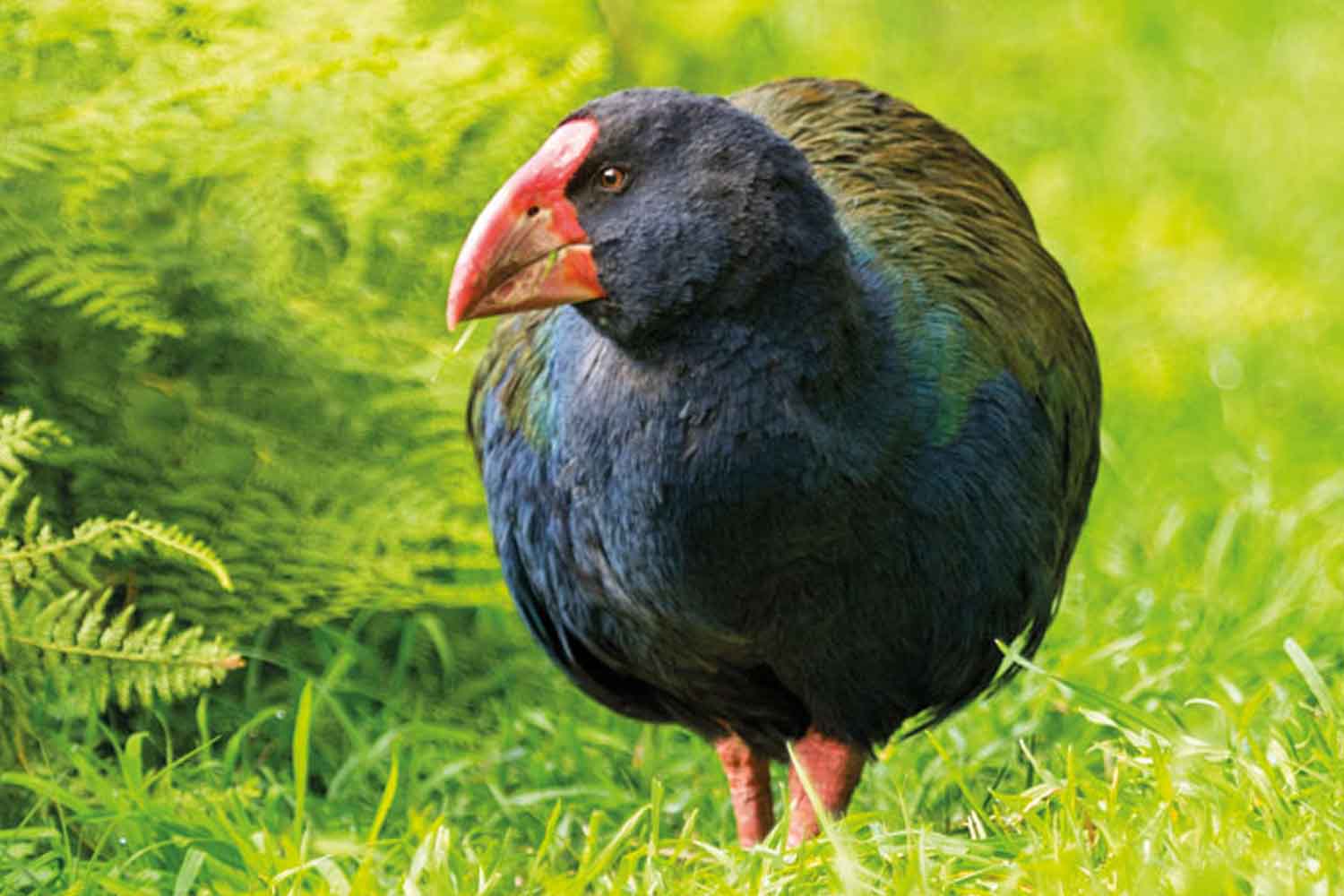
There is a story, which comes from New Zealand, capable of overturning a belief now taken for granted: a species can come back from the brink of extinction. The protagonist is the takahē, a large flightless bird, with intense blue plumage and an almost prehistoric appearance, which for decades was considered to have disappeared forever. But no: he remained hidden, silent, waiting for someone to give him back space and time.
The takahē (Porphyrio hochstetteri) is an endemic bird of New Zealand, belonging to the rail family, of which it represents the largest living exponent. It does not fly, has robust legs, a massive bright red beak and plumage that ranges from deep blue to iridescent green, so much so that it seems to have come out of another era.
After the arrival of European colonizers in the 19th century, its population rapidly collapsed. Habitat destruction, hunting and above all the introduction of predators such as cats, rats and stoats led the takahē to such a drastic decline that, for over fifty years, no one observed another specimen. For the scientific community it was an extinct species, a name relegated to books.
Then, in 1948, the unthinkable happened: an expedition led by explorer Geoffrey Orbell spotted some live takahē in a remote, mountainous area of Fiordland. A rediscovery that went around the world and marked the beginning of one of the longest and most complex conservation operations ever undertaken.
The slow rebirth of takahē
Saving the takahē was neither simple nor quick. On the contrary, it was decades-long work, made up of small steps, mistakes, corrections and a lot of determination. The New Zealand authorities have started a recovery program based on controlled breeding, genetic management, health monitoring and, above all, control of introduced predators, still the main threat to this species today.
Some specimens have been bred in protected environments, others transferred to islands and in fenced areas where predators are absent. Over time, the number of takahē slowly began to grow, until it surpassed a threshold that seemed unattainable.
Today there are over 500 individuals, with an increasingly higher percentage living in nature again. Some have been reintroduced into territories where the takahē had not been sighted for more than a century, a concrete sign that the species is regaining part of its original space.
Because the takahē is much more than a rare bird
The takahē is not just a fascinating animal or biological curiosity. He is living proof that conservation works when it is sustained over time and based on scientific knowledge and human responsibility. Its history demonstrates that nature is not as fragile as we often think, but not invincible either: it needs the right conditions to be able to regenerate.
Every new birth, every pair that breeds in the wild, every successful reintroduction tells the same thing: extinction is not always a point of no return. Provided, however, that man stops being the problem and becomes part of the solution.
You might also be interested in:
