
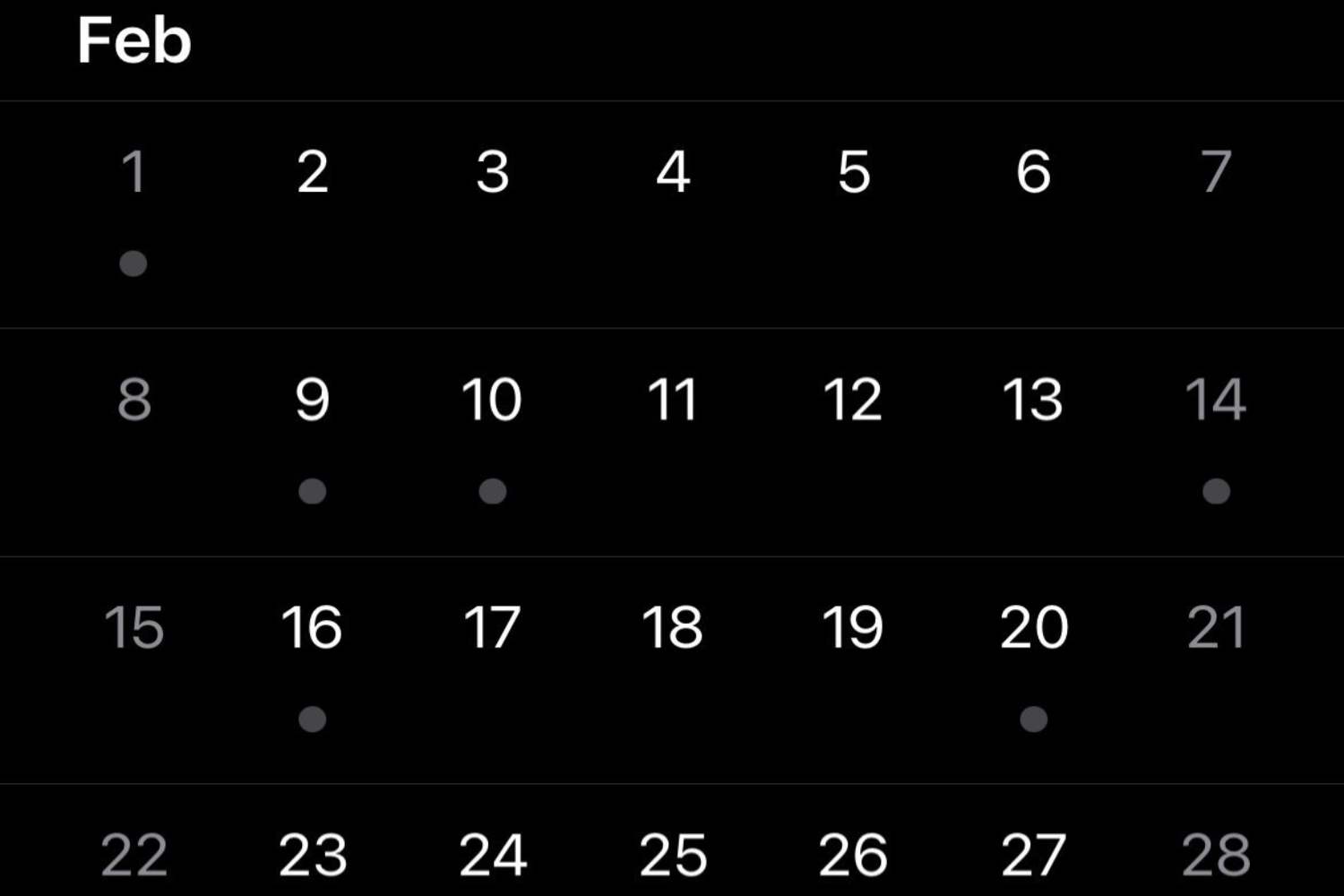
February 2026 suddenly became the protagonist on social media for an unusual but immediately recognizable reason: its perfectly ordered structure. In a non-leap year, the shortest month on the calendar has 28 days that are distributed impeccably, resulting in a rectangular layout that has attracted the attention of users, numbers enthusiasts and lovers of symmetry.
The month opened with Sunday 1st February and will close with Saturday 28th, with no “out of place” days or broken weeks. The result is a visual grid made up of four complete weeks, with four occurrences for each day. A rarity that many have dubbed “Perfect February”.
This year is gonna have the perfect month, and that is February.
Everything balanced pic.twitter.com/wO9OC4wICw
— Swanki_LaLa of KD (@Ani_zizo) January 6, 2026
What is a perfect month according to the calendar
From a mathematical and calendar point of view, a perfect month is one in which the number of days is divisible by seven and the first day of the month coincides with the beginning of the week. In the Gregorian calendar, this condition can only occur in February, and only in common years, when the month has exactly 28 days.
In the case of 2026, the coincidence concerns countries that adopt the week starting on Sunday, a convention followed by approximately 67 nations. In contexts where the week starts on Monday as here, however, the next “perfect” February will arrive in 2027.
Im sorry, but the perfect February starts on a Monday, like this https://t.co/138kYIdiKg pic.twitter.com/ZPRujb2Ust
— harry (@ITalk21) January 5, 2026
Because the phenomenon is not as rare as it seems
Despite the online enthusiasm, experts urge us to downplay the exceptional nature of the event. February with 28 days exists every non-leap year and each year still has four occurrences for each day of the week. The difference, in this case, is purely visual.
The uncluttered layout, with no indents or blank spaces on paper and digital calendars, creates a feeling of balance that many describe as “relaxing” or “satisfying.” But it does not involve any concrete change in the length of days or the passage of time.
In the Gregorian calendar, perfect February occurs following regular sequences of six and eleven years, with variations due to the rules on non-leap centuries. After 2015, 2026 marks the new date for calendars with Sunday as the first day of the week, while the next is expected in 2037.
You might also be interested in:
