
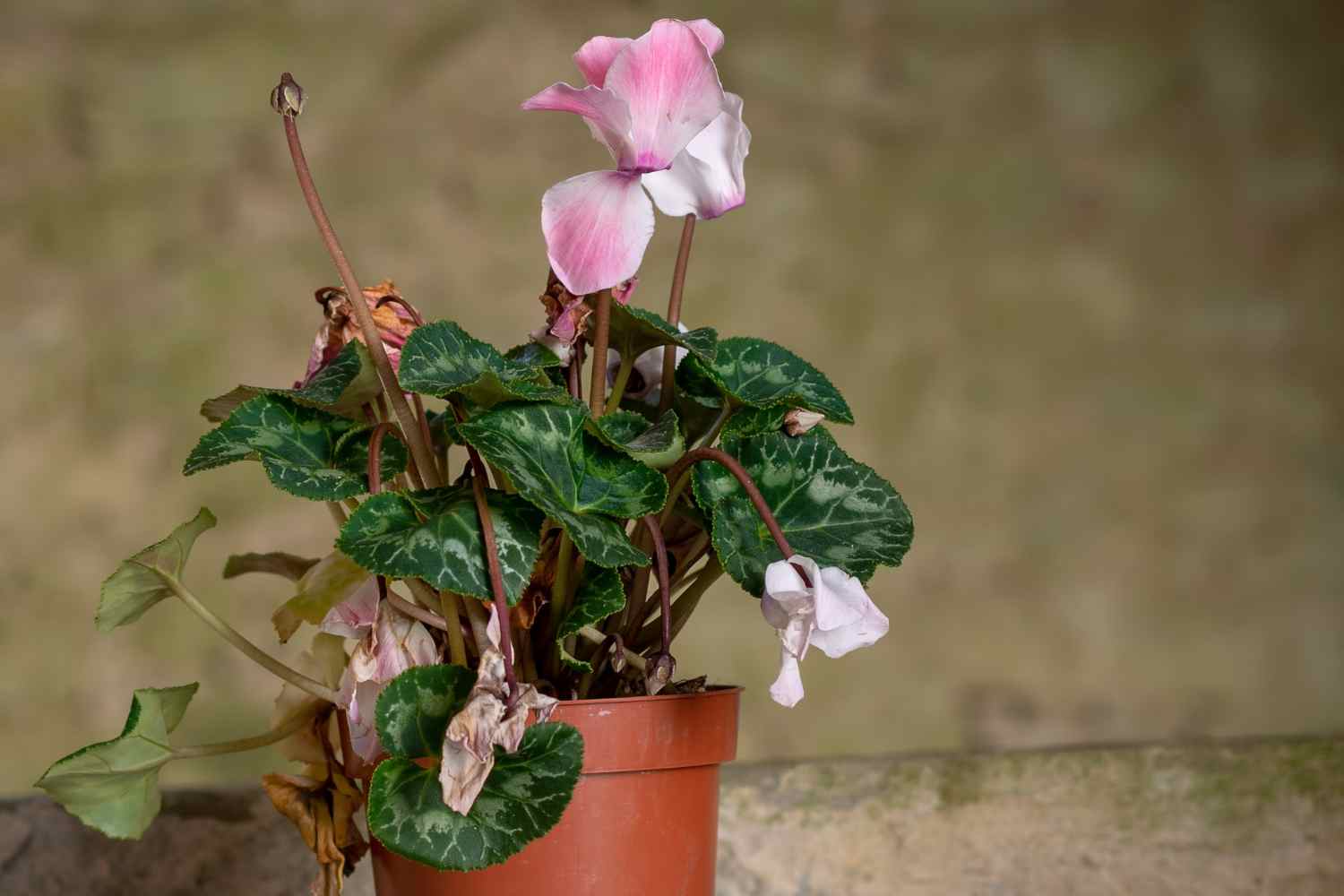
Have you wondered what to do to revitalize cyclamen? If in recent times your cyclamen has shown signs of distress such as dangling and falling leaves, then use these tips to revitalize it.
Why does the cyclamen “sag”?
Cyclamen is a plant with wonderful colors that will fill your home as soon as spring arrives. But what are the stress conditions for this plant? How to prevent the cyclamen from weakening and sagging?
To start, you need to understand what the ideal conditions are for the growth of this plant.
In general, cyclamen needs a temperate, moderate but humid climate. This means that very hot or cold temperatures can cause weakening in the plant. If, for example, you have placed it on a window that gets a lot of direct light, then it can communicate its intolerance to the heat by sagging.
Even if it cannot tolerate excessive cold and heat, the cyclamen needs a lot of indirect light, and should therefore be placed in a bright room.
As for soil moisture, make sure you plant it in a pot that has good drainage, possibly with lots of holes in the bottom. However, if you have planted the cyclamen in the garden, make sure that the soil can drain the water quickly enough, otherwise it could develop mold on the roots.
If you overwater cyclamen, the plants will droop and develop fungal root infections. When you want to improve the humidity of the plant, spray water on the leaves, but make sure they can dry quickly.
How to revitalize a cyclamen?
In general, cyclamen is an excellent plant to grow precisely because it does not need special care and can even survive some involuntary neglect. The only point not to forget is to carefully measure the amount of water with which we water.
If the plant droops, the tubers from which the flowers emerge have probably become soft from excessive water. In this case, the most effective trick is to replant.
Remove the cyclamen from its old pot and get some new soil. Before replanting, rinse and check all tubers for discolored areas and soft spots. Separate them from the rest of the plant with shears and then replant.
Cover the tubers only half with soil and keep the plant in a cool area well lit by indirect light. When watering, avoid overdoing it and remember seasonality. Cyclamen absorbs less water in autumn and early winter. Towards the end of the cold season and until flowering, however, you can increase the amount of water.
In general, the best method is to pour a glass of water every 5-6 days into the saucer underneath the vase, so that the plant can absorb the necessary quantity independently. After 20-30 minutes, empty the saucer, otherwise you could encourage the growth of mold. If the soil dries out (which is to be absolutely avoided) we can water even before 5-6 days.
For fertilizer, you can use one with a higher amount of nitrogen from September-October until the end of winter, where it will be better to use a fertilizer with a higher concentration of potassium, so as to favor flowering when it occurs in spring.
Once summer arrives, the cyclamen will lose its leaves, and therefore it will need very little water and you will have to eliminate the fertilizer. During the dormant phase you need to keep the water level under even closer control, simply making sure that the soil doesn’t dry out completely.
The SOS signals of the cyclamen
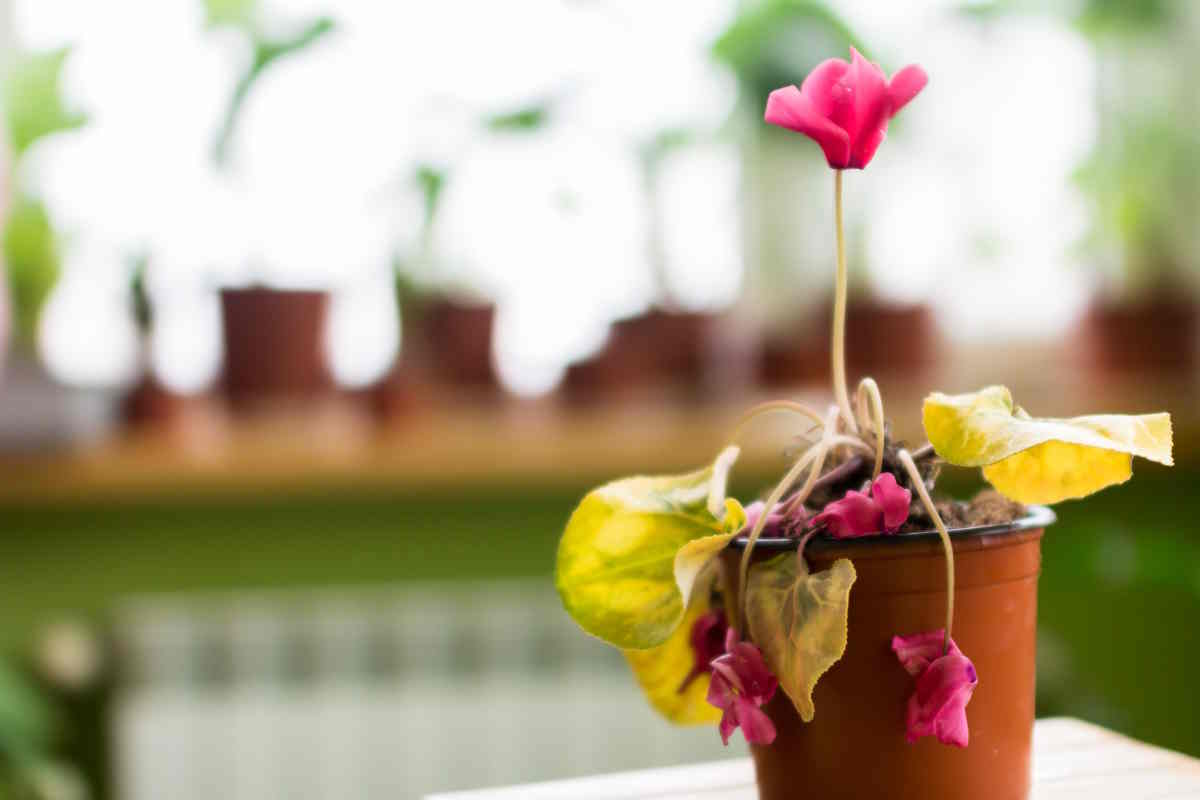
Cyclamen is a plant that clearly communicates its state of health through visible signals, you just need to know how to interpret them.
Yellow leaves
Yellow leaves are one of the most common symptoms and can indicate two opposite problems: an excess of water that is causing the roots to rot, or a lack of light. If we notice this yellowing, the first thing to do is check the humidity of the soil. If it is soaked, we drastically reduce watering; If, however, the plant is located in a dimly lit corner, move it to an area with more indirect light.
Brown leaves
Brown leaves, on the other hand, are a warning sign of excessive exposure to direct sun. Too intense sun rays literally burn the cyclamen leaves, which become brown and dry at the edges. In this case, the solution is simple: we move the plant away from the window or filter the light with a light curtain.
Withering flowers
Flowers that fade too quickly, even before fully opening, tell us that the air is too dry or the temperature is too high. This often happens when cyclamen is placed near heat sources. Finally, dark or grayish spots on the leaves are a symptom of fungal diseases, almost always caused by excess humidity combined with poor ventilation.
Where to put it at home
Finding the right place for cyclamen in your home can make the difference between a thriving plant and a suffering one. The bathroom can be a perfect location, as long as it is bright and well ventilated. The natural humidity of this room creates an ideal microclimate for the cyclamen, which appreciates humid air without having to resort to frequent misting.
Cool hallways and stairways are also great locations, especially if they have windows that provide indirect light. The unheated bedroom is another excellent choice: the cyclamen prefers cool temperatures, ideally between 10 and 18 degrees, and many bedrooms naturally maintain these temperatures, especially at night.
However, there are some places to absolutely avoid. Never place the cyclamen near radiators or other heat sources: hot, dry air is its main enemy. We also avoid placing it on top of appliances that give off heat such as televisions, computers or refrigerators. Completely dark rooms are inappropriate because, although the cyclamen does not like direct sun, it still needs a lot of light to grow healthily and produce abundant flowers.
How to remove dried leaves and flowers
Correctly removing the dried parts of the cyclamen is essential to keeping the plant healthy and preventing diseases. Many people make the mistake of cutting wilted leaves and flowers with scissors, but this is exactly what you shouldn’t do. When we cut the stem, we inevitably leave a stump that remains attached to the tuber. This stump rots quickly, becoming a perfect breeding ground for mold and bacteria that can then infect the entire plant.
The correct method consists in delicately grasping the stem of the dry leaf or flower at the base, as close as possible to the tuber, and pulling it with a firm but delicate upward movement, accompanying the gesture with a slight twist. This way, the stem comes off completely without leaving any residue. At first it may seem like you are damaging the plant, but this is exactly the right technique.
This cleaning operation should be carried out regularly, at least once a week during the flowering period. By promptly removing the withered parts, we also stimulate the plant to produce new flowers and maintain a tidy and well-groomed appearance.
Outdoor vs indoor cyclamen
Not all cyclamens are the same, and knowing the difference between garden and apartment varieties is essential to ensure the plant receives the appropriate care. Outdoor cyclamens, such as Cyclamen hederifolium and Cyclamen coum, are rustic varieties that are much more resistant to the cold. They can withstand temperatures even below zero and are perfect for planting in the garden, where they naturalize easily forming splendid spots of colour.
These outdoor varieties have a slightly different vegetative cycle: they flower in autumn or at the end of winter, when temperatures are still cold, and go dormant during the summer. They require very little maintenance once established and prefer shaded or semi-shaded positions, ideal under deciduous trees.
Indoor cyclamens, on the other hand, are mainly varieties of Cyclamen persicum, selected for their abundant flowering and bright colors. They are much more delicate and cannot tolerate frost: for this reason they must be grown in pots and kept indoors during the cold months. They require more attention in terms of watering and temperature, and their flowering is mainly concentrated between winter and spring.
If we buy a cyclamen at the supermarket or in a garden center during the winter, it is almost certainly an indoor variety that would not survive if planted in the garden in our latitudes.
The complete cyclamen calendar
Following the natural rhythm of the cyclamen throughout the year is the key to keeping it healthy and flowering profusely. September, October and November represent the awakening phase. During these months, the cyclamen comes out of summer rest and begins to produce new leaves. It is time to gradually resume watering, still moderate, and to administer a nitrogen-rich fertilizer every two weeks to encourage the development of the foliage. The plant should be placed in a cool and bright place.
From December to March we experience the magical period of flowering. The cyclamen is in its full splendor and requires more frequent watering, always using the saucer method. During this phase we switch to a fertilizer richer in potassium, which supports continued flower production. Let’s remember to regularly remove withered flowers and leaves to stimulate new blooms.
April and May mark the natural decline. The flowers thin out, the leaves slowly begin to yellow. Let’s not worry: it is a physiological process. We progressively reduce watering and suspend fertilization. The plant is preparing to rest.
June, July and August are the months of vegetative rest. The cyclamen completely loses its leaves and the tubers go dormant. During this critical phase, we water only sporadically, just to prevent the soil from drying out completely. No fertilizer. We place the vase in a cool, shady and well-ventilated place. Many believe that the plant is dead, but in reality it is just resting, accumulating energy for the next cycle.
Common parasites and diseases
Although cyclamen is generally a robust plant, it can be attacked by some parasites or develop diseases, especially if growing conditions are not ideal. Aphids are among the most common parasites: these small green or black insects colonize the underside of leaves and buds, sucking the sap and weakening the plant. To eliminate them naturally, we can prepare a solution of water and Marsiglio soap (about one tablespoon per liter of water) and spray it on the infested parts. Alternatively, diluted neem oil is an excellent natural pesticide.
The red spider is another insidious enemy, which manifests itself especially when the air is too dry. We can recognize its presence by small cobwebs on the underside of the leaves and by yellowish dots on the foliage. The best prevention is to maintain an adequate level of humidity by occasionally misting the leaves. If the infestation is already active, frequent showers with room temperature water can help reduce the population of these mites.
Root rot is probably the most serious and common disease, caused by fungi that proliferate when the soil remains too moist. Symptoms include leaves that suddenly droop even though the soil is wet, an unpleasant odor coming from the pot, and tubers that are soft to the touch. Unfortunately, when the rot is advanced, it is difficult to save the plant. The only solution is to immediately remove the cyclamen from the pot, eliminate all the rotten parts with a clean and disinfected knife, let the tubers dry for a few hours and replant in completely new, dry soil. Prevention, through correct watering and good drainage, is always the best strategy.
