
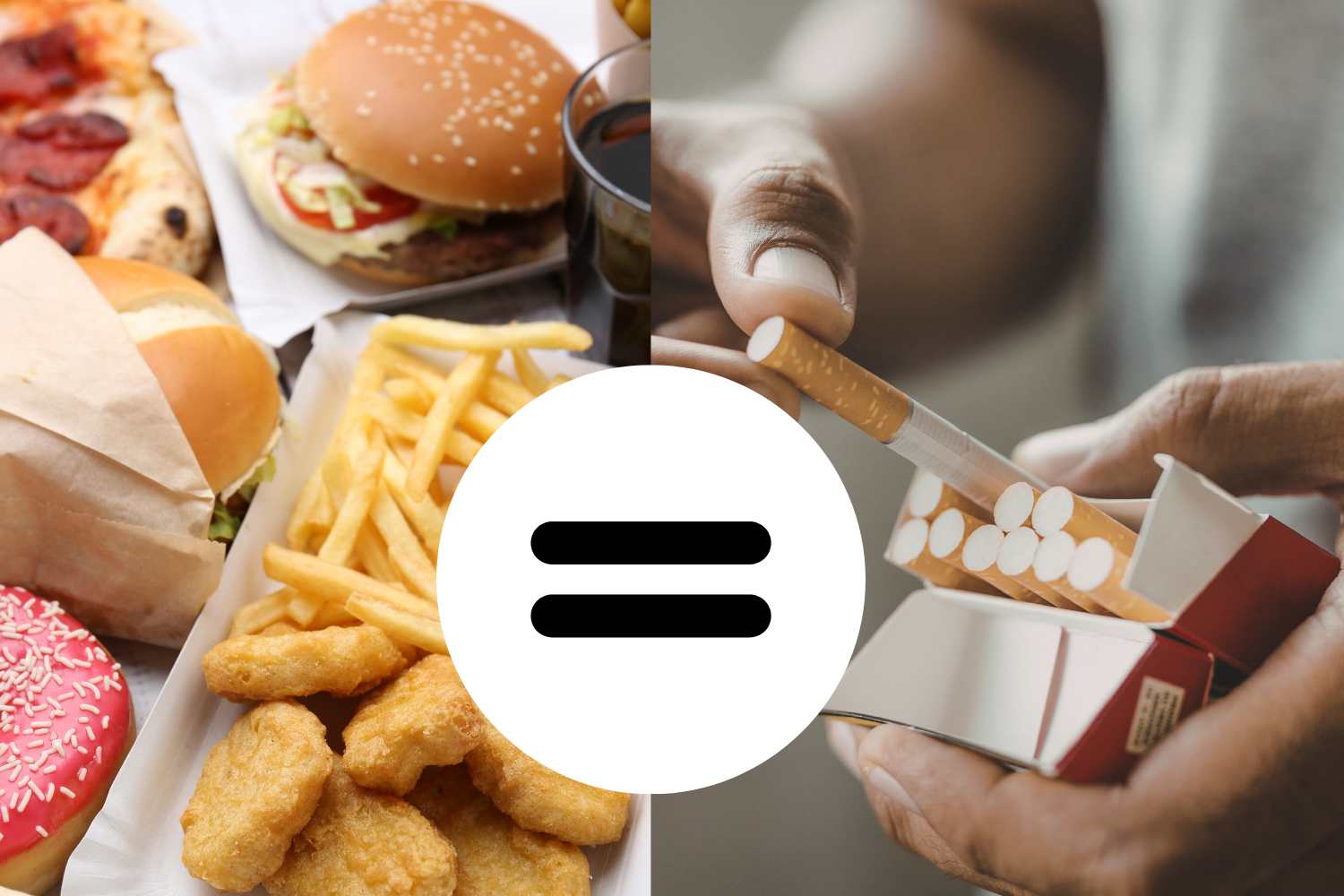
A study published in the scientific journal Milbank Quarterly by three researchers from the universities of Michigan, Duke and Harvard is causing discussion in the scientific community. The analysis is not limited to superficially comparing cigarettes and junk food, but documents how both are the result of precise industrial engineering strategies designed to maximize compulsive consumption.
Researchers have identified 5 key areas where tobacco and food industry strategies overlap in surprising ways.
Dose optimization
Modern cigarettes contain between 1% and 2% nicotine – a concentration calibrated to stimulate without causing nausea. Ultra-processed foods follow the same precision logic.
Carbonated soft drinks, for example, contain around 10-12% sugar, a concentration that exceeds that of breast milk (7%) and any natural fruit. Some sweets reach 81% sugar. But the real stroke of genius is the combination of refined carbohydrates and added fats – a combination that is almost non-existent in nature.
The study documents that this combination produces a “supra-additive” effect on the brain. In other words, sugars and fats together stimulate the brain much more than they would separately, creating a pleasure response that is disproportionate to the sum of the individual effects. When consumed together, carbohydrates and fats can increase dopamine release by up to 300% above the basal level, compared to 120-150% with fats alone. Chocolate, ice cream, chips and pizza exploit precisely this synergy.
Speed of administration
The tobacco industry uses ammonia to chemically modify nicotine and make it more quickly absorbable. In this way, the inhaled smoke reaches the brain in a few seconds, enhancing its effect.
Ultra-processed foods employ parallel strategies. The research explains how these products are literally “pre-chewed”, “pre-salivated” and “pre-digested” through industrial processes that dismantle the natural matrix of food: fibers removed, proteins degraded, water eliminated.
Some manufacturers add enzymes such as amylase and protease that speed up digestion before the food even enters the mouth. The result is products that dissolve quickly, allowing for almost instantaneous absorption of sugars and fats into the blood.
Hedonic engineering and short duration of pleasure
One of the most disturbing elements that emerged from the study concerns “short hang time” – the brevity of the pleasant experience, designed to trigger the desire to consume more.
Particularly illuminating is the testimony reported by the researchers, taken from an interview on the “60 Minutes” program with two flavorists from Givaudan, one of the largest global companies in the sector. Experts candidly admit that they design flavors that “explode at first” but “don’t persist too long, so as to stimulate the desire to consume more”. When the reporter asks if they are trying to create addiction, the answer is: “Exactly.”
This strategy is achieved through volatile flavor compounds that dissipate quickly and emulsifiers that facilitate rapid transitions from crunchiness to creaminess. Physiologically, rapid blood sugar spikes followed by sudden drops create irritability and renewed cravings, just like nicotine withdrawal.
Ubiquity and convenience
Another crucial similarity concerns the consumption environment. Cigarettes and ultra-processed foods are designed to be economical, portable, always available and easily consumable in any context: on the street, in the car, in front of a screen, without preparation or time limits.
According to researchers, this ubiquity drastically reduces the ability to self-regulate and normalizes repeated consumption, transforming occasional use into a daily habit. It is not only the product that encourages compulsive consumption, but the environment in which it is placed.
Deceptive reformulation and health washing
Perhaps the most cynical strategy is “health washing”. In the 1950s, the tobacco industry introduced filters and then “light” cigarettes, creating the illusion of harm reduction while smokers simply compensated by smoking more or inhaling more deeply.
The food industry uses identical tactics. Labels like “fat-free” or “sugar-free” are applied to products that keep addictive combinations intact. The study cites protein-enriched foods: although marketed as healthier, clinical studies suggest they continue to promote overeating with similar risks to conventional confectionery.
The use of non-sugar sweeteners (NSS) is particularly critical. Research reports that in some animal experiments, NSS are even preferred to cocaine, and neuroimaging studies suggest that they may interfere with appetite regulation.
Neurobiological data
The study documents how ultra-processed foods activate the mesolimbic dopaminergic pathway – the same circuit as drugs. Simple sugars can increase dopamine by up to 150-300% above baseline, comparable to nicotine.
Studies on animal models demonstrate that concentrations of liquid sugar of 10% – such as Coca-Cola or Pepsi – trigger typical addiction behaviors, i.e. compulsive consumption, abstinence and lasting alterations of the dopaminergic system.
When tobacco and food had the same masters
Few people know it, but in the 1980s and into the mid-2000s, major tobacco companies – RJ Reynolds and Philip Morris – bought giants like Kraft, General Foods and Nabisco, becoming the leading producers of ultra-processed foods.
This merger, the researchers point out, allowed the direct transfer of expertise in addiction engineering, aggressive marketing and regulatory evasion from tobacco to food. Compounds developed for cigarettes found application in the food industry.
The proposals
Researchers propose strategies similar to those that have reduced smoking by 73% among American adults:
The study then launches an important appeal: it’s time to consider ultra-processed foods.”less like food and more like optimized cigarette-like consumables”.
For cigarettes, decades passed between knowledge of the damage and significant action to stem it, decades during which millions of people became ill. For ultra-processed foods we must not make the same mistake also because there is a crucial difference with tobacco: we have many alternatives of minimally processed foods that have nourished humanity for millennia. But it will take the same political courage once reserved for tobacco to take on an industry that systematically puts profit before public health.
