
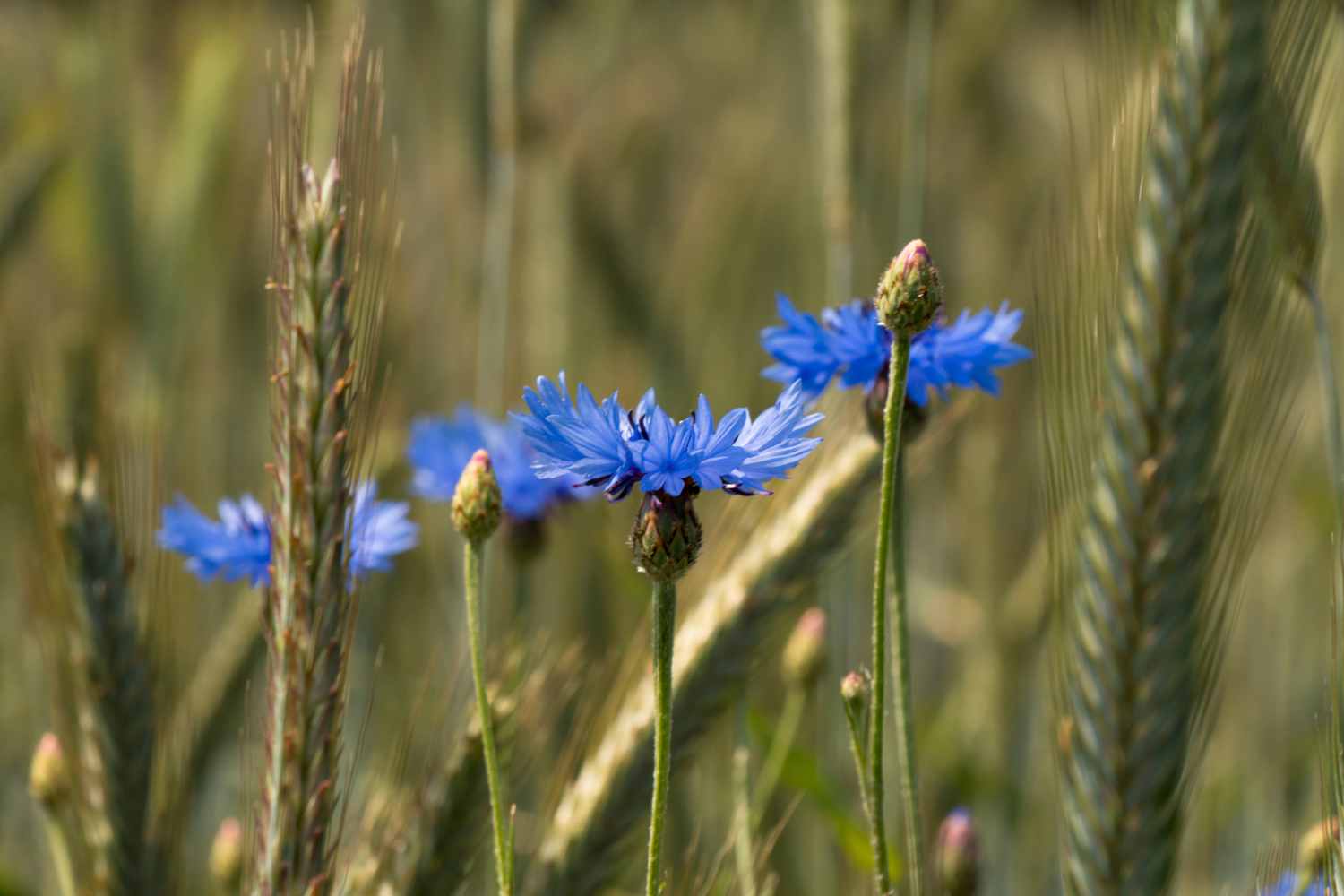
The cornflower – Cyanus segetum – has fully entered the list of particularly protected species in the provincial territory of Trento. The decision was formalized by the Provincial Council in mid-January as part of a broader amendment to the regulation on spontaneous flora which implements the provisions of the provincial law on forests and nature protection of 2007, as well as the budget adjustment law of 2025.
What the law says
Concretely, the flower can no longer be collected, marketed or damaged in any way. Anyone caught doing so is entitled to a fine ranging from 13 to 133 euros for each specimen involved. This is not a new rule, given that the same protective logic already applies to a list of protected species that includes edelweiss, orchids, saxifrages, Kerner’s buttercup, wild daffodil, holly and butcher’s broom.
The reason is quite straightforward. In Trentino all naturally spreading herbaceous and shrubby species are protected from the point of view of indiscriminate collection, and in this context the so-called “particularly protected species” represent an additional level: no exceptions, no minimum quantity allowed. The cornflower entered that list because, according to available data, its presence in Alpine meadows has significantly decreased, thanks to both intensive agriculture and constant harvesting by tourists.
What about other plants?
The rules for other plants remain more flexible. Normally you can harvest up to five flowering stems, as long as you do not uproot roots or tubers. For species linked to ancient local customs – nettles, chamomile, elderberry, hops, bay leaves and others – a larger quantity is allowed, up to a maximum of 0.5 kilograms depending on the species. Mosses and lichens can be harvested up to one kilogram per person. The detailed operational provisions are contained in the implementing regulation of the provincial law.
The study
The measure does not arise out of nowhere. According to the biodiversity monitoring conducted by Eurac Research, which began in 2019 in Alto Adige but with results applicable to the entire Alpine area, both fauna and flora are under increasing pressure. Intensive agriculture has progressively impoverished traditional grasslands, while climate change is rapidly altering ecological conditions at altitude. The more specialized alpine species, the research reports, are slowly being replaced by others: a process that, once started, is difficult to reverse.
The cornflower, in this sense, is an emblematic case, a plant that once colored every side of the Trentino mountains has become rare precisely where it should be common. The inclusion in the list of particularly protected species is a sign that the Province intends to take the issue seriously, at least on paper.
