
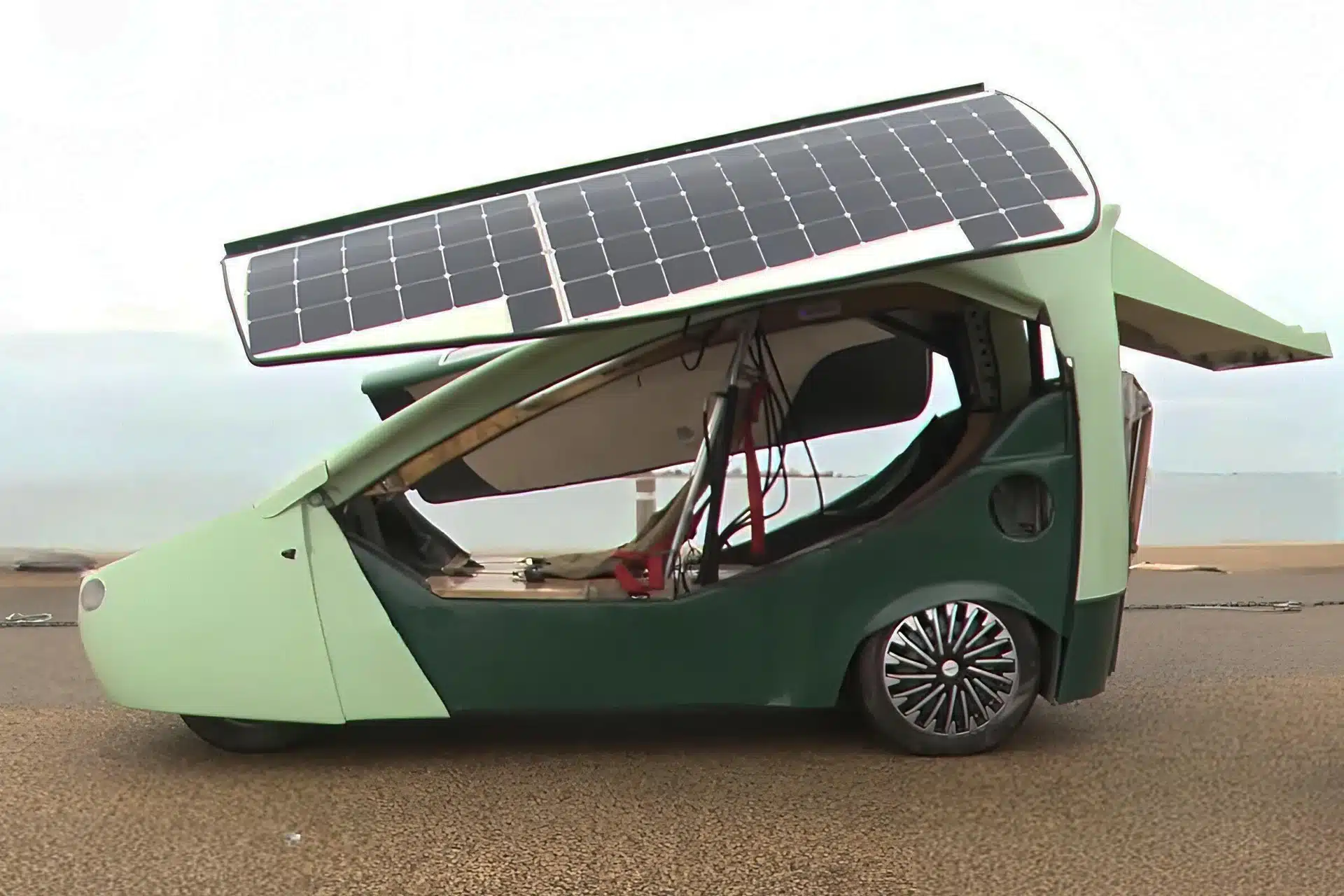
It’s not a car, it’s not a bike and it’s not even yet another futuristic gadget good only for renderings. The Scaramobile is a solar quadricycle, without a steering wheel and autonomous from an energy point of view, which tries to answer an increasingly urgent question: how do we move every day, especially outside big cities, without continuing to depend on oversized, expensive and polluting vehicles?
Designed in France by Denis Baulier, the Scaramobile was born with a clear idea: not to copy the car, but to rethink the concept of daily mobility from scratch, truly adapting it to the territories and the people who live there. However, being a motorized quadricycle, an AM license is required to drive it. Having clarified this point, we can focus on what makes the Scaramobile an interesting project also – and above all – from an environmental point of view.
A vehicle designed for daily travel
The Scaramobile was not created to amaze, but to function. It was designed to cover those distances that are too long for an electric bike, but where the use of the car appears excessive and often inevitable only due to a lack of alternatives. We are talking about rural areas, suburbs, small towns, places where public transport is scarce or completely absent.
Here the Scaramobile finds its natural space, placing itself halfway between e-bike and car. It can transport people, but also objects, minimizing resource consumption and dependence on infrastructure. A pragmatic approach, far from the unrealistic promises of certain “green” mobility only on paper.
Autonomous thanks to the sun, modular and designed to last over time
From a technical point of view, the Scaramobile falls into the L7 category and can accommodate up to three people, with a cockpit that can be modulated according to needs. The heart of the project is a lightweight structure, designed to be metamorphosable, repairable and evolutionary, a choice that is anything but obvious in a sector dominated by planned obsolescence.
One of the distinctive elements is the search for energy autonomy, obtained thanks to the integration of orientable solar panels, which allow us to drastically reduce dependence on the electricity grid. It’s not just about energy saving, but about resilience, especially in those contexts where access to infrastructure is not guaranteed.
The Scaramobile was awarded in 2022 and selected by ADEME as part of the eXtrême Défi, a program that supports radically innovative projects for more sustainable mobility. Today it is still at the advanced prototype stage, with several models already built, but the direction is clear.
The strength of the solar quadricycle lies not only in technology, but in vision. It doesn’t claim to replace the car everywhere, but offers a credible, sober and coherent alternative for most of the daily journeys, the ones we do every day almost without thinking about it.
In a world in which the car often remains a disproportionate response to real needs, Scaramobile invites us to ask ourselves whether the time has not come to use smaller, lighter and better designed vehicles, especially for territories that have been left on the margins of mobility policies for years.
It is not a universal solution, but it is a clear signal: the ecological transition also involves less flashy means, but more suitable for real life.
You might also be interested in:
