
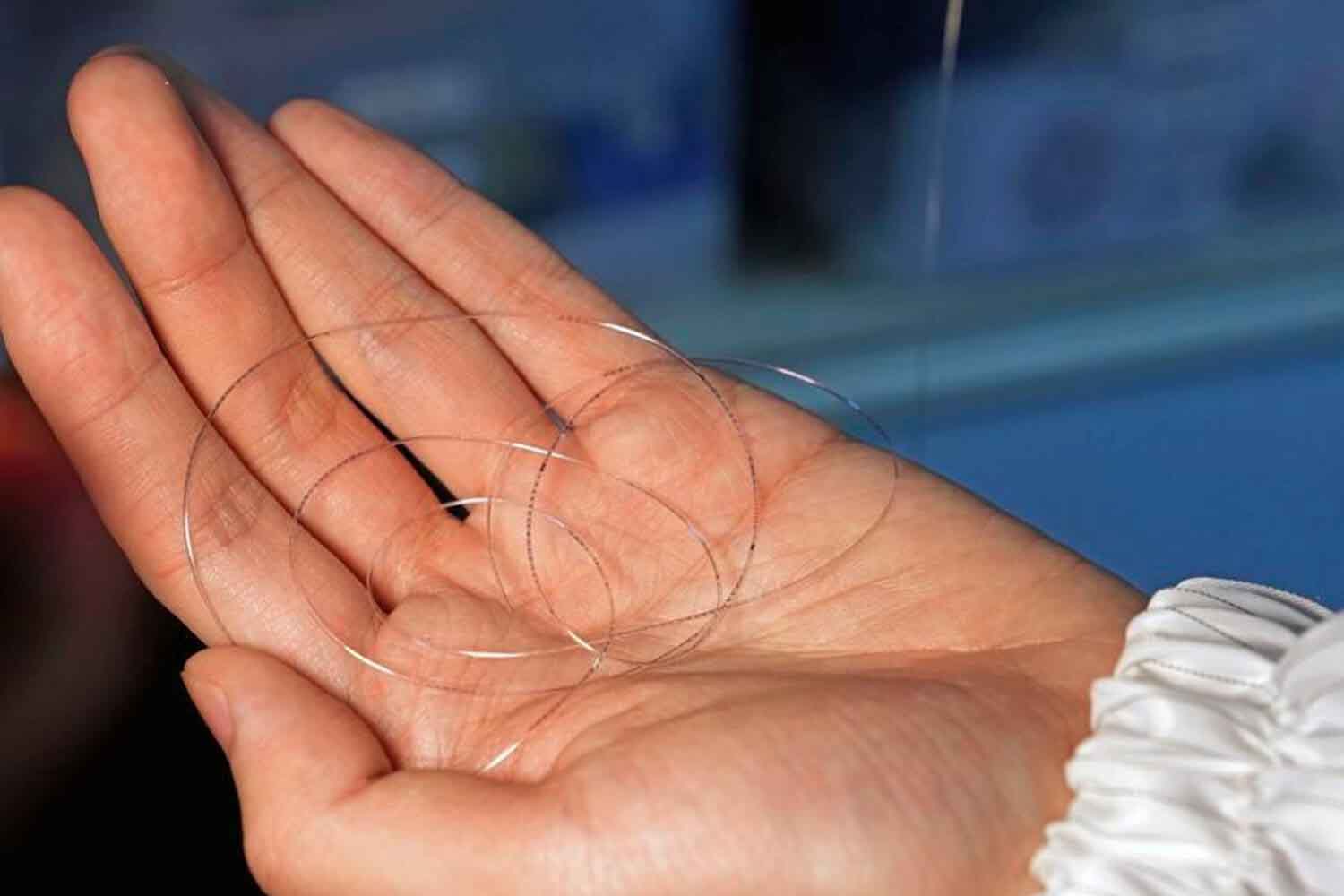
The computers of the future may not be smartphones or smartwatches. They could be, much more simply, the clothes we wear every day. This is the perspective opened by a group of Chinese researchers who developed a ultra-thin fiber chipcapable of calculating, analyzing data and resisting the typical stresses of fabrics: folding, twisting, washing and daily wear.
The project was born in the laboratories of Fudan University, in China, where scientists managed to integrate a complete electronic circuit inside a fiber thinner than a human hair. The result is a thread as soft and flexible as fabric, but with real computational capabilities. This is not a simple sensor: this fiber can process signals, perform basic artificial intelligence tasks and recognize imagesbringing fabrics closer to the concept of real wearable computers.
The authors of the study speak openly of a breakthrough for flexible electronics, underlining how this technology can push fiber devices towards integrated intelligent systemsovercoming the limits of current wearable solutions.
From flat chip to rolled chip
Integrating advanced electronics into a soft fiber is a huge challenge. Traditional chips are rigid and flat, while a fiber is curved, irregular and subject to constant deformation. Building circuits directly on its surface is comparable, as researcher Chen Peining explained, to build a skyscraper on muddy and uneven groundhoping that it resists any stress.
The solution adopted by the team was as simple as it was ingenious: . The researchers initially created an ultra-thin, elastic and perfectly smooth sheet at the nanometric level. On this surface they were able to use standard lithography techniques from the semiconductor industry to create transistors, resistors, capacitors and diodes, then protecting everything with an insulating layer against chemicals and wear.
The decisive step comes immediately afterwards. This spreadsheet comes rolled up on itself like sushiforming a compact spiral which is finally incorporated into a polymer fibre. Thus was born the so-called fiber integrated circuit (FIC)a structure that allows you to concentrate a huge amount of components in a tiny space.
The numbers are impressive: approximately 100,000 transistors per centimeter of fiber. In practice, a single meter of wire can contain millions of transistors, an order of magnitude comparable to that of the CPUs of classic computers from a few decades ago.
As thin as a hair, as strong as an industrial cable
These fibers have a diameter of approx 50 micrometerswhile a human hair is around 70 micrometres. Despite their very small size, they show surprising resistance. They can be stretched up to 30%, twisted repeatedly and subjected to more 10,000 bending and abrasion cycles without losing functionality.
Laboratory tests pushed the fiber to its limits: it continued to work after being crushed with a pressure equivalent to 15.6 tonsheated up to 100 degrees Celsius and even afterwards 100 machine washes. Fundamental characteristics if you think about real use in everyday clothing.
Functionally, these fiber chips can and do handle both analog and digital signals neural computing taskssuch as image recognition, with high accuracy.
Another key aspect is industrial compatibility. According to Peining, the manufacturing method is fully compatible with tools already used in the chip industrymaking large-scale production not only theoretically possible, but already technically feasible.
From health to virtual reality
If these computational fibers become commonplace, clothes could turn into smart platforms. They could monitor vital signs, collect health data, display information, or even help regulate body temperature.
In the field of virtual and augmented reality, even more concrete scenarios open up. Gloves made from these fibers can offer extremely realistic tactile feedback, while remaining indistinguishable from normal fabric. According to the researchers, surgeons engaged in remote robotic surgeries could “feel” the texture of tissuesimproving precision and safety.
In the medical field, the potential impact is enormous. The flexibility of these fibers is comparable to that of brain tissue, making them also suitable as soft and biocompatible implants. Applications such as epilepsy monitoring, Parkinson’s treatment and assistance in cardiovascular and neurological surgery are already being studied, in collaboration with hospital facilities.
The research, published in the journal Naturegives a glimpse of a new generation of smart textileswhere the line between clothing and electronics becomes increasingly thin. Literally.
