
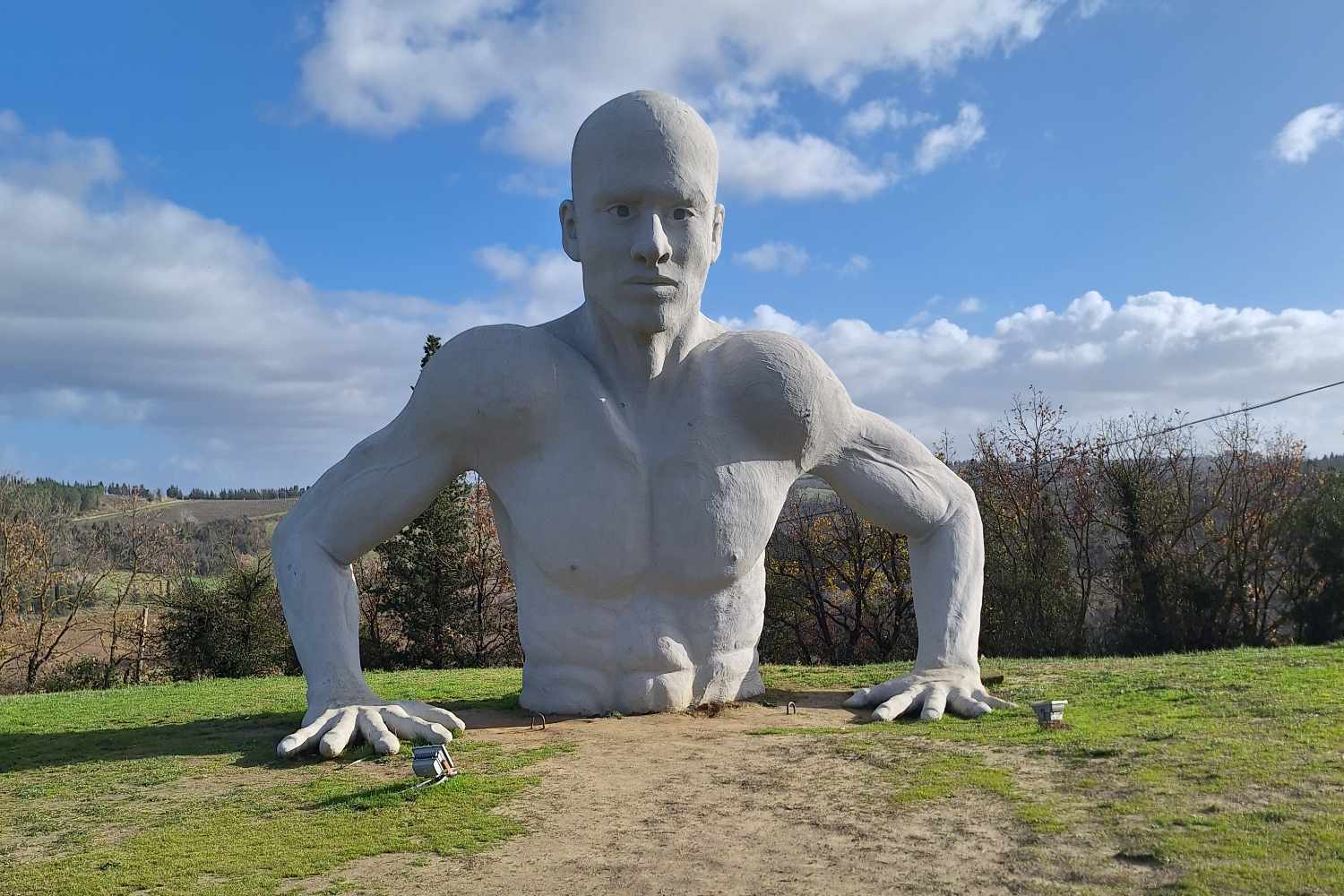
Our journey to Peccioli, in the heart of the Tuscan Valdera in the province of Pisa, passed between soft hills, rows of vines and silences interrupted only by the wind. Nothing really prepares you for what you encounter just outside the village: gigantic human figures emerging from the ground, motionless yet full of tension. The Giants of Peccioli are not a simple attraction, but the result of a precise vision, linked to the territory and its transformation.
The Giants as Presences in the landscape
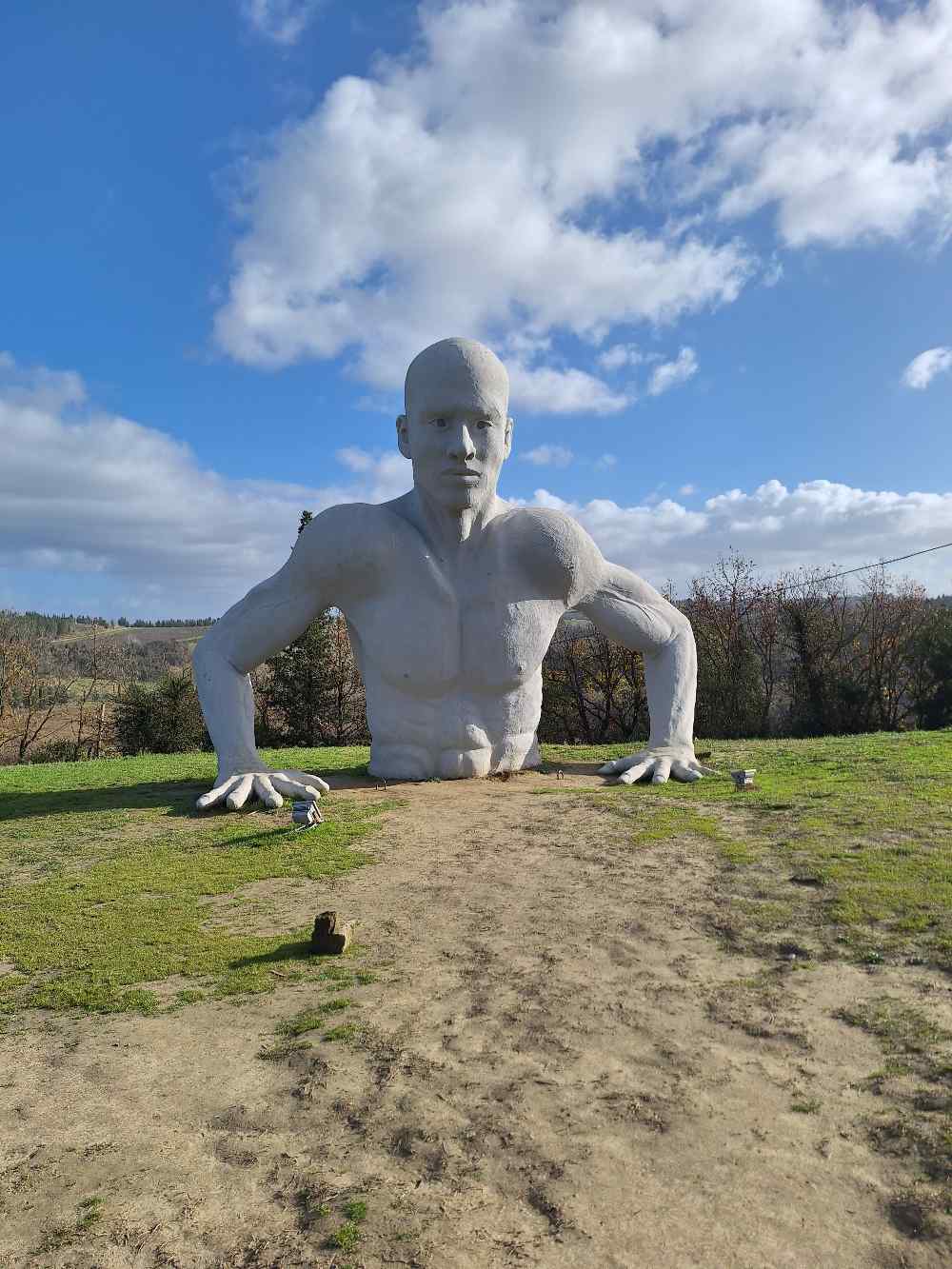
They call them Giants, but their original name is Presenze. Monumental sculptures that reach up to nine meters in height, created by the craftsman and artist Gianluca Salvadori with his company Naturaliter. They were born in 2009 as part of a project to enhance an unusual place: the Legoli waste disposal and treatment plant, today known as the Green Triangle. Here, where the idea of waste once dominated, today we talk about regeneration, energy and a rethought landscape. The Giants seem to emerge from the ground as if the earth itself was giving something back.
A narrative that is rooted in the material
As we approached, what struck us was the physicality of the works: naked, white, muscular bodies, marked by folds reminiscent of classical sculpture, but placed in a contemporary context. Salvadori made them with simple and hard materials: expanded polyurethane, resins, cement, worked by hand, with a long and tiring process.
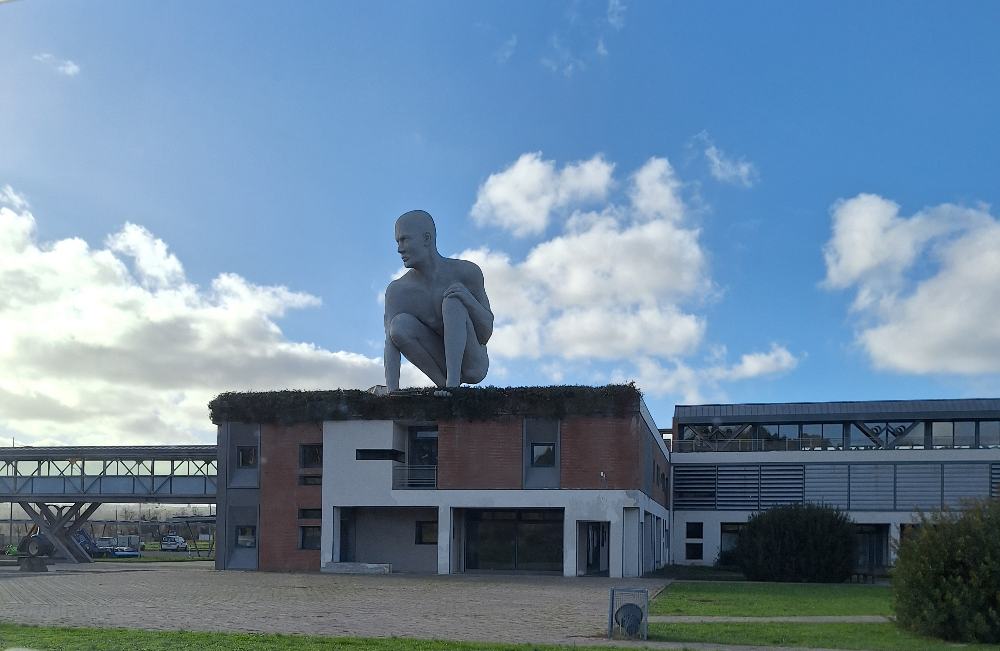
The first giant, with his arm outstretched, becomes a test model. More and more complex figures follow: a body that emerges up to the bust, a female figure that emerges from the hips, up to the last, most imposing one, crouching as if it had just emerged from a crater. If it had been erected, it would have exceeded sixteen metres.
The journey of the Giants is not just symbolic. Some sculptures have been moved and used as scenography for cultural events, such as concerts at the Teatro del Silenzio in Lajatico. One of them was even transported by helicopter, dismantled into several parts to exceed the weight limits.
Today the works are distributed: two at the Green Triangle of Legoli, one at the Fonte Mazzola Amphitheatre, one on the roof of the La Fila business incubator. A widespread route that invites you to move, to look for them, to observe them from different perspectives.
A museum spread across alleys and hills
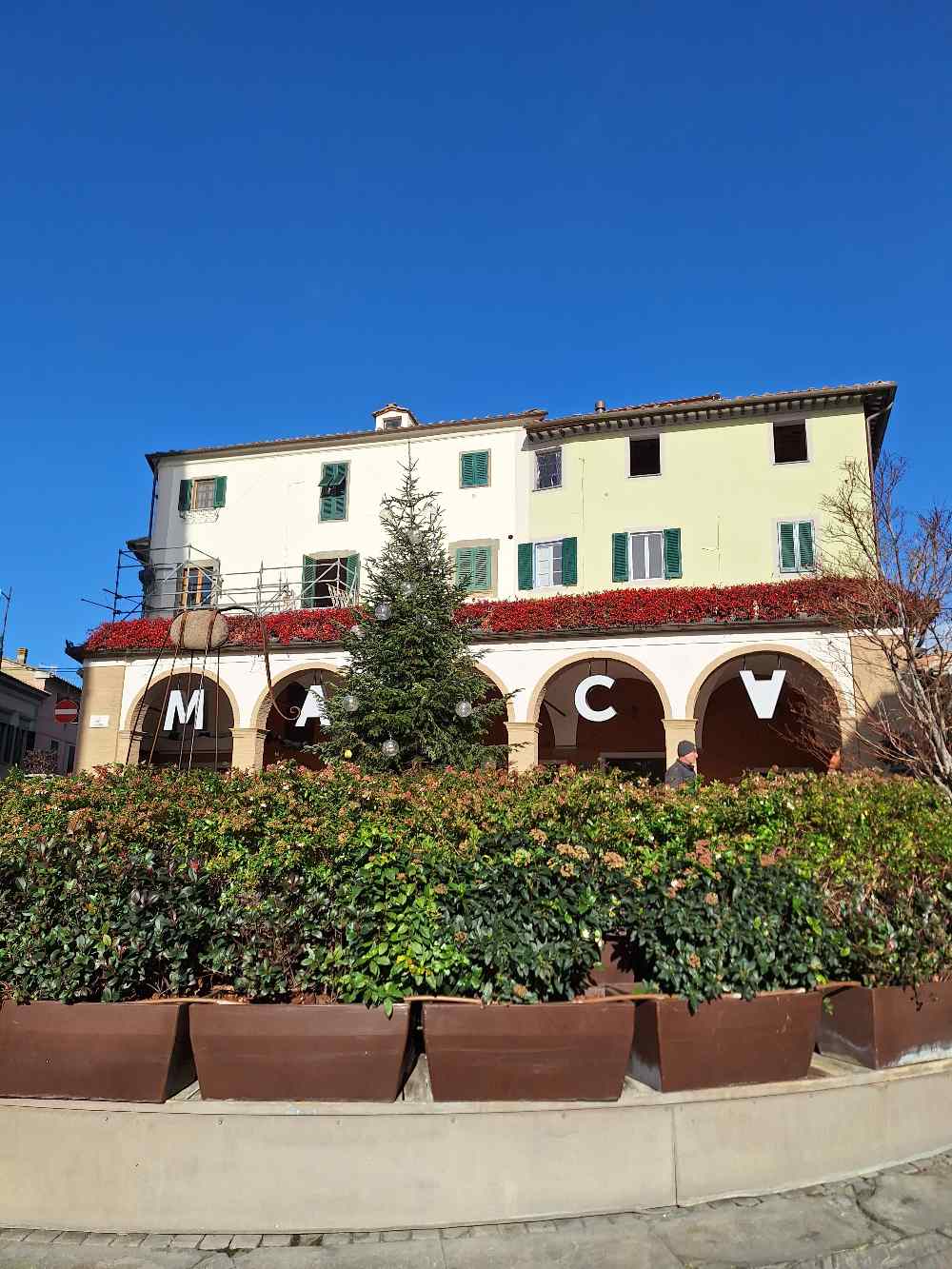
But Peccioli, elected “Borgo dei Borghi 2024”, is much more than its Giants. Walking through the streets of the town, we encountered works of art scattered everywhere. Installations that dialogue with the landscape, with visitors and, sometimes, with the daily life of residents. The MACCA – Open Air Museum of Contemporary Art now collects over seventy interventions located between the historic center and the countryside.
The first that strikes you is the Endless Sunset walkway, a work by Patrick Tuttofuoco: a colored ribbon of steel that wraps around a panoramic walkway and captures the reflections of the sunset, transforming a simple pedestrian connection into a unique chromatic experience.
The Timeless Palace and the suspended terrace
In the center you will find the Palazzo Senza Tempo, an ancient building carefully renovated to become a space dedicated to art, history and culture. The renovation was able to keep thehistorical atmosphere, but adding a touch contemporary which makes the building particularly fascinating. Inside, the palace hosts temporary exhibitions, cultural events and activities that allow you to learn more about the history and traditions of Peccioli.
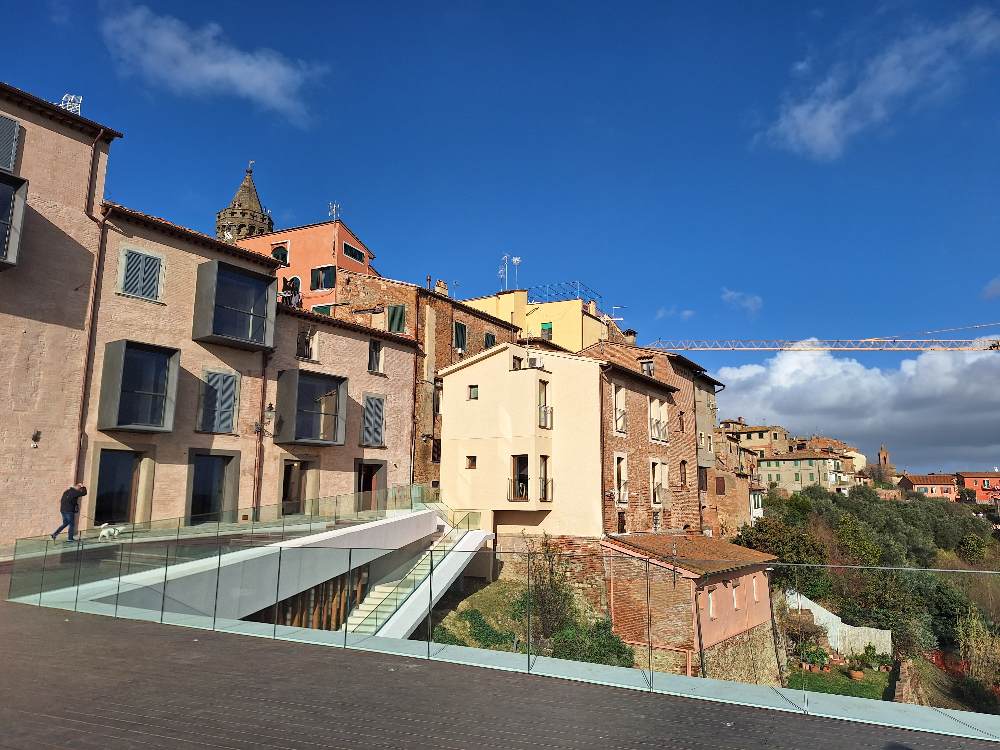
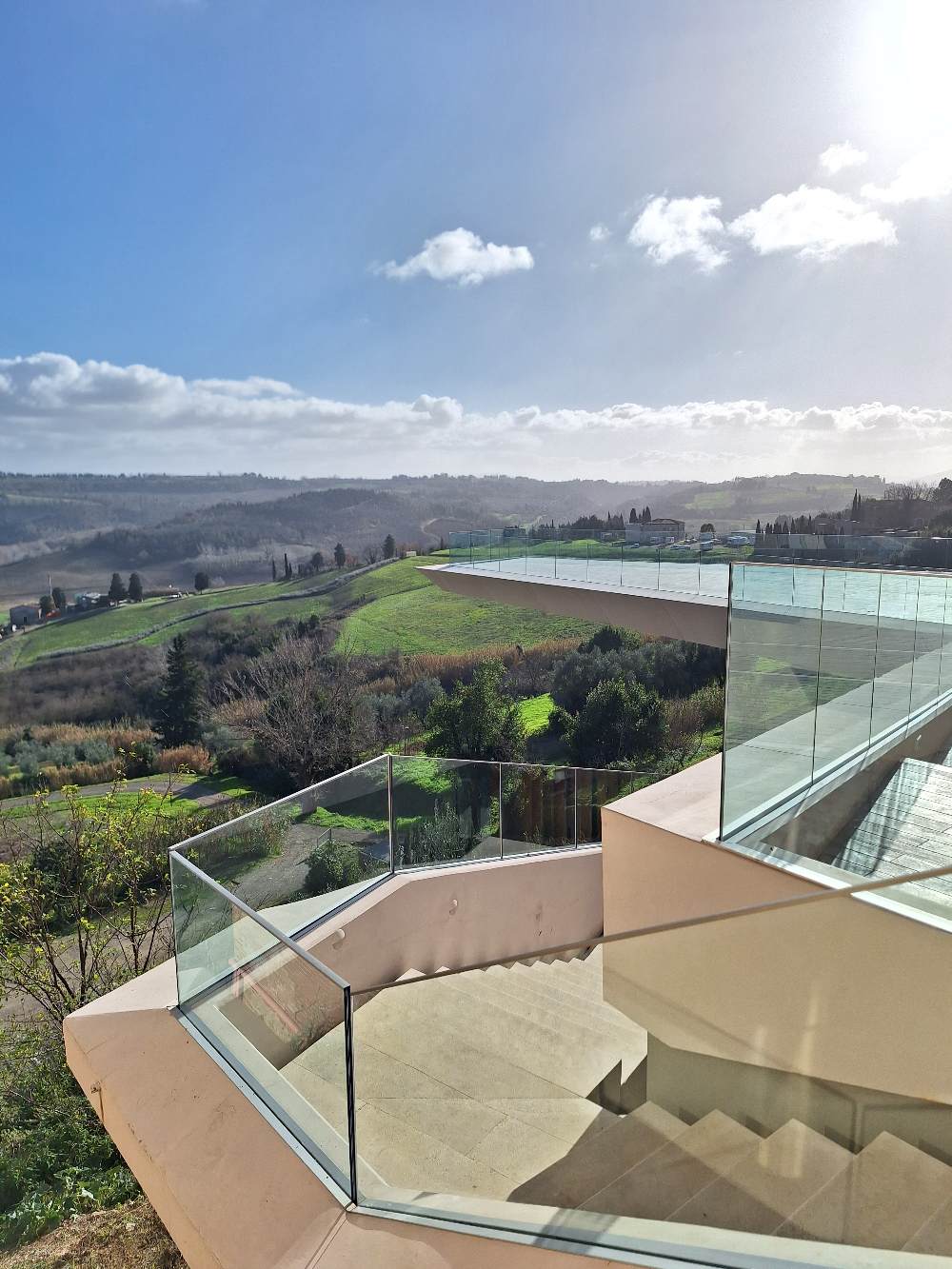
Climbing on Suspended Panoramic Terrace, the panorama opens up to 360 degrees: hills, vineyards and small villages extend as far as the eye can see. The terrace, with an innovative design and made with modern materials, seems to float in the landscape, offering a unique and immersive experience. This combination of history, art and nature make the Palace and its terrace an unmissable destination during a visit to the village, offering a new and surprising look at contemporary Tuscany, where past and present coexist harmoniously. Here a selfie and a panoramic photo of the surrounding nature are a must.
Art that tells history and territory
The past and the contemporary intertwine in the village: the Parish Church of San Verano, with its medieval history, overlooks the most recent installations; the Praetorian Palace houses collections of icons and engravings that recall distant eras, while the Archaeological Museum preserves Etruscan and Roman finds.
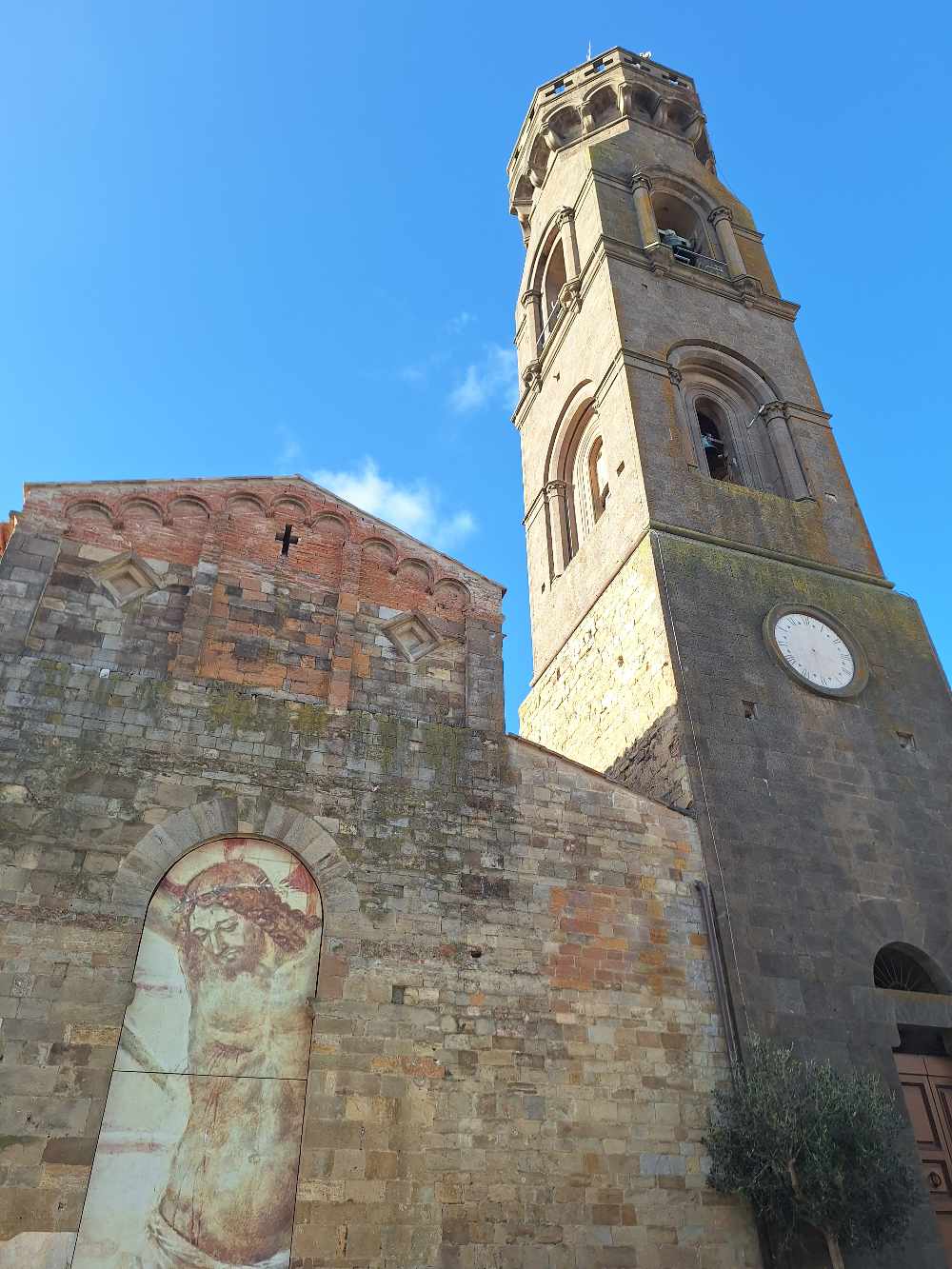
From square to square we perceive a continuous dialogue between what is ancient and what is innovative: it is as if Peccioli challenged us to look at culture from multiple angles. A village that has made contemporary art and sustainability an identity feature, which does not live on nostalgia, but on experimentation.
This balance between tradition and innovation, between historical past and creative present, struck me more than any single work: Peccioli invites you to look at every detail with new eyes, from the ancient stones to the bold shapes that appear in the landscape and in doing so it tells of a different Tuscany, less postcard-like and more aware.
You might also be interested in:
