
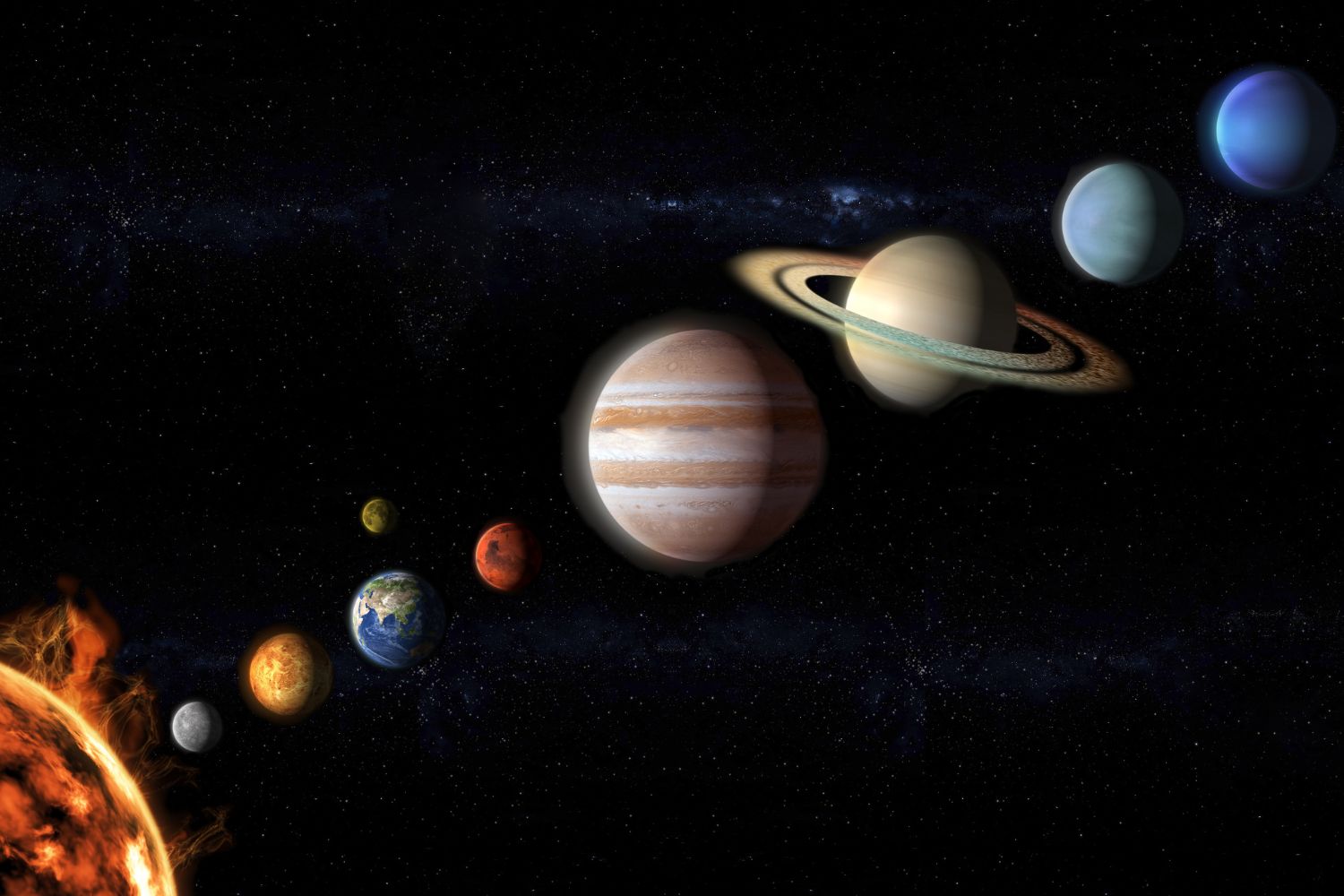
The February 28 we will really admire a planetary alignment with six planets, four of which are perfectly visible to the naked eye? The news is not exactly the one that has been circulating for days, but the event is true: we will in fact admire it Jupiter, Venus, Mercury, Saturn, Neptune and Uranus. And in reality there will also be Moon clearly visible just 4 days after the flood phase (on March 3rd, in fact, we will admire the Worm Moon).
What is meant by planetary alignment
As he explains StarWalka planetary alignment is defined as an astronomical event in which planets, at the same time, cluster very closely together on one side of the Sun, when viewed from above the solar system.
But, even if the term “alignment” can make you think of a straight line in the skythe planets cannot achieve full alignment in three dimensions.
Even a less rigid grouping in a quadrant (a 90 degree sector) is extremely rare: all planets group in a quadrant only 7 times in the current millennium
But there is another definition of planetary alignment, which is a visual phenomenon in which the planets appear close together in a small sector of the skywhen observed from Earth.
When Earth is one of these planets clustered on one side of the Sun, it appears to the observer that several planets are lined up in the sky. The smaller the sector in which the planets are seen, the more spectacular the alignment
What we will really see on February 28, 2026
Surely, this time too, we won’t see a straight line with all the planets aligned, but in reality we won’t even have them all in the same portion of the sky. In fact, as can be seen from the Stellarium maps, while Jupiter and Uranus are on the western horizonthe first in the constellation dei Twinsthe other in Bull (with the Moon in Cancer), all the others are in the South-Eastwith Venus in Acquariumwhile Saturn, Mercury and Neptune in Fish (in the maps the sky in the South-East and West on February 28, 2026 at approximately 6.30 pm).
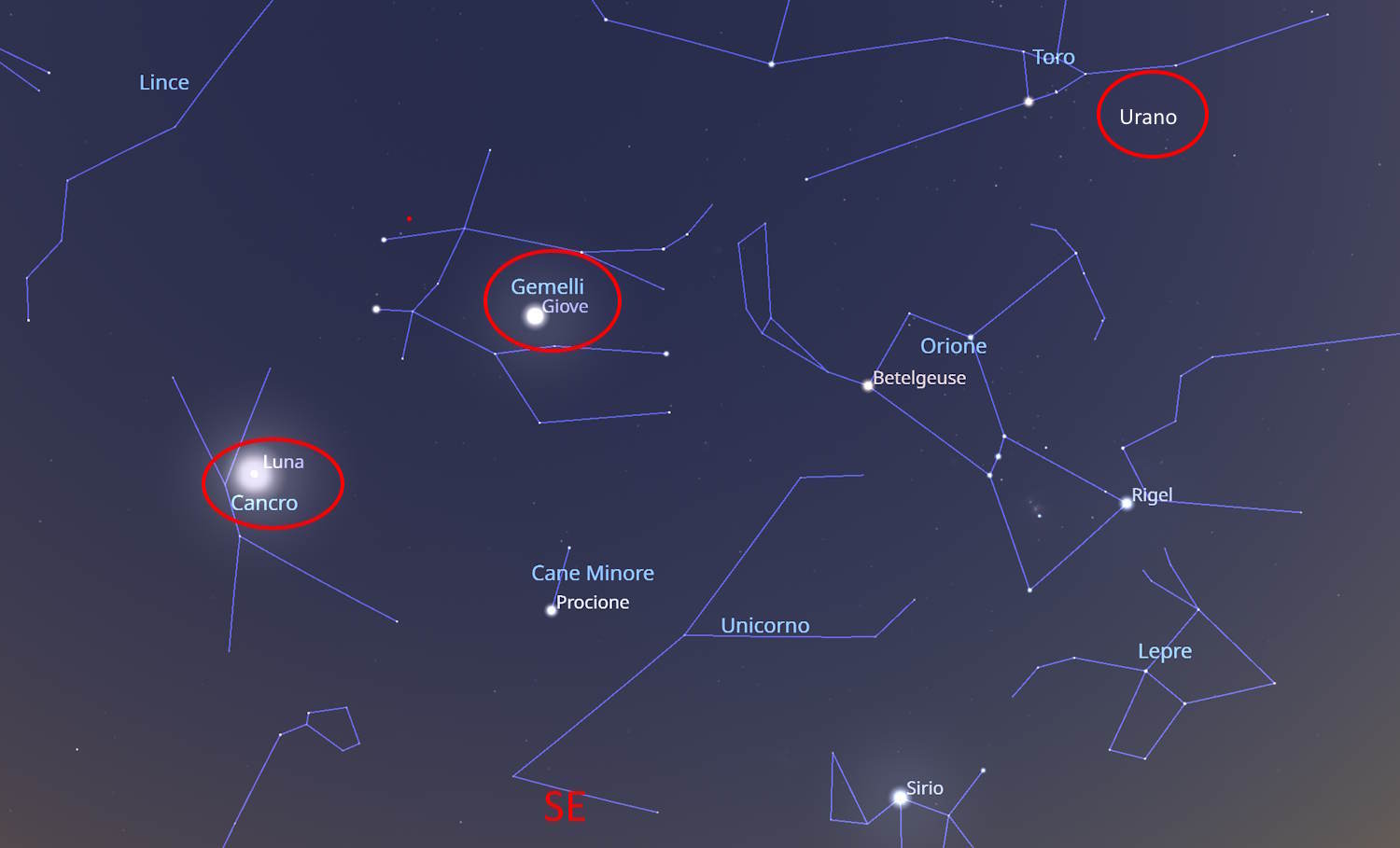
Let’s also not forget that the stars certainly visible to the naked eye (weather permitting) are only Jupiter, Mercury and Venus (in addition to the Moon), while for Saturn, although potentially observable without instruments, it is still preferable to have good binoculars to observe the rings. For Uranus and Neptune, however, at least a small telescope is needed.
This does not take away from the fact that the evening will be spectacular, and therefore, we cannot miss it.
Happy viewing!
Source: Starwalk
