
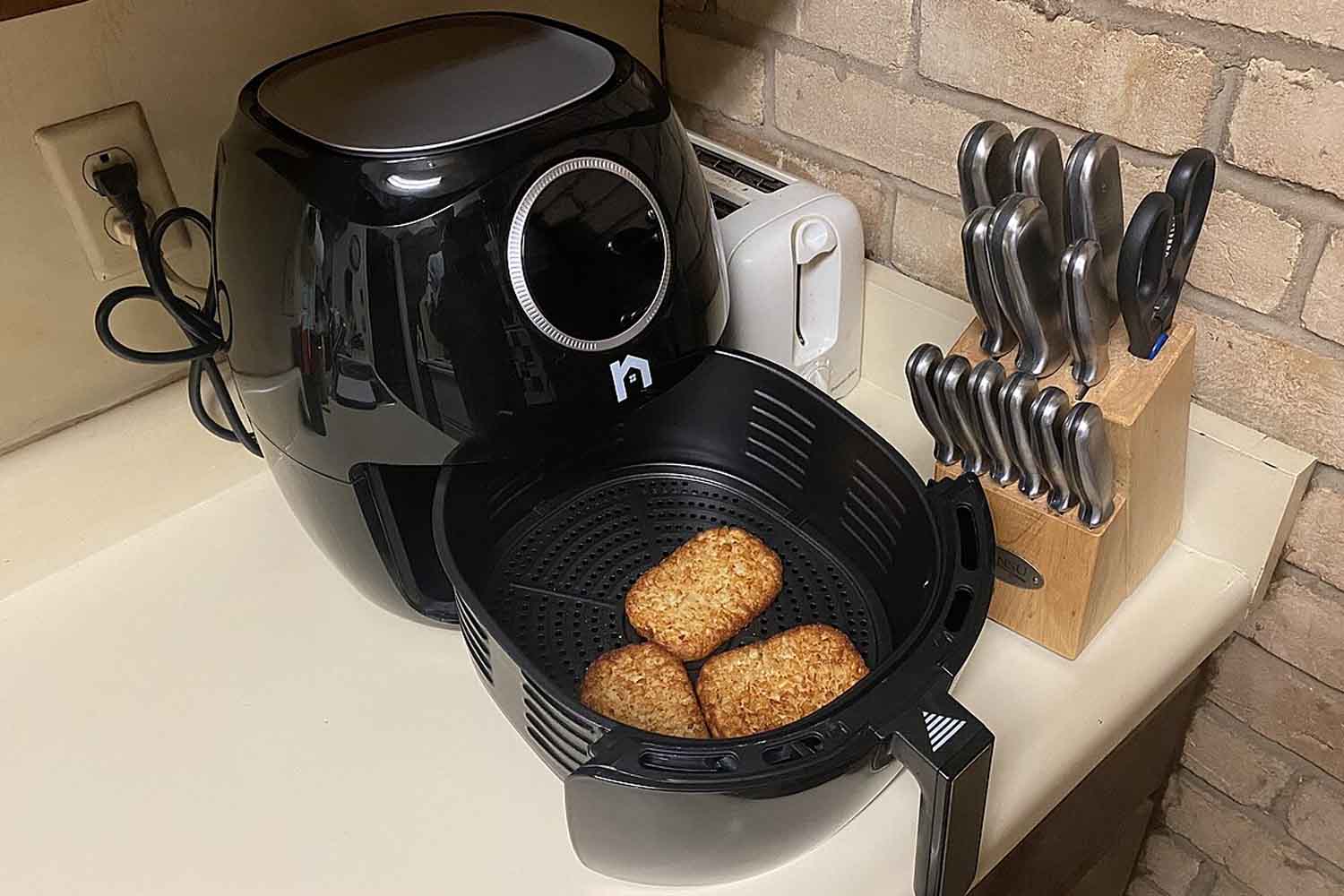
Air fryers entered Italian kitchens almost on tiptoe, but today they are everywhere. We use them because they consume less, because they reduce oil and because they promise lighter dishes. But there is an aspect that is still little talked about and which concerns everyone, every day: the air we breathe at home while we cook.
According to new scientific research, the air fryer can really make a difference on this front too. Not always, though. And not automatically.
Air fryers and air quality in the home
A group of researchers from the University of Birmingham analyzed in a very concrete way what happens to the domestic air during cooking with an air fryer. It did so by measuring volatile organic compounds (VOCs) and ultrafine particles, two of the main indoor air pollutants, often underestimated but present in almost all homes.
VOCs are chemical substances that are released from many daily sources – paints, detergents, furnishing materials – but also from the kitchen, especially when cooking foods rich in fat. In closed environments, like our homes, they tend to accumulate easily.
A 4.7-liter air fryer was used for the study, cooking different types of foods: frozen, low-fat fresh foods, and high-fat fresh produce. The results were published in the scientific journal ACS ES&T Air and tell a rather clear story: the air fryer pollutes the air at home much less than traditional frying in oil.
The Royal Society of Chemistry also confirms this
The Royal Society of Chemistry also intervened to reinforce these data, disseminating the study, explaining how air fryers are, to date, one of the least polluting cooking methods for domestic air.
According to the RSC, the difference to deep frying is particularly noticeable when cooking fatty foods. Bacon, bacon and onion rings, for example, produce emissions, but much lower than traditional frying. In some cases, the levels of VOCs released by frying in oil are 10 to 100 times higher.
A fact that debunks the idea that “frying is always the same”, and reminds us how much the cooking method matters as much – if not more – than the food itself.
The critical point
However, there is a fundamental condition, without which these benefits risk disappearing. The air fryer must be cleaned carefully and regularly.
The researchers observed that grease and food debris, especially those that accumulate in hard-to-reach places, can increase emissions of VOCs and ultrafine particles over time. In an empty basket test, a fryer used more than 70 times showed 23% more VOCs and more than double the ultrafine particles compared to a new appliance.
These are not dangerous levels for health, scientists clarify, but the message is clear: without deep and constant cleaning, part of the environmental benefit is lost. This is also why experts are asking manufacturers to design fryers that are increasingly easier to disassemble and clean thoroughly.
In addition to the impact on the air, air fryers continue to stand out for their lower energy consumption compared to traditional ovens, an aspect that is anything but secondary in a period of rising prices and growing attention to the domestic environmental footprint.
You might also be interested in:
