
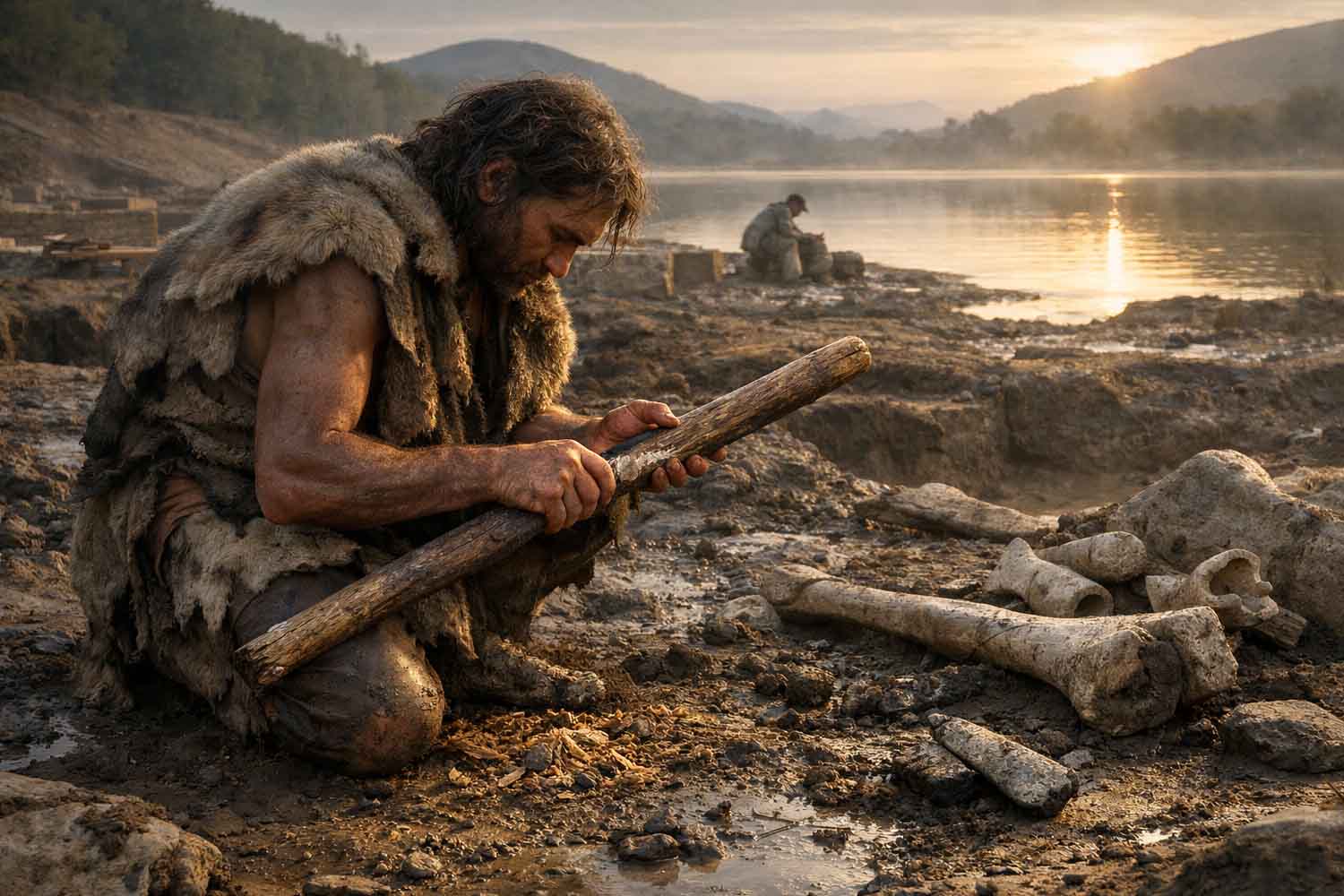
For decades we have called the “Stone Age” a period which, upon closer inspection, only tells part of the story. The discovery which occurred in southern Greece, inside a lignite mine, today forces archaeologists and scholars to radically review this narrative. Here, at the Marathousa 1 site, the oldest portable wooden instruments ever founddated to ca 430,000 years ago. A leap back in time at least 40,000 years than previously believed.
The discovery concretely demonstrates that wood, a fragile and rarely preserved material, was already a fundamental technological resource for our ancestors, even if its importance has long been obscured by the almost eternal resistance of stone.
The context in which these instruments were found is extraordinary. The Marathousa 1 site is located in the Megalopoli basin and was identified in 2013 thanks to the mining activity of the open pit mine. The excavation itself made it possible to reach layers of sediment that, under normal conditions, would have remained buried forever.
Between 2013 and 2019, excavations yielded a surprisingly detailed scene of prehistoric life: the almost complete skeleton of a straight-tusked elephant (Palaeoloxodon antiquus)with obvious signs of butchering, flanked by the remains of hippos, turtles, birds and more 2,000 lithic tools. All elements that tell of an ancient lake environment, rich in resources and long frequented by groups of hominins.
This association occurred at a time that was anything but favorable. About 430,000 years ago Europe was caught in the grip of one of the harshest glacial periods of the Pleistocene. Despite this, the Megalopolis basin would function as climatic micro-refugeoffering slightly warmer temperatures and critical resources for survival.
The mystery of the digging stick
Between the 144 wood fragments preserved exceptionally well in the mud, the researchers identified two real tools. The most impressive is a 81cm long stickmade from an alder trunk. The surface clearly shows signs of intentional cutting and carvingunequivocal proof of conscious human workmanship.
One end is rounded, probably to facilitate the grip, while the other is flattened, frayed and chipped, characteristics compatible with intensive use. Its shape and size surprisingly coincide with those of the digging sticks used in many traditional cultures to dig up tubers, roots or edible plants.
The detail that makes the discovery even more fascinating is the position of the object: the stick was found next to the butchered bones of the elephant. This opens up intriguing scenarios. It may have been used to dig in the mud of the lake, but it cannot be ruled out that it also had a role in the processing of the carcass of an enormous animal.
Who were the wood craftsmen of 430,000 years ago?
The second artifact is much smaller, just barely 5.7 centimetresprobably derived from willow or poplar. It was completely debarked and shaped, with one end rounded and marked by small cavities. This is an unprecedented object in the archaeological record.
Scholars speculate that it could have been used as retouching tool to refine the edges of stone chips, but its function remains uncertain. Precisely this uncertainty makes him precious: it shows how much he was complex and diverse the use of wood in prehistory.
No human remains were found at Marathousa 1, so the identity of the craftsmen remains open. The dating excludes Homo sapiens, who arrived in Europe much later. The most accredited hypotheses call into question Homo heidelbergensis or very ancient forms of Neanderthal, in a region that at the time was a true crossroads of hominin populations.
Beyond stone: wood, bone and a distorted vision of prehistory
The case of Marathousa 1 fits into an increasingly clear picture: prehistoric technology was by no means limited to stone. Wood, bone and organic materials were widely used, but were preserved only in exceptional contexts.
A large alder trunk with deep grooves was also found at the Greek site. In this case we are not talking about human signs, but about scratches left by a large carnivoreprobably a bear. A detail that tells the story direct competition between humans and animals for the same resources, in the same space.
Similar findings reinforce this view. In England, in Boxgrove, a 500,000 year old elephant bone hammerwhile in Zambia, at the Kalambo Falls site, they emerged interlocking wooden structures dating back 476,000 yearsprobably parts of a platform or shelter.
However, portable tools, such as digging sticks or stone tools, require an even more intimate level of planning and interaction with the environment. They tell of little men capable of choose the right material, shape it and transport itadapting to extreme climatic conditions with surprising flexibility.
