

The Ministry of Health has announced a new precautionary recall of fresh eggs due to microbiological risk, due to the possible presence of the Salmonella enteritidis bacterium.
All egg specifications recalled
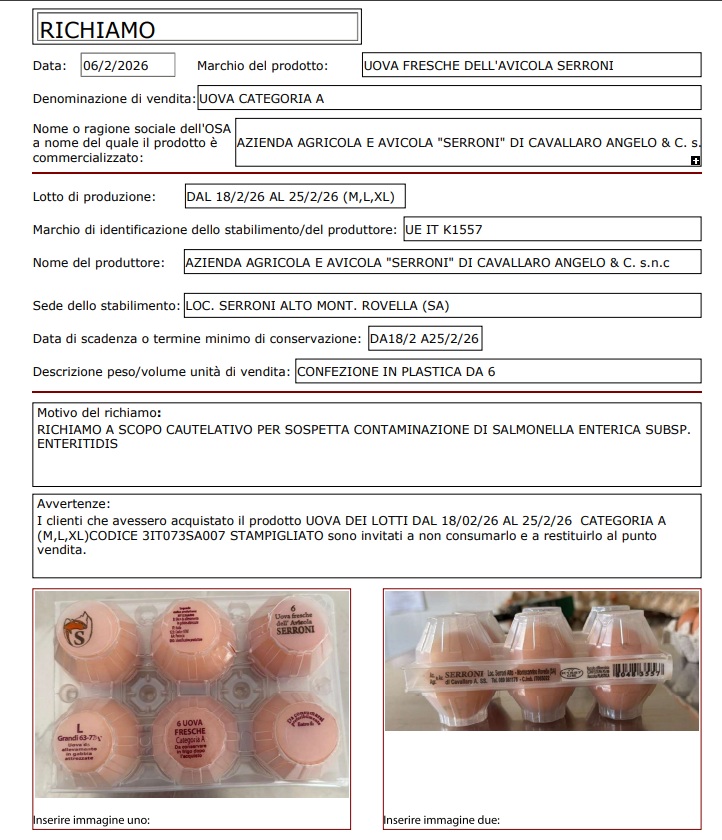
The alert concerns in particular fresh category “A” eggs produced by the Avicola Serroni company, sold both in packs of six and in whole cartons of 180 pieces.
According to the official notices from the Ministry of Health, the lots involved are those with expiry dates from 18 February 2026 to 25 February 2026, in categories M, L and XL.
The affected lots have the code 3IT073SA007 stamped on the eggs.
The recall was ordered directly by the company as a precautionary measure, after suspicion of contamination from Salmonella enterica subsp. Enteritidisa subspecies of Salmonella enterica frequently associated with foodborne infections in humans.
The eggs subject to the recall come from the establishment of the “Serroni” agricultural and poultry company in Montecorvino Rovella (Salerno), identified with EU code IT K1557. The company has already taken steps to collect the unsold lots from the points of sale, but invites consumers who have purchased the affected eggs not to consume them and to return them to the point of sale.
The risks of salmonella
It is a bacterium that mainly affects the gastrointestinal system, causing symptoms such as diarrhea, abdominal cramps, fever and nausea. Symptoms can appear between 6 and 72 hours after ingestion of contaminated food, with a typically benign course of 4-7 days. In rare cases, especially in fragile individuals such as young children, the elderly or immunocompromised, the infection may worsen and require medical attention.
To reduce the risk of contamination, experts remind us of some simple but fundamental rules: always wash your hands before and after handling raw eggs, cook the eggs until the yolk and white are solid and store them in the refrigerator at controlled temperatures.
If you have any concerns or suspicious symptoms after consuming eggs, it is advisable to contact your doctor and report the episode to the local health authorities.
