
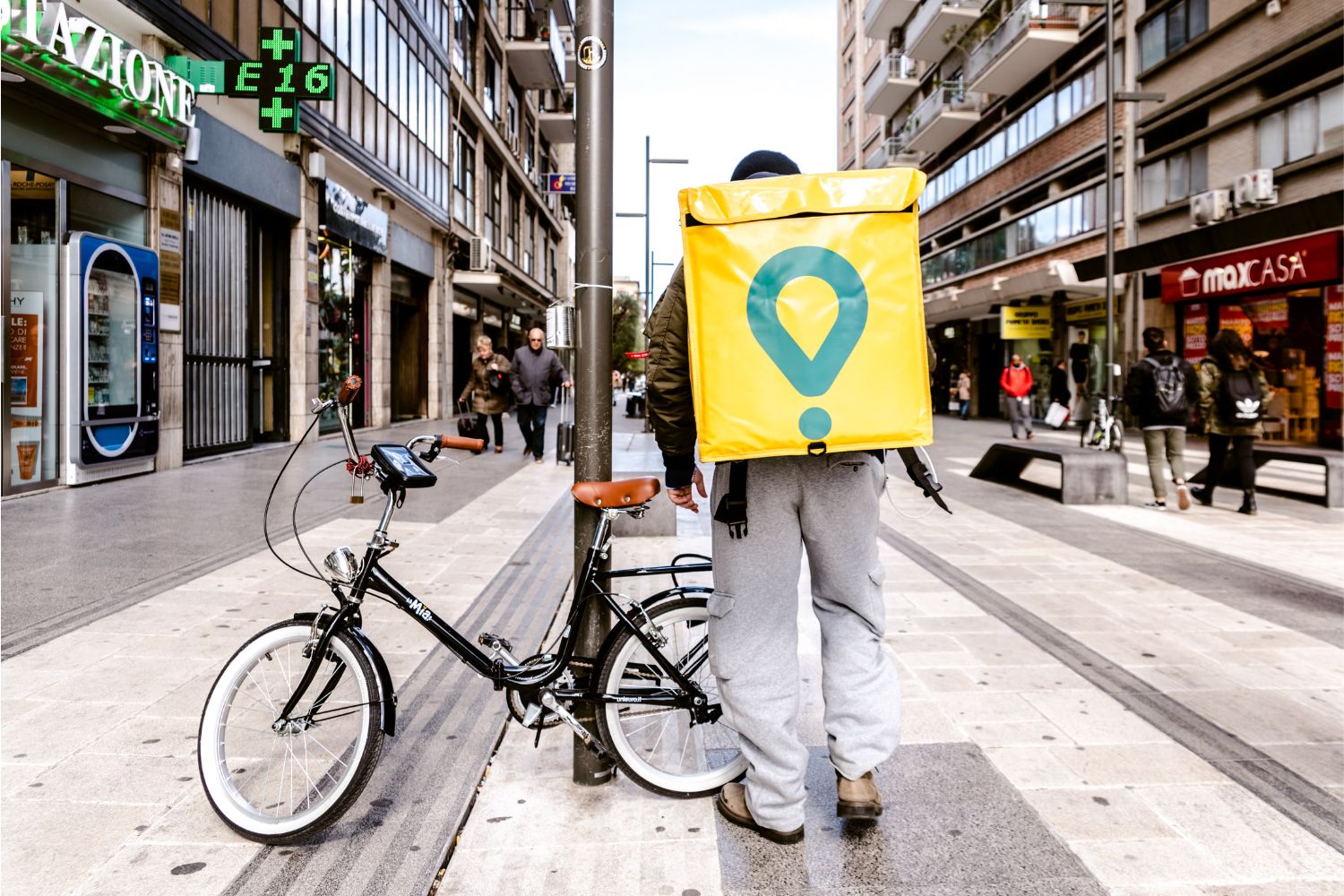
There is a word that often comes up when talking about home deliveries: convenience. An app, a few clicks, food delivered to your home. Everything simple, fast, almost invisible. Much less visible, however, is what happens on the other side of the screen.
An investigation by the judiciary has turned the spotlight on a work system which, according to investigators, would have produced wages below the poverty line, conditions far from national collective agreements and a situation defined as real labor exploitation to the detriment of tens of thousands of riders throughout Italy.
It is the Milan public prosecutor who has in fact urgently ordered judicial control for gangmastering for Foodinho, the delivery company of the giant Glovo. According to the accusation, the riders were paid wages “below the poverty line“, in particular “lower by up to 81.62% compared to collective bargaining“, a sum that “is certainly not proportionate to either the quality or quantity of the work performed in order to guarantee a free and dignified existence and clearly differs from national collective agreements”.
Wages too low for a dignified life
From the reconstructions a precise picture emerges, especially very low delivery fees, in some cases more than 80% lower than what is foreseen by the collective bargaining agreement.
So:
A combination which, according to the prosecution, would not guarantee a free and dignified existence, a basic principle envisaged by the Italian Constitution. The testimonies collected tell, in fact, of a work punctuated by algorithms and continuous geolocalization (every movement is tracked); monitored collection and delivery times; phone calls in case of delays and fewer tasks if orders are rejected or delays accumulate.
In practice, a system that formally presents riders as autonomous but which, in fact, exercises very stringent forms of control. And when something goes wrong – a stolen bike, an accident, a day without orders – the economic risk almost always remains on the shoulders of the worker
The most important aspect of this story is that it goes beyond a single case. It concerns the entire model of the gig economy, based on fragmented and on-call work, with compensation linked to individual performance and very few guaranteed rights as well as a strong dependence on algorithms and digital platforms.
A model that promises freedom but which, without solid rules, risks turning into structural precariousness.
The question we should all ask ourselves
Each delivery tells of a collective choice: how much is the work that makes our comfort possible worth? Low prices and very fast deliveries have a hidden cost. And that cost is often paid by those who cycle in the rain, in traffic, at night. Do we ever realize it?
Talking about sustainability today means not just talking about the environment, but also about rights, equity and social justice. What can change now with this judicial intervention? Let’s hope so, but the real turning point will come when there are stronger rules, effective controls and a different awareness on everyone’s part.
