
From Latin foveathe foibe are the natural sinkholes typical of karst areas, deep cavities today sadly linked to the events that occurred in the former provinces of Trieste, Gorizia, Pola and Fiume, when those sinkholes were used to get rid of those killed in the clashes between Nazi-fascists and partisans, and above all to hide the victims of the waves of mass violence unleashed between 1943 and 1945 by the Slovenian liberation movement and Croatian and the structures of the new Yugoslav state created by Tito.
February 10th is the day of remembrance. But we want to remember the sinkholes – those abysses of natural origin that sink for tens of meters into the subsoil of the Karst, behind Trieste and Gorizia (but also in the surrounding areas, in Istria and Carnaro), through the beautiful pages of Jules Verne and the legends connected to them.
Verne’s Pazin Foiba
It is here that the great French writer sets his Mathias Sandorfan adventure novel initially published in series in the magazine Les Temps and then published as a single text in 1885 by Pierre-Jules Hetzel.
Between islands and cryptograms, futuristic equipment that Verne has accustomed us to and a solitary hero in search of revenge, the father of science fiction, dropped this story between the Pazin Foiba and the Lim Channel (Limski canal). To do this, he used the detailed descriptions of another French writer and traveler, Charles Yriarteand some photographs sent to him by the then mayor of Pazin Giuseppe Cechi.
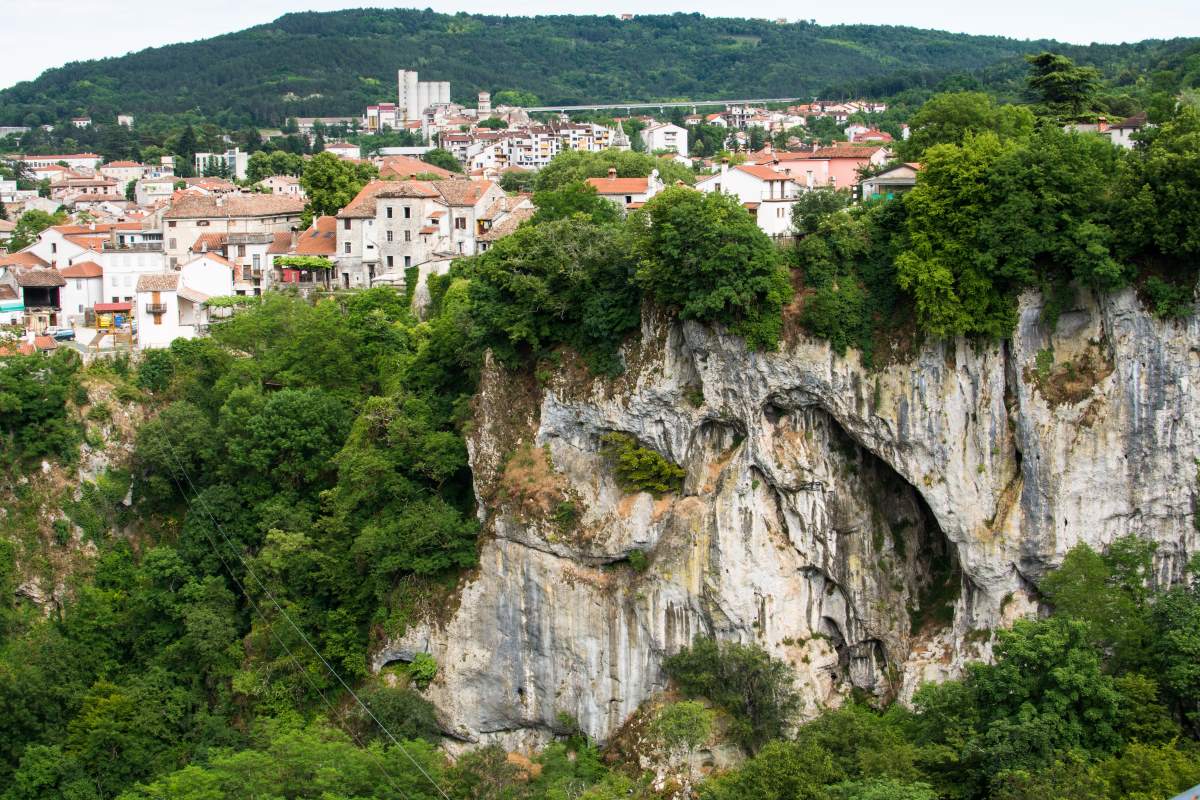
The Pazin foiba, simply called “Foiba” (in Croatian Fojba), is an abyss 100 meters deep and about 20 meters wide. It opens at the foot of the Montecuccoli Castle and the stream of the same name (in Croatian Pazincica) flows into it. To date, it is an important landscape site protected by law including the Foiba canyon and sinkhole and the 270 meter long underground part.
The first speleological explorations began at the end of the 19th century, when the speleologist Alfred Martel made the first drawing, later in the 1960s Mirko Malez he made a more accurate drawing.
The entrance to the cave is located under a cliff almost 200 meters high on which the houses of Pazin stand today. It is accessed through a high and wide cavity topped by a semicircular ceiling. The underground canal extends in a south-west direction, narrowing and widening, creating a long and wide room where there is a siphon lake, Lake Martel.
An unusual play of nature inspired Jules Verne’s imagination which enthralled his characters, the Count Mathias Sandorf and his friends Ethienne Bathory And Ladislav Zathmar, through adventures in the fortress of Pazin and in the Foiba stream, which passed just below the place of their imprisonment. A long and difficult journey in violent waters that take them to the town of Rovinj. But it doesn’t end there: with the typical skill of Verne, the description of a nineteenth-century Trieste and then of the natural quarries, allow you to travel and imagine a wonderful place without comparison.
And the legend
According to popular tradition, this Croatian peninsula was once also inhabited by some giants. Among them, there was Dragonja, a good giant, generous and ready to help everyone. When the men begged him to help them irrigate the land on the southern side of the peninsula, arid and without water sources, the giant ran to attach his enormous plow to a yoke of oxen. He thus furrowed the land creating a canal from the lake to the sea. Here it is: the river Dragonja According to legend, (Dragogna) was born exactly like this.
Immediately afterwards, the giant also plowed a second canal and created the bed of that river Mirna (Quieto), which he named after his wife. But the inaccessible terrain, the karst rock and the depressions all around did not allow him to dig as deeply as he would have liked and when he arrived in the heart of Istria, right in Pazin, the captain regent from the castle walls loudly accused him of not having done his job well.
Feeling accused, Dragonja flew into a rage and chased away the oxen. At that moment, the water began to flow through the unfinished furrow and fill the Pazin basin. The people of the village, fearing the consequences of a flood, then prayed to the giant to intervene and save them from certain death.
Today it is possible to visit “the work of the giant Dragonja” with a speleological adventure which, starting from Pazin Castle, enters the mysterious underground world of the Pazin Foiba.
