
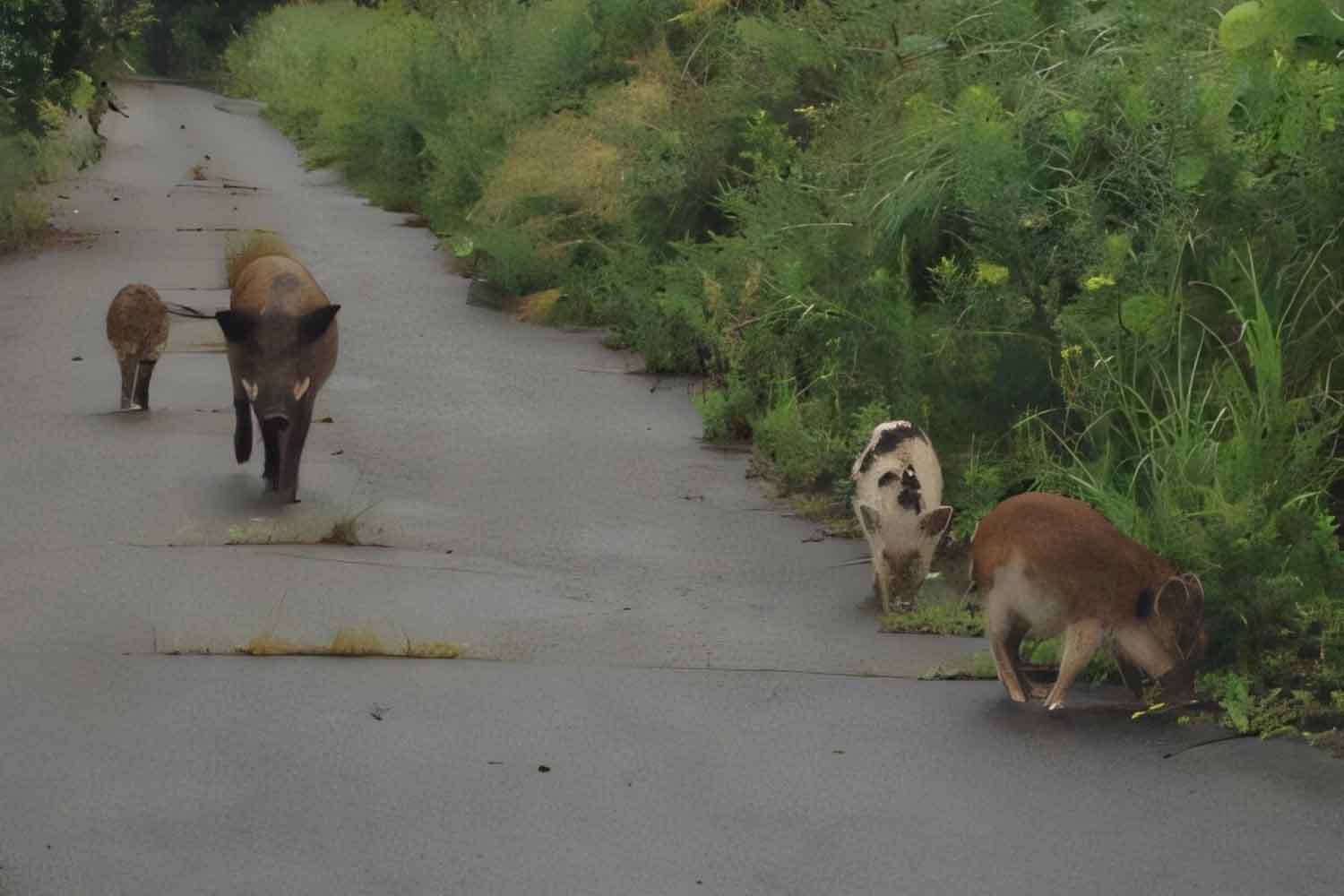
Sometimes it is nature itself, in the silence left by man, that tells us stories we wouldn’t expect. This is what happened in Fukushima after the 2011 nuclear disaster, when agricultural fields and abandoned forests became the scene of a rare and surprising phenomenon: the birth of wild boar-pig hybrids in Fukushima, animals that today help science better understand how genetic evolution works in extreme conditions.
Research led by Fukushima University has analyzed this unique case, showing how the escape of domestic pigs and their interbreeding with wild boars gave rise to a true natural experiment, with useful results far beyond the borders of Japan.
When man disappears and wildlife takes over again
After the accident at the Fukushima Daiichi Nuclear Power Plant, entire areas were evacuated. Without breeders, controls and fences anymore, many domestic pigs escaped from farms and entered the woods and fields left to their own devices. Here they encountered wild boars, already present and ready to take advantage of the human absence.
No new animal introductions, very little human activity and a suddenly “free” territory: extremely rare conditions that have allowed scientists to observe what really happens when two populations interbreed without external interference. An open-air laboratory, born from a tragedy.
The study, published in the Journal of Forest Research, was coordinated by Professor Shingo Kaneko, with the collaboration of Dr. Donovan Anderson. And the result is anything but intuitive.
We tend to think that hybridization with domestic animals leaves a lasting and problematic genetic imprint. In this case, however, the opposite happened. The researchers found that maternal lines of domestic pigs accelerated generational turnover, contributing to a rapid dilution of pig genes within wild boar populations.
The reason lies in reproductive biology. Domestic pigs reproduce faster and throughout the year, while wild boars have seasonal breeding cycles. This characteristic, transmitted maternally, remained active even after escaping into the wild.
By analyzing mitochondrial DNA, which is inherited only from the mother, and nuclear genetic markers, the team studied 191 wild boars and 10 domestic pigs, collected between 2015 and 2018. The data shows that the animals with “pig mothers” already had very few domestic genes, despite hybridization having occurred only a few years earlier. In many cases more than five generations had already passed since the initial crossing.
In other words, nature was quick to “reabsorb” the anomaly.
Not just Fukushima
Scientists are keen to point out: Fukushima is an extreme case, but the mechanism observed could be the same wherever feral pigs and wild boars coexist. And it’s not just good news for those who study genetics.
Understanding how genetic turnover occurs also helps predict population growth and possible damage to ecosystems. In a world where feral pigs are increasingly widespread, this information can become concrete tools for managing wildlife and protecting biodiversity.
The story of the boar-pig hybrids in Fukushima reminds us that nature is resilient, adaptive and often faster than we imagine. Even after a nuclear disaster, it continues to evolve, finding solutions that challenge our certainties.
You might also be interested in:
