
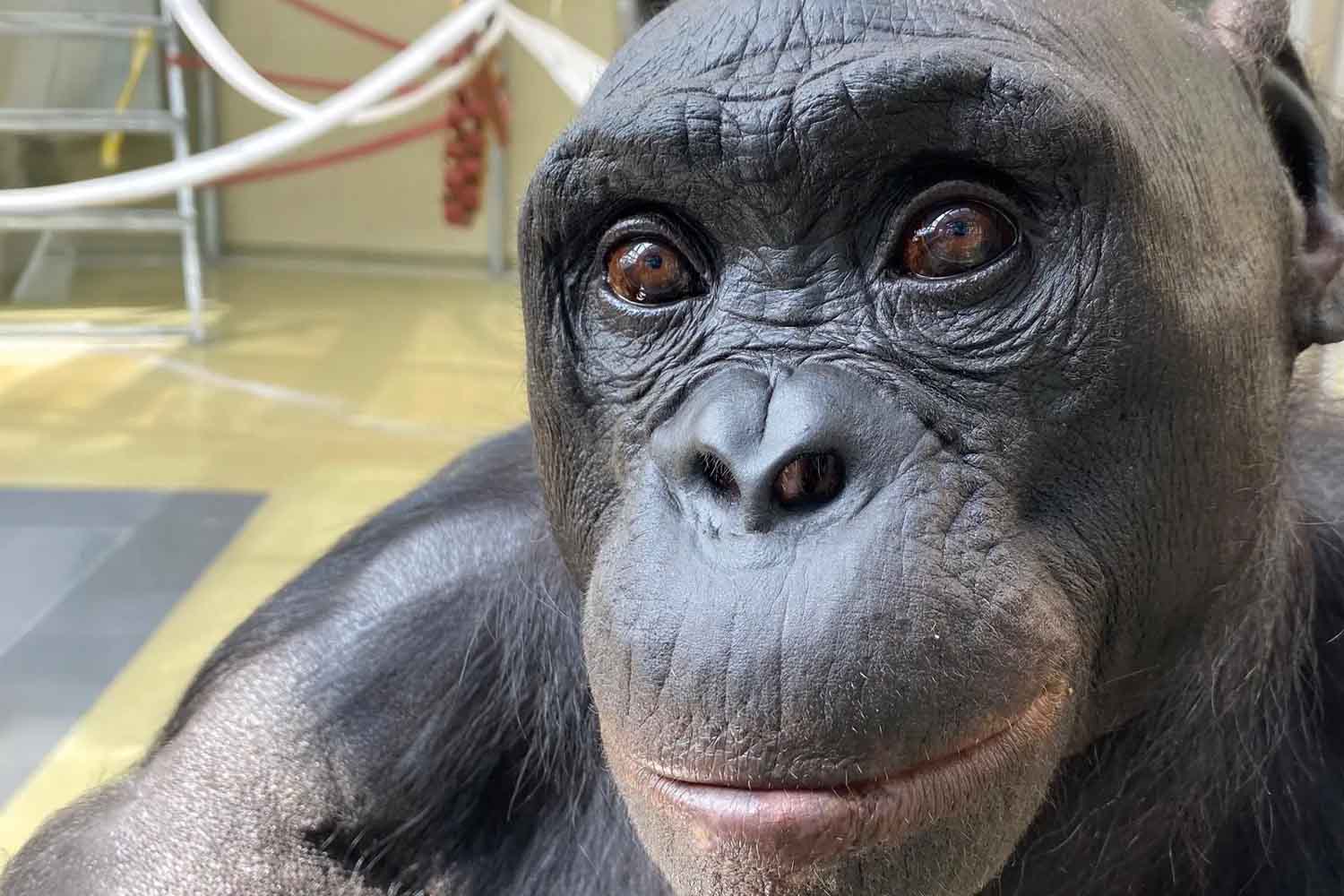
Imagination in bonobos could be much more than a scientific curiosity: it could be proof that we are not the only ones on this planet who also live in the world of the unseen.
This is suggested by a study published in the journal Science and conducted by researchers at Johns Hopkins University. At the center of the research is Kanzi, a 43-year-old bonobo who lives at the Ape Initiative. He is not just any specimen: for years he has been known for his ability to understand verbal stimuli and communicate by pointing to objects.
This time, however, he did something that changes the cards on the table.
The experiment on symbolic play
The researchers chose a simple, almost domestic context. A scene reminiscent of the classic children’s pretend tea game: empty cups, a transparent jug, no real drink. The experimenter pretends to pour juice into two cups. Then he pretends to empty one, shaking it to “show” that it no longer contains anything. At that point he asks Kanzi a direct question: “Where’s the juice?”.
Kanzi indicates, in most cases, the cup which, in the imaginary game, should still contain the invisible drink. It is not an isolated gesture. Even when the cups are moved on the table, the bonobo continues to follow the logic of the invented scene.
To avoid ambiguous interpretations, the researchers introduced a decisive variant: one cup actually contained juice, the other only “pretend” juice. When asked which he preferred, Kanzi almost always chose the real juice. A sign that he wasn’t confusing fantasy and reality. He was managing both.
A third experiment replicated the pattern with grapes. The examiner pretends to take a grape from an empty container and place it in one of two jars. After simulating emptying one, he asks: “Where are the grapes?”. Once again, Kanzi points to the correct jar according to the imagined scene.
He didn’t answer correctly in every single attempt, of course, but the coherence of his answers was enough to speak of a real capacity for mental representation.
Because Kanzi changes the way we look at other animals
For years we have considered imagination a human prerogative. Children begin to play “pretend” around the age of two and already show surprise at 15 months when an adult pretends to drink from an empty cup. But until now, no one had demonstrated in a controlled way that a non-human primate could follow non-existent objects in a coherent sequence.
Yet, observations in nature had already sparked some suspicion: young chimpanzees treating sticks like newborns, symbolic behavior in captivity. Experimental proof was missing. According to researchers, the roots of imagination in bonobos may trace back to a common ancestor that lived between six and nine million years ago. In other words, the ability to go beyond the “here and now” may not have arisen only with Homo sapiens.
Christopher Krupenye, one of the authors of the study, spoke of a result that forces us to rethink the mental life of animals. If a bonobo is able to conceive of something that is not physically present and, at the same time, know that it is not real, then its mind is not anchored only in the immediate.
And here the question is no longer just scientific.
If we share fragments of imagination with them, if they are capable of representing what is not there, then perhaps they are also capable of desiring, anticipating, remembering with a depth that we do not yet fully understand. Continuing to consider them creatures guided only by instinct becomes increasingly difficult.
Imagination in bonobos is not a side note in ethology textbooks. It’s a crack in our idea of uniqueness. And, as often happens when nature resembles us more than expected, that crack forces us to ask an uncomfortable question: are we really that different?
You might also be interested in:
