
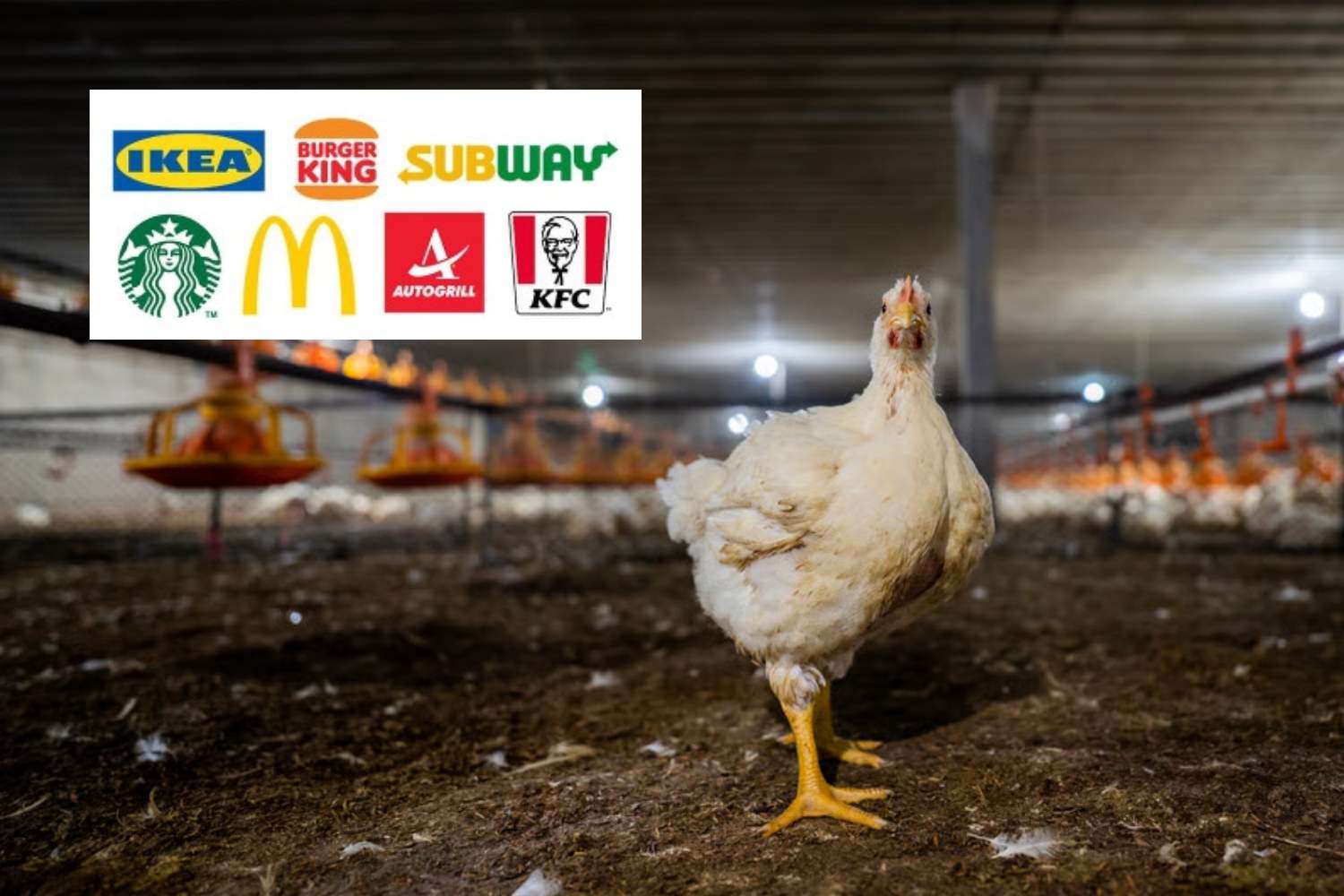
The new annual report of The Pecking Order photographs a disheartening reality for our country: Italy is second to last in Europe for the commitment of fast food and restaurant chains to protecting the welfare of chickens along their production chains. A result which, although a slight improvement compared to 2024 – when we were actually last – leaves very little room for optimism.
Since 2019, The Pecking Order monitors every year the public policies adopted by large catering brands in relation to the European Chicken Commitment (ECC): a set of criteria aimed at raising the minimum living standards of broiler chickens on farms. Among the parameters considered are the reduction of density in the sheds, the use of genetically less precocious breeds, the environmental enrichment of the structures and the adoption of more respectful slaughter techniques.
The 2025 edition — created in collaboration between World Animal Protection, Humane Society International, Obraz andessereanimali — examined 81 companies in seven European countries: Denmark, France, Italy, Poland, the Czech Republic, Romania and Sweden. For Italy, Autogrill, Burger King, IKEA, KFC, McDonald’s, Starbucks and Subway ended up under the microscope.
The European ranking
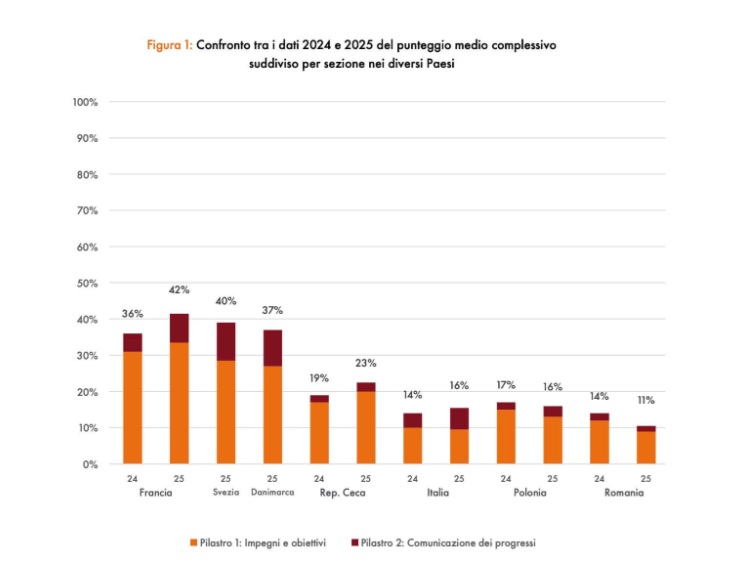
France confirms its lead in terms of commitment to animal welfare with 42%, followed by Sweden at 40% and Denmark at 37% – the latter participating in the report for the first time and already among the leaders. The Czech Republic stands at 23%, while Italy and Poland both stop at 16%, ahead only of Romania with 11%.
As Being Animals points out, “The data emerging from The Pecking Order report is deeply alarming”: while France advances at a pace three times higher than ours and the Czech Republic at double speed, the Italian restaurant sector shows “a structural stagnation that is difficult to ignore”.
What makes the national picture even more bitter is the fact that, of the seven companies analysed, six – Autogrill, Burger King, KFC, McDonald’s, Starbucks and Subway – have not adopted any public policy on animal welfare nor communicate concrete progress in this sense. The only exception is IKEA, which for years has structured an approach aimed at eliminating the main critical issues.
The KFC Italia case
In the already critical panorama of Italian chains, KFC stands out as a particularly significant case. With a turnover of 179 million euros and the declared ambition of opening over 200 stores by 2027, the company represents a major player in the national market. Yet it is the only European branch of the KFC Western Europe group that has not made explicit commitments to ECC — a stark contradiction to what the company has already done in France, Sweden and Denmark.
The report also highlights a worrying fact: between 2022 and 2023, KFC Italia drastically reduced the use of slower-growing breeds, going from 7.21% to 0.9% of the total. A choice which, according to the organizations promoting the report, has contributed to increasing both mortality on farms and the use of antibiotics.
Meat chickens represent the largest category of farmed animals in the world, and the conditions in which they grow have direct consequences not only on their well-being, but also on public health – in particular on the phenomenon of antibiotic resistance – and on the environmental sustainability of intensive farming.
That large restaurant chains have the power — and the responsibility — to drive change in the sector is demonstrated precisely by the countries that lead the ranking today. Italy can and must do more: Italian consumers deserve the same transparency and guarantees that some European colleagues are already getting.
Sources: Humane World for Animals /Being Animals
