
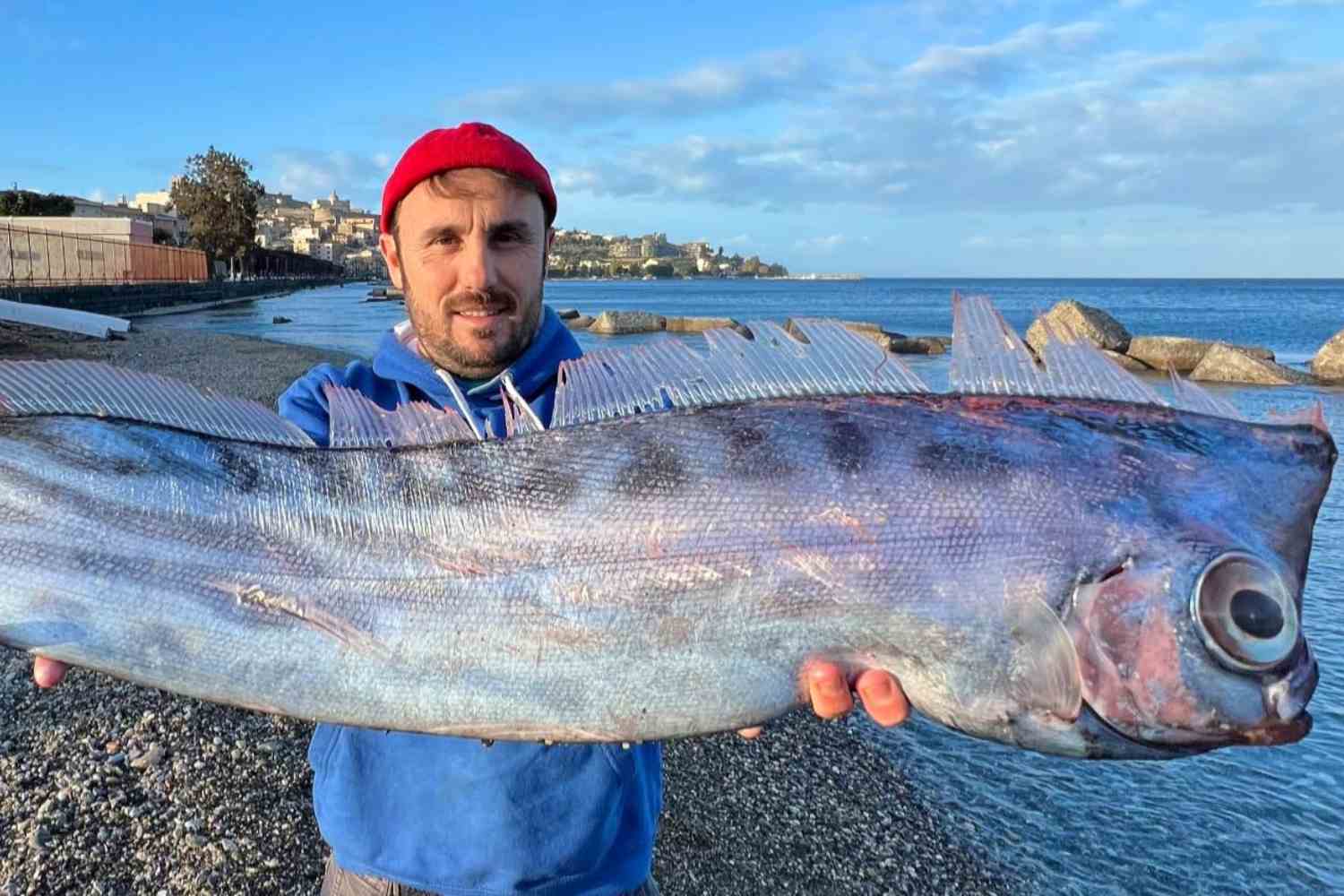
On the beach of the Tennis and Sailing Club of Milazzo, in the province of Messina, the sea has deposited an unexpected guest, a creature that rarely allows itself to be observed. This is the unicorn fish – Lophotus lacepede, a mesopelagic species that lives in the intermediate and deep layers of the sea and which has very few reports in the Mediterranean.
The discovery immediately attracted the attention of experts for its scientific value. The specimen, still alive at the time of the stranding, was rescued in an attempt to bring it back into the water, but unfortunately it did not survive. A rare event that opens a window onto normally invisible ecosystems.
The race of biologists and scientific analyses
The biologist Carmelo Isgró, director and founder of MuMa – Museo del Mare Milazzo, intervened on site, together with Alessandro Magistri and Gianni D’Angelo who promptly reported the presence of the animal. After recovery, the specimen was transferred to the Anton Dohrn Zoological Station in Messina, where Isgró and the researcher Pietro Battaglia are carrying out the relevant analyses.
The objective is to understand the conditions that brought one of the most enigmatic fish of the Mediterranean basin to the shoreline. Once the studies have been completed, the animal will be displayed in a museum at the MuMa, inside the Milazzo Castle, and at the Fauna Museum of the University of Messina, becoming concrete evidence of the abysmal biodiversity.
A body of a mythological creature
The nickname “liocorno” recalls the idea of a marine unicorn. In fact, a protuberance that resembles a horn stands out on its head, a detail that contributes to its almost legendary aura. The body is elongated and ribbon-shaped, tapering towards the tail and has a long red dorsal fin that runs along almost the entire back, made up of flexible rays. The anal and caudal fins are tiny, while the enormous eyes reveal adaptation to the darkness of the abyss. The conical teeth, arranged in three irregular rows, are perfect tools for catching small pelagic organisms.
Upon stranding, the animal emitted a jet of thick liquid from an internal sac, a defensive strategy reminiscent of that of cephalopods. A detail that adds further biological interest to an already extraordinary discovery. The sea, once again, has returned a fragment of its mysteries.
You might also be interested in:
