
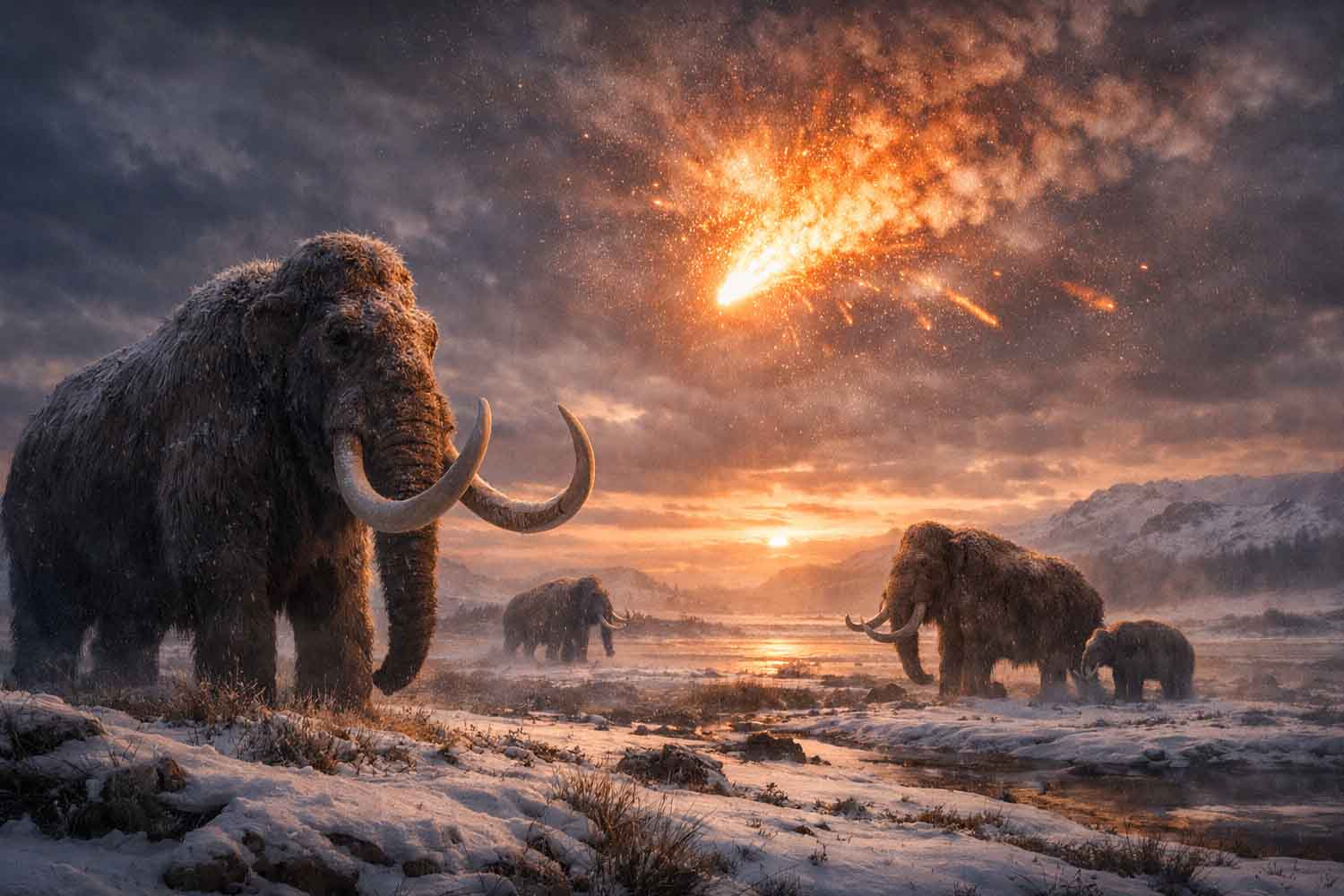
About 13 thousand years agothe Earth changed its face in a sudden, almost brutal way. Gigantic animals, perfectly adapted to the cold and capable of resisting for millennia, disappeared in a very short time. Among them were the mammoths, absolute protagonists of the ice age. At the same time, also the Clovis culturerecognizable for its stone tools, stops appearing in archaeological finds in North America. A coincidence that has been putting scholars in difficulty for decades.
The slowly changing climate is not enough to explain such a rapid collapse. Too fast, too extensive. And it is precisely from this fracture in the scientific story that a new hypothesis is born, now strengthened by concrete data and published in the journal PLOS One. A hypothesis that looks to the sky, rather than to the Earth.
An explosion in the atmosphere would have disrupted life on the planet in record time
The study is led by the geologist James Kennettfrom the University of California at Santa Barbara, together with an international group of researchers. The idea is as fascinating as it is disturbing: a great one fragmented comet it would have exploded in the Earth’s atmosphere, without hitting the ground, but releasing enormous energy over vast areas of the planet.
Not a classic impact, therefore, but a airbursta low-altitude explosion capable of generating very violent shock waves and extreme temperatures. Events of this type can devastate entire ecosystems without leaving obvious craters, making evidence difficult to detect even thousands of years later.
For this reason the researchers did not look for large visible signs, but tiny trackshidden in the sediments. They analyzed three key archaeological sites related to the Clovis culture: Murray Springs in Arizona, Blackwater Draw in New Mexico and Arlington Canyon in California’s Channel Islands. All three tell of the same historical moment: the one in which large Ice Age animals and Clovis tools stop appearing.
From space to frost
The data collected coincides with the beginning of Younger Dryasan anomalous climatic phase in which, after the onset of post-glacial warming, temperatures suddenly plummeted. For about a thousand years, the planet returned to almost glacial conditions, putting already fragile natural environments in crisis.
According to the researchers, the comet’s explosion would have triggered continental-scale firesraising enormous quantities of dust and soot into the atmosphere. The sunlight would have been shielded, giving rise to a sort of sudden winter. In parallel, the accelerated melting of ice would have poured large masses of fresh water into the oceans, altering currents and amplifying climate instability.
In such a scenario, finding food would have become increasingly difficult for mammoths. Even human communities, like those of Clovis, would have found themselves living in a hostile environment, marked by cold, fires and rapidly declining resources.
One of the most interesting clues is the so-called black mata dark layer of sediment present at numerous sites in North America and also in Europe. It is rich in carbon, a clear sign of widespread fires. Added to this are anomalous concentrations of platinum and iridiumelements that are rare on Earth but common in cosmic bodies, together with nanodiamonds and tiny metallic spherules formed from materials that are melted and cooled very quickly.
Among all the tests, however, there is one that weighs more than the others: the “shocked quartz”, the “shocked” quartz. These are grains of sand with microfractures that can only form under extreme pressures and temperatures, impossible to achieve with natural fires, lightning or volcanic activity. Electron microscopic analyzes even showed traces of fused silica, an unmistakable signature of an off-scale energetic event.
The absence of a large crater, at this point, is no longer a problem. Airbursts release their destructive force above the surface, obliterating forests, animals, and habitats without leaving visible wounds in the ground.
By putting all these clues together, the picture becomes coherent. According to the study, the explosion of a comet in the atmosphere would have represented a key factor in the extinction of mammoths and in the collapse of the Clovis culture, contributing to the initiation of the Younger Dryas. Not the only cause, perhaps, but a spark capable of accelerating a change already underway, with devastating effects on life on the planet.
