
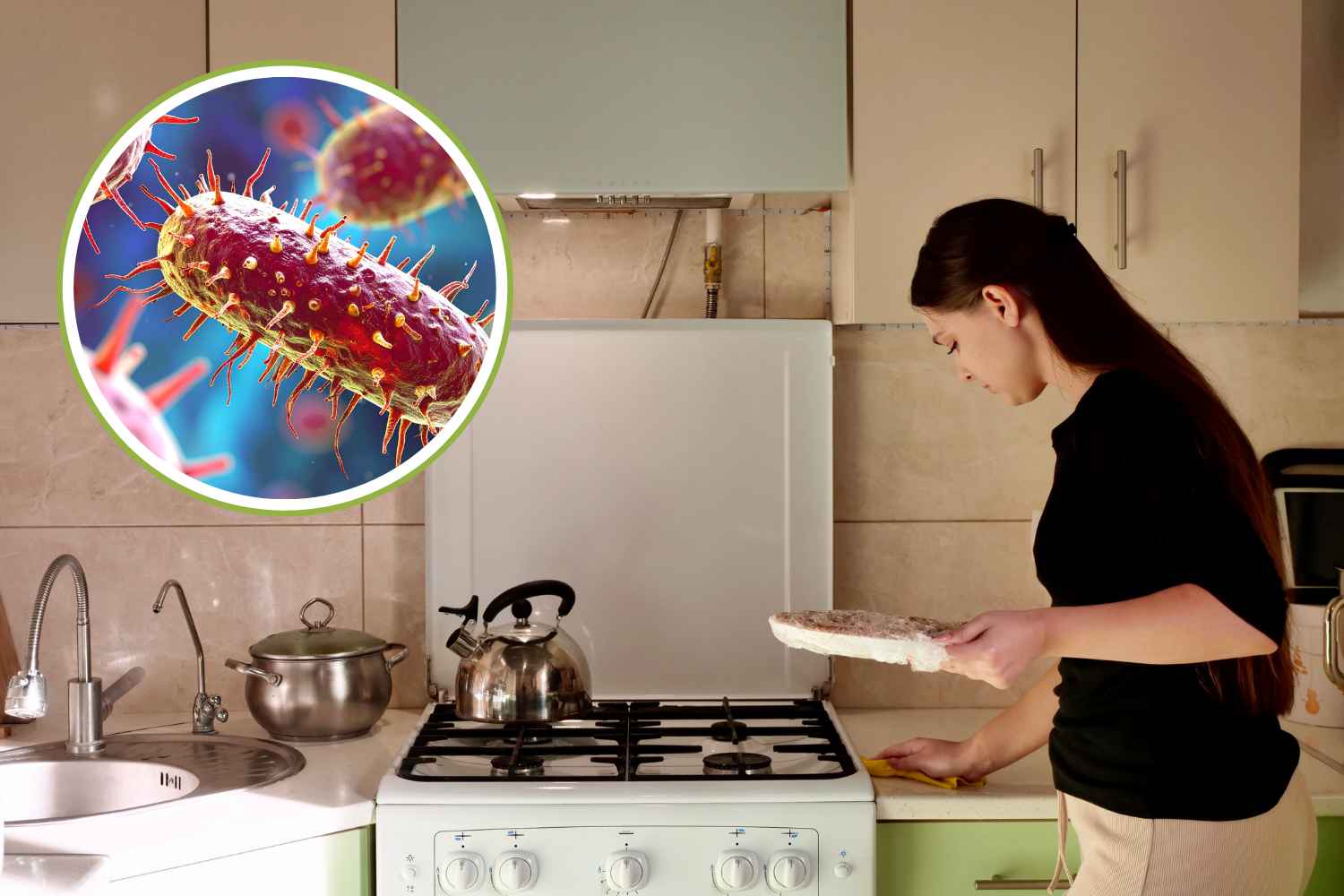
When we think about dirt in the house, our mind immediately goes to the toilet. It is the object we most easily associate with germs, contamination and disgust, but this idea is misleading. The toilet is cleaned quite regularly, often using strong detergents and specific disinfectants. Precisely because we consider it dangerous, we treat it with great care. Paradoxically, in many homes the toilet is cleaner than surfaces we touch every day without thinking about it. The real problem is not where we imagine there is dirt, but where we ignore it.
Kitchen sponges, an invisible ecosystem
The sponge we use to wash dishes and surfaces is one of the most contaminated objects in the house. It stays moist for hours, traps food residue and is rarely changed. This creates an ideal environment for bacteria to thrive. Every time we use it to “clean”, we actually risk spreading microorganisms on dishes and worktops. It is a hygienic short circuit: what should eliminate dirt becomes the main vehicle of domestic contamination.
The cutting board, crossroads of food and bacteria
The cutting board, especially if made of plastic or wood marked by knives, retains tiny organic residues that are difficult to remove. Here raw meat, vegetables, bread and cheese are mixed. Without proper separation and sanitization, the risk of cross-contamination is real. Unlike the toilet, which is disinfected with specific products, the cutting board often only receives a quick rinse. But the foods we eat pass precisely over this surface: a significant detail.
The remote control, the most touched and least washed object
Few things are handled as much as the television remote control. Dirty hands, snacks consumed on the sofa and daily use by multiple people make it a real receptacle for germs. Yet, despite everything, it is rarely included in the cleaning routine. Its surface, with all those cracks between the keys, becomes an ideal refuge for dirt accumulated over time. It’s a clear example of how our perception of risk can be distorted: what doesn’t seem dirty tends to be overlooked.
Light switches and handles, continuous contact points
Every day we touch switches and handles dozens of times. These shared surfaces are crossed by hands returning from outside, from those who have cooked, or from those who have coughed or sneezed. Yet, during routine cleaning, they are often ignored. Their invisible function makes them almost transparent to our eyes. In fact, they are among the main vehicles of microbial spread within the home.
The cell phone, dirtier than any domestic surface
We take it everywhere: in the bathroom, on public transport, at the table, on the bed. We place it on dirty surfaces and then bring it closer to the face. The phone accumulates bacteria in surprising quantities, precisely because we don’t consider it an object to be cleaned. It is one of the clearest examples of how everyday technology has created new hygienic gray areas in our domestic habits.
Sofa cushions, reservoirs of dust and microorganisms
The sofa is synonymous with relaxation, but rarely with deep cleaning. Pillows absorb sweat, dead skin cells, pet hair and dust. Without periodic washing, they become an ideal environment for mites and bacteria. The problem is not immediately visible, but slowly accumulates over time. Once again, what appears harmless may be more contaminated than the bathroom.
The shower curtain, the constant humidity and the mold
Unlike the toilet, which is regularly cleaned with detergents, the shower curtain tends to be neglected. Persistent humidity creates an ideal environment for mold and bacterial biofilms. Even when it looks clean, it can hide invisible colonies developing in the lower creases. It is a classic example of “silent” dirt, thriving away from our eyes.
The toothbrush and his glass
Paradoxically, the object we use for our oral hygiene can become a real receptacle for germs. If we keep it near the toilet or in a container that we don’t wash often, the toothbrush is at risk of contamination. Humidity favors the growth of bacteria, especially if we do not let it dry well. It is an obvious domestic contradiction: what we use to clean ourselves may not be clean at all.
The refrigerator, cold but not sterile
Cold slows bacterial growth, but does not eliminate it completely. Refrigerator shelves, drawers and seals can accumulate liquids, food residue and mold. We often only clean it when something falls or starts to smell. Meanwhile, fresh foods can come into contact with contaminated surfaces. The low temperature creates an illusion of safety that does not reflect microbiological reality.
Because we ignore the invisible dirt
The problem is not so much the quantity of bacteria, but our perception. We tend to clean what seems visually or culturally dirty to us, rather than what poses a real health risk. The toilet symbolizes dirt, so it receives constant attention. Everyday objects, on the other hand, seem harmless and are neglected. This discrepancy between perception and reality is the real problem with modern home cleaning.
Rethink daily cleaning
Becoming aware of those overlooked areas means taking a new approach. We don’t need obsessions or disinfectants at every corner, but rather greater attention to the surfaces we touch most frequently. Effective cleaning isn’t just what catches the eye: it’s above all about what we don’t see. Ultimately, domestic hygiene is not just a question of appearance, but of invisible habits.
Beyond disgust, towards a truly healthy home
Thinking of the toilet as the dirtiest place in the house is comforting, because it gives us a clear enemy to face. Accepting that dirt lurks in everyday objects is more uncomfortable, but also more realistic. A truly clean home isn’t one that smells like detergent, but one where the most used surfaces get the attention they deserve. It is a simple change of perspective, but fundamental for the health of those who live there.
