
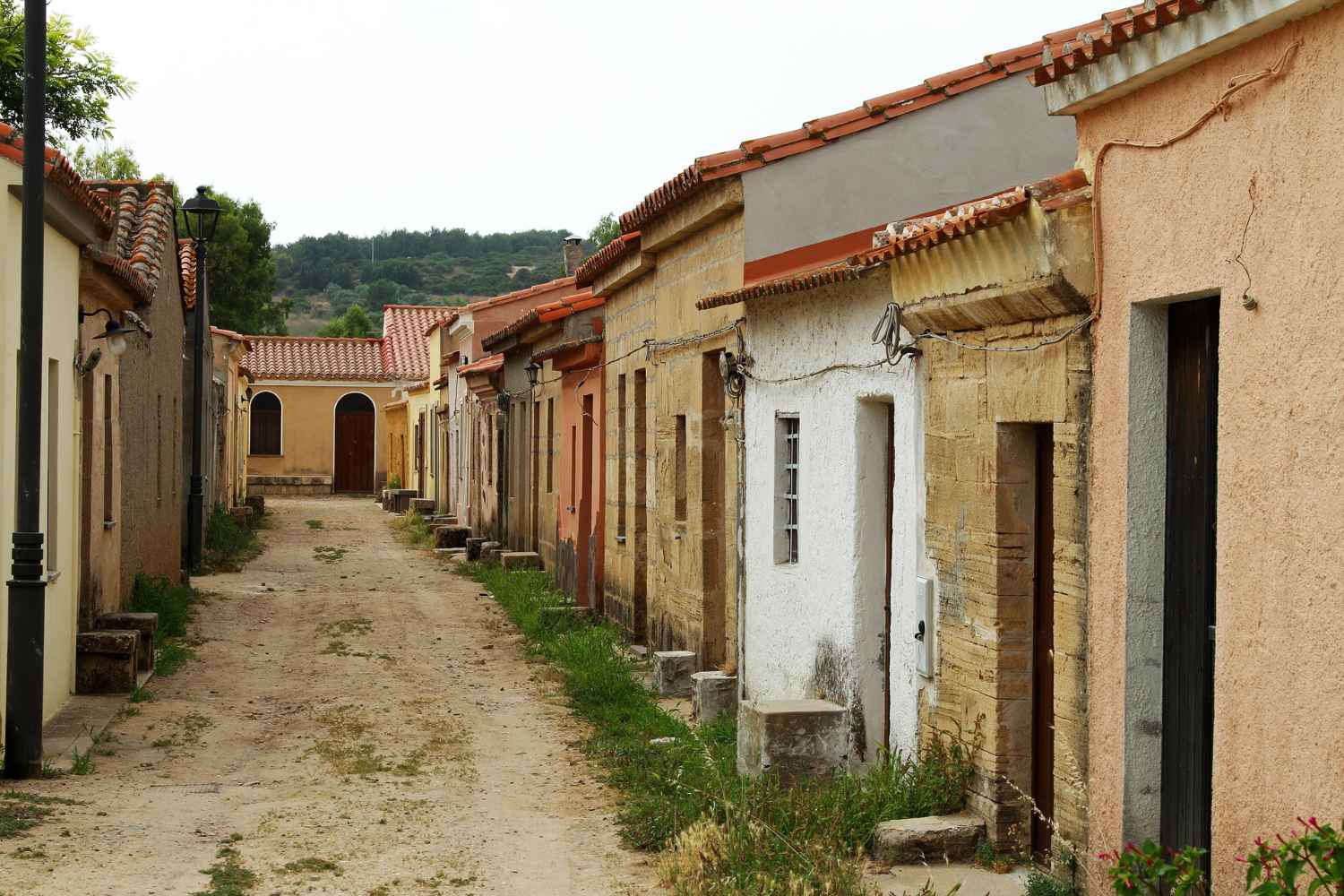
Imagine walking on a dirt road, surrounded by absolute silence. The low houses with stone walls follow one another on the sides, the splintered wooden doors creak in the wind, the dust rises with every step. All that’s missing is a horse tied to a pole and the distant sound of an out-of-tune piano coming out of a saloon to convince you that you’re in the heart of the American Wild West. But no, you are not in Texas or Arizona, you are in Sardinia, in San Salvatore di Sinis, one of the most fascinating and surreal villages in Italy.
This small village in the province of Oristano, part of the municipality of Cabras, is a place that seems to have come straight out of a Sergio Leone film. And it is no coincidence: between the Sixties and Seventies, when spaghetti westerns were all the rage at the cinema, San Salvatore di Sinis became one of the favorite sets of Italian directors, transforming itself for over twenty years into a perfect double of Mexican and Texan villages.
The ghost village that comes to life
View this post on Instagram
San Salvatore di Sinis is an almost completely uninhabited village. For much of the year, its streets remain empty, the windows of the houses closed, time seems to have stopped. Only a handful of residents live here permanently, making the village a true ghost town that retains the charm of a bygone era intact.
The cumbessias – this is the name of the characteristic one or two-storey houses – were built in the 17th century during the Spanish domination as accommodation for pilgrims who came to pay homage to the patron saint of the village. These unadorned homes, with their thick sandstone walls and wooden portals, create a frontier atmosphere that has won over the directors of Italian western cinema.
When you visit San Salvatore di Sinis, you immediately perceive that same cinematic tension of the great classics of the genre. You look around half expecting to see a cowboy pop around the corner or a tumbleweed roll down the main street. The total absence of modern elements – no antennas, no neon signs, no parked cars – makes the illusion perfect.
View this post on Instagram
A thousand-year-old place
San Salvatore di Sinis is not just cinema. Behind the western set façade lies a place that has its roots in a thousand-year history, which began already in the Nuragic era. In the center of the village is the Church of San Salvatore, built in the 17th century, but the real wonder is underground. Going down a staircase you enter a hypnotic hypogeum, an underground sanctuary dug into the rock, much older than the church above it.
Here we read an extraordinary stratification of cults and civilisations. Originally, in the Nuragic era, the sanctuary was linked to the cult of water and in the center there was a sacred well. With the arrival of the Punics, the space was consecrated to Sid, a healing deity, and under the Romans the cult was transformed again, passing to Asclepius, the god of medicine. Even the Arab world has left a mark: an Arabic inscription is visible on one wall, probably dating back to a medieval Saracen incursion.
Walking in these underground environments, among inscriptions in Greek, Latin and Arabic, is not a romantic suggestion: it is concrete proof of how this place was sacred to different peoples, in different eras, without ever losing its spiritual function. The sacred well is even below sea level and a crack in the ceiling allows light to filter from above, creating a visual and symbolic connection between the underground world and the church. It is one of those places that do not tell a single story, but all together, overlapping, alive, impossible to separate.
Hollywood? No, a Sardinian Cinecittà
Between 1967 and 1990, San Salvatore di Sinis transformed into a typical place of the Italian Far West. The natural features – between dirt roads, barren hills behind, and simple and essential architecture – made it the perfect set for western films, without having to cross the ocean.
Several spaghetti westerns were filmed here, including:
It is rumored that Sergio Leone also filmed some scenes of the legendary “A Fistful of Dollars” in San Salvatore di Sinis, although there is no official confirmation. But just walk around the village to understand why this legend persists: every corner seems tailor-made for a western scene.
During those golden years, the village came alive with film crews, actors and extras. The old village bar was transformed into an authentic saloon with the typical swinging doors, and even today you can see this structure, perfectly preserved, which continues to evoke the era of western cinema.
The barefoot race
There is a magical moment a year when San Salvatore di Sinis awakens from his sleep: the first weekend of September, on the occasion of the Corsa degli Scalzi.
This event is one of the most exciting and heartfelt in Sardinia. Over 800 faithful – called curridoris – wear a white habit and run barefoot for about 9 kilometers along the dirt road that connects Cabras to the village, carrying the simulacrum of San Salvatore.
The race starts at dawn on Saturday from the church of Santa Maria Assunta in Cabras and reaches San Salvatore di Sinis. The following day, Sunday, the procession is repeated in reverse, bringing the statue back to the parish church of Cabras.
The legendary origin
The tradition was born from an event in 1619. According to legend, a group of fishermen who inhabited the village were surprised by an imminent Saracen invasion. To save the precious statue of San Salvatore, they ran barefoot to Cabras. With an ingenious cunning, they tied branches to their feet to raise as much dust as possible and give the impression of being a large army. The trick worked: the Saracens, convinced that they were facing superior forces, decided to retreat.
Since then, the race has been repeated every year to commemorate that miraculous rescue and to renew popular devotion towards the patron saint. During the two days of celebration, the ghost village is completely transformed: the houses are reopened, families return to live there temporarily, processions, traveling shows (such as the Tumbarinos of Gavoi), fireworks and concerts are organised. It is the only moment in which San Salvatore di Sinis returns to being a living and breathing village.
How to reach this village
San Salvatore di Sinis is located on the Sinis peninsula, on the western coast of Sardinia. To reach it from Cabras, follow provincial road 6 that runs alongside the pond, the village is about 9 kilometers from Cabras, along the road you will find signs for the beaches of Is Arutas and for the archaeological site of Tharros.
The village can be visited all year round, although temperatures can be scorching in summer. If you want to live a unique experience, plan your visit for the first weekend of September, on the occasion of the Corsa degli Scalzi, when the village comes alive and you can witness one of the most authentic traditions of Sardinia.
What to see in the surrounding area
The Sinis peninsula offers much more than San Salvatore:
Is Arutas beach
One of the most beautiful beaches in Sardinia, famous for its quartz grains instead of sand, which create an extraordinary chromatic effect with white, pink and green shades.
Tharros
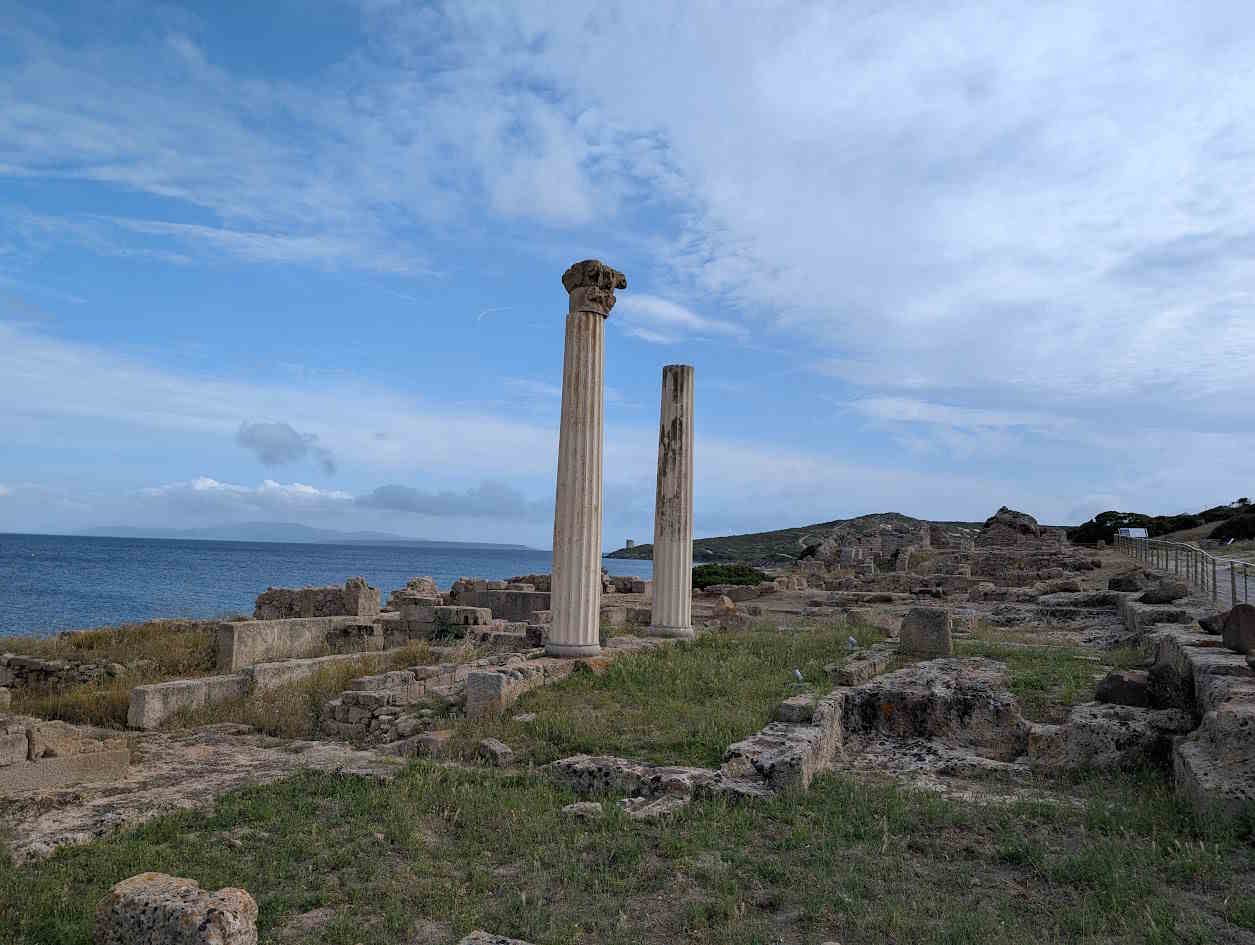
The ancient Phoenician-Punic and then Roman city preserves fascinating ruins: temples, paved streets, baths and a necropolis. The panoramic position on the coast makes the visit even more suggestive.
Archaeological Museum of Cabras
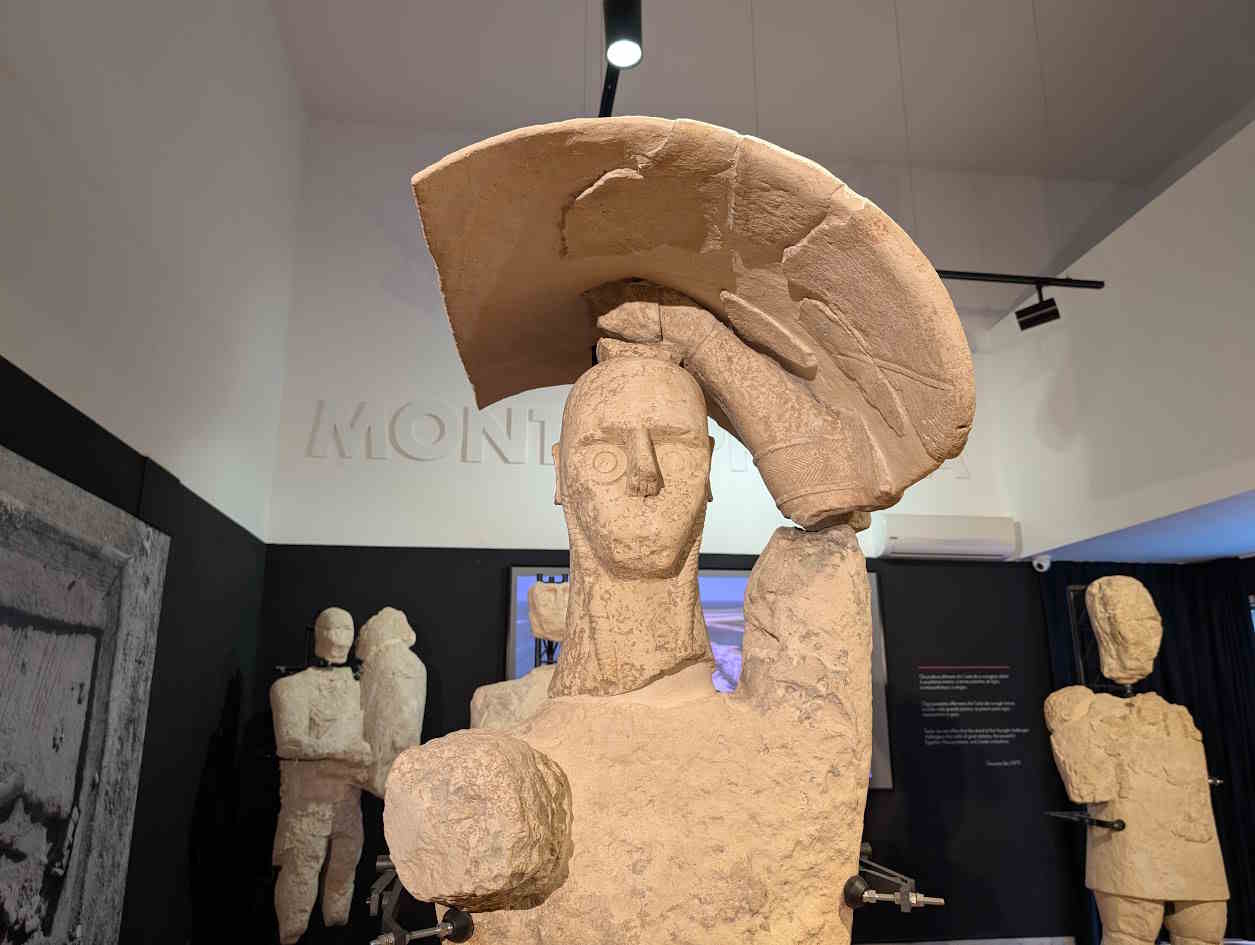
Here you can admire the famous Giants of Mont’e Prama, imposing Nuragic statues over two meters high representing warriors, archers and wrestlers. They are among the oldest in the round statues in the Mediterranean.
