
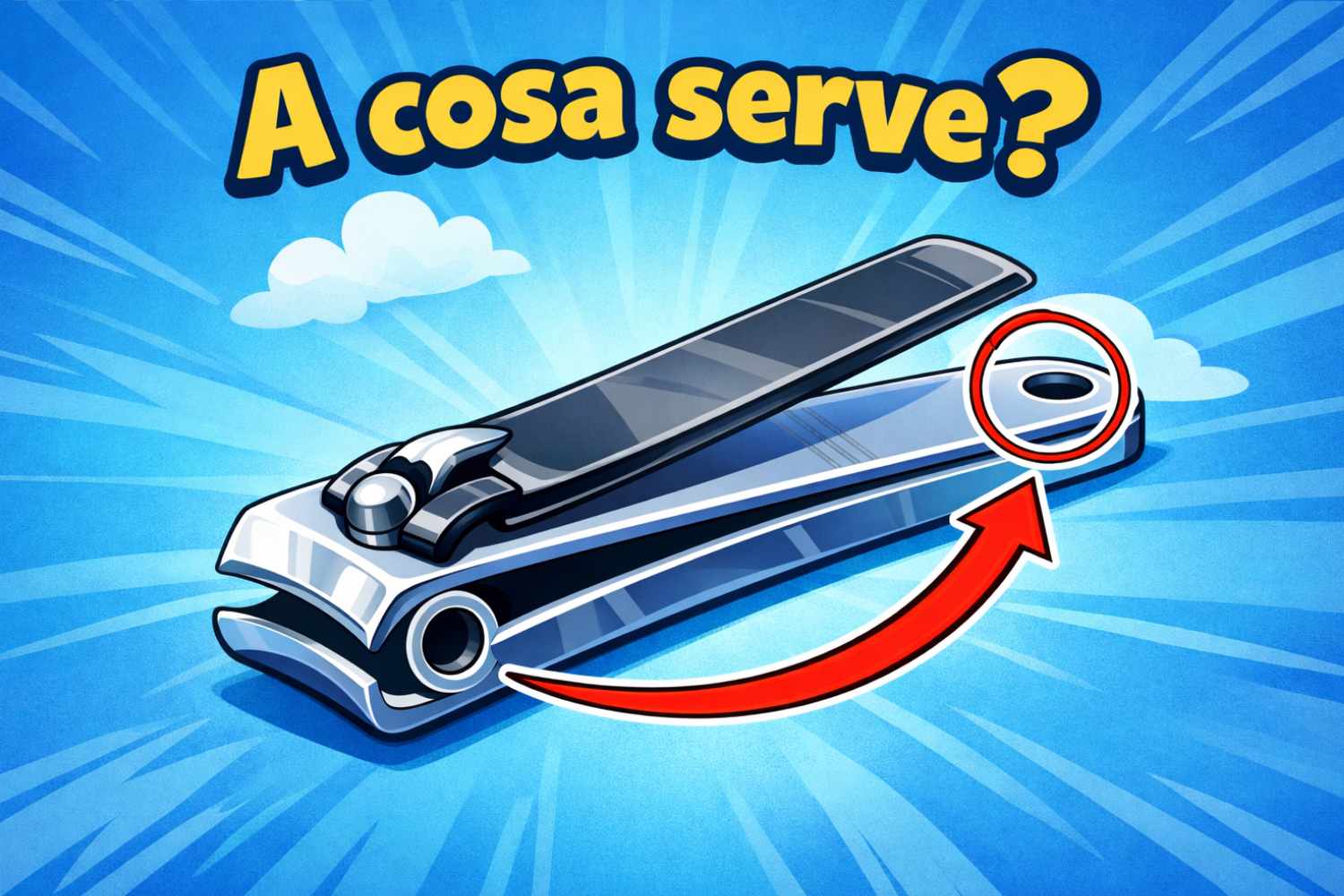
An insignificant detail, which goes unnoticed, has found the limelight thanks to the usual social networks, sparking curiosity and amazement. This is the small round hole at the end of the nail clipper, an element that has always been considered purely decorative. The reality is very different.
The discovery that went around the web
It all started when Purlow’s Facebook profile, with 1.7 million followers, shared her experience: “My mother-in-law couldn’t stop laughing when she realized I had no idea what that little hole in the nail clipper was for. Now I wonder: am I the only one who never knew?”
The question triggered hundreds of comments and the theories quickly multiplied, some serious, others downright creative. Someone hypothesized that it was used to store clipped nails, others thought of a compartment for dental floss. All wrong answers.
The actual function of the hole
The truth is much more practical than you might imagine. The hole is mainly used to attach the nail clipper to other objects via a ring, rope or hook, so you can attach it to, for example, key rings, toiletry kits and travel cases.
Considering how easily these small tools tend to disappear into drawers or bags, this feature is particularly useful. Some styles even include beaded chains to make it easy to attach quickly.
When the explanation went viral, the reactions were immediate. “I will never look at my nail clippers the same way again,” someone wrote. Another user commented: “Time to attach this to my keys!”
The origins of the modern nail clipper
The nail clipper as we know it today has a relatively recent history. The first modern versions date back to 1875, the year in which Valentine Fogerty patented the first lever model in the United States. Before this innovation, nail care required the use of small knives, a less precise and decidedly riskier method.
In 1881, Eugene Heim and Celestin Matz further perfected the design, creating the clamp mechanism that we still use today and it is precisely in this version that the small hole appears, conceived from the beginning as a functional element.
Other secrets of everyday objects
Remember when we talked about kitchen scissors and the mysterious serrated metal part on the handles? That discovery also surprised many people. A Reddit user had asked a question as simple as it was enlightening: “Does anyone know what this part of the scissors is for?”
The network’s collective response was not long in coming. The serrated metal part is used to crack nuts, open bottle caps and remove fish bones. Some use it to open particularly resistant lids by prying around the edge of the cap. A professional chef had added an interesting detail: that part also serves to remove bones from meat, placing the bone between the metal teeth, rotating it slightly and pulling it away.
Everyday objects often hide functions that we take for granted, or that we ignore completely. Both the nail clipper and the kitchen scissors demonstrate how small design details can make life easier, even when we don’t realize it. The next time you use a commonly used object, look more carefully: it could hide other surprises.
