
The lithium it has become one of the most strategic materials of our time. Without him there would be no electric cars, batteries for renewable energy storage or most of the devices we use every day. But global demand is growing much faster than the capacity to extract it, and traditional methods remain expensive, polluting and water-thirsty.
It is from here that research begins that looks at the sea and the sun as allies. A study published in the scientific journal Device describes an innovative device capable of extract lithium from seawater and, at the same time, desalinate itusing exclusively solar energy. A double response to two major emergencies: the energy transition and the scarcity of fresh water.
It may seem incredible, but the oceans contain approximately 230 billion tons of lithium. An enormous quantity, theoretically sufficient to cover global needs for centuries. The real obstacle is that lithium in sea water is present in minimal quantities: approximately 0.2 milligrams per literversus beyond 12,000 milligrams per liter of sodium.
This imbalance has always thrown separation systems into crisis. Technologies such as nanofiltration, electrochemical intercalation or liquid-liquid extraction have proven to be ineffective precisely because they are “disturbed” by other salts. Even the so-called ionic sieves for lithiummaterials designed to selectively capture this metal, work yes, but too slowly.
In recent years, attempts have been made to improve the process by combining it with the evaporation of water, but here another problem arises: the accumulation of salts other than lithium creates encrustations that block everything. A technological dead end which, until now, has prevented us from truly exploiting the sea as a resource.
Yet, achieving this would mean saying goodbye to – or at least drastically reducing – land mining, which is often accused of devastate ecosystems, consume enormous quantities of water and pollute groundwater and soil.
How the rocker solar extractor works
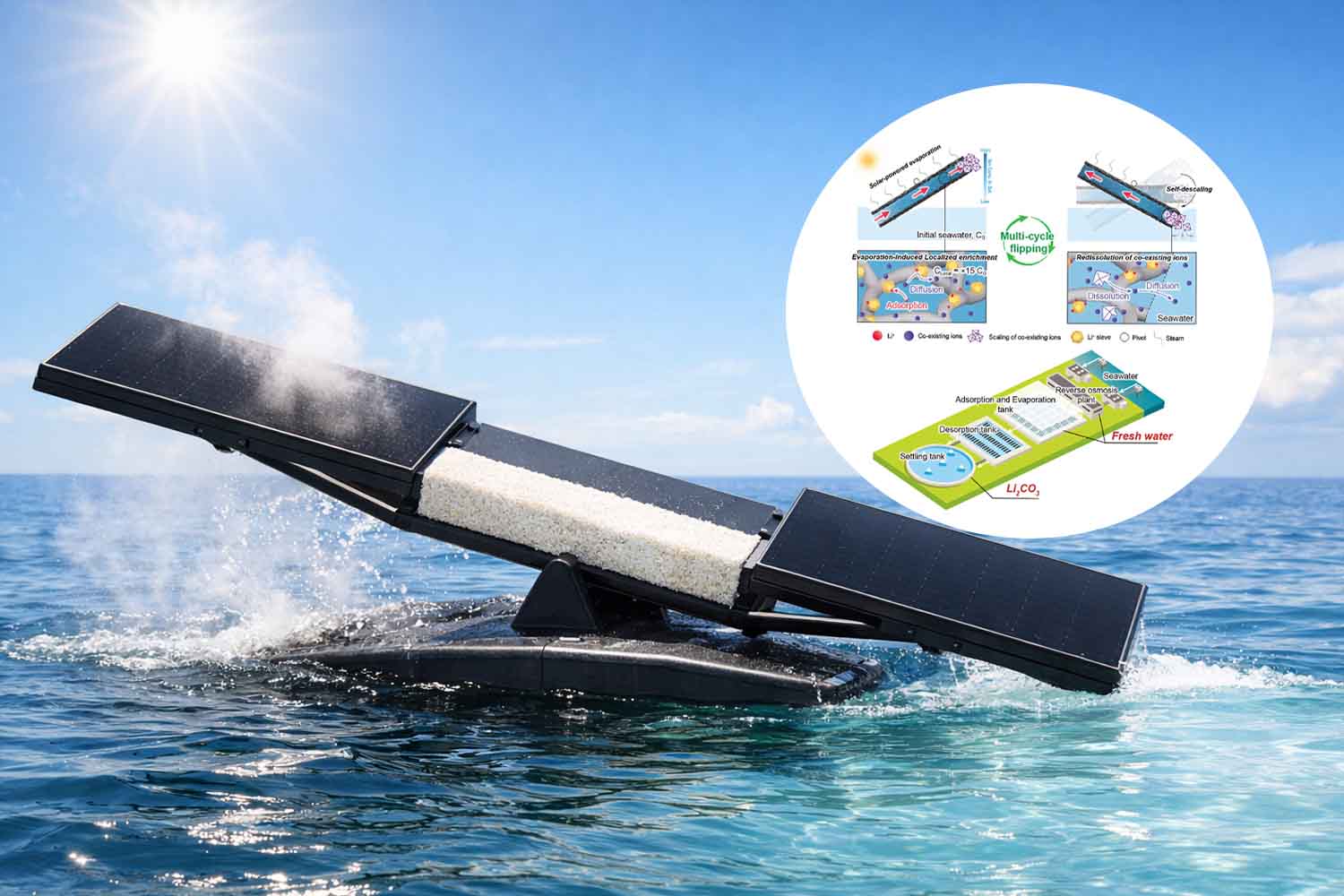
The solution proposed by the researchers is called Solar-Powered Seesaw Extractor (SPSE)a name that already tells a lot about how it works. It is a floating device composed of a central layer hydrophilicwhich captures the lithium, enclosed between two layers hydrophobic and photothermal.
When the sun hits the surface, the heat causes seawater to evaporate. This process activates a continuous capillary flow that drags the ions towards the adsorbent layer, where the lithium is progressively concentrated. The device is initially tilted by approx 30 degrees and, as salts accumulate at the top, it begins to wobble like a barbell.
And here is the brilliant intuition: when the encrusted part is immersed in water again, the salts dissolve, the surfaces are “cleaned” and the cycle starts all over again. In this way the system it cleans itselfavoiding one of the main limitations of previous technologies.
According to the authors of the study, the central nanofibrous mat acts as both capillary pump be like lithium capture tank. The carbon layers turn sunlight into heat and provide buoyancy, while the hydrophobic surfaces push salts towards the edges, reducing the risk of blockages.
The device succeeded in increasing the local lithium concentration by 15.5 timesdrastically improving the adsorption speed. The separation between lithium and sodium exceeded a factor of 370,000a result that until recently seemed unattainable.
There’s more. With further optimizations, the process also produces high purity desalinated watercompatible with drinking water standards. A collateral benefit that is anything but secondary, especially in an increasingly thirsty world.
In comparative tests, the rocker model demonstrated significantly higher efficiency than a fully immersed system: after 120 hourslithium absorption resulted higher than 69%.
The challenges still open and the future of this technology
Like any emerging technology, the rocker solar extractor still has room for improvement. After 30 cycles of useperformance decreased by approx 21.6%mainly due to the poor stability of manganese-based ionic sieves.
Then there remains the issue of real sea conditions: Many of these technologies work best in controlled environments, while natural seawater has variations in pH and chemical composition. Indeed, pH is one of the main problems, because many materials capture lithium only in alkaline conditions.
For the future, the researchers propose to replace manganese-based materials with titanium ionic sievesmore resistant, and to develop solutions that work directly to the natural pH of the ocean.
If these challenges are overcome, we could find ourselves facing an epochal turning point: lithium cleanly extracted from the seausing the sun as the only source of energy and also producing fresh water. A concrete example of how technology, if thought well, can truly ally itself with the environment.
