
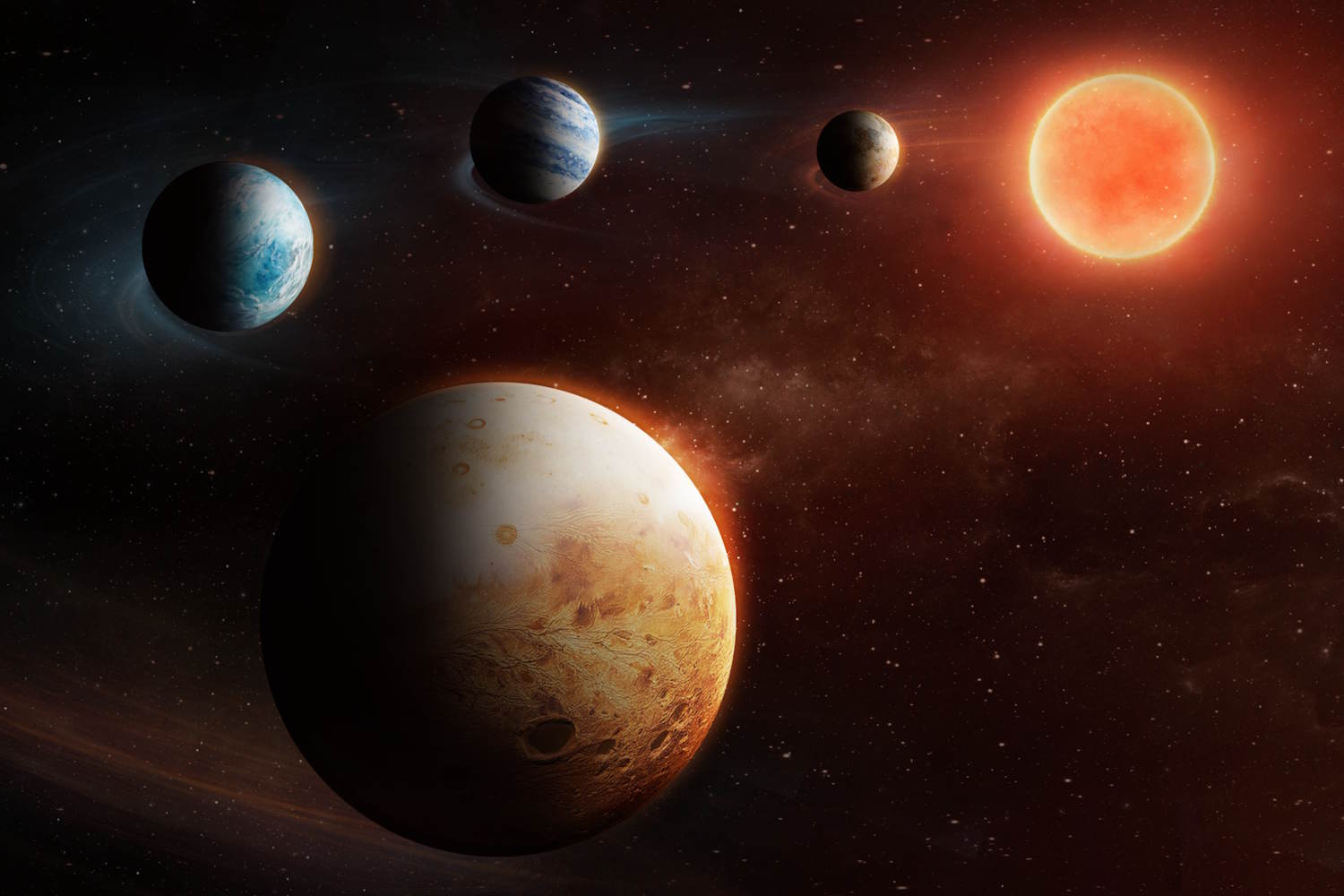
Not all planetary systems are like our solar system – we knew this – but now scientists at European Space Agency (ESA) have found one that challenges all theories of planet formation: the system around the star LHS 1903in fact, it is “on the contrary”with rocky planets being more distant from the star and possibly having formed later than gaseous ones.
Astronomers identified the unique planetary system thanks to the CHAracterising satellite ExOPlanet Satellite (Cheops)which highlighted how the most distant outer planet could be rocky and perhaps even “younger”, also being in a different environment compared to the other planets around the star.
What we knew so far
In our planetary system, called solar because the planets revolve around the star Sun, the eight planets can be divided into rocky and gaseous: in particular, the internal planets closest to the Sun – from Mercury to Mars – are rocky, while the external planets – from Jupiter to Neptune – are gaseous.
This general scheme, according to which planetary systems form with rocky planets closest to the starfollowed by gaseous planets as external bodies, has been commonly observed throughout the Universe. And this is what current theories on planet formation predict and what observations have largely confirmed.
What astronomers have discovered now
From today the scheme rocky planets closest to the star and oldest: the planetary system around the star called LHS 1903 with the satellite they have just discovered it could turn our understanding of how planets form is ordered “in reverse”, with the rocky planets being more distant and younger.
The story, however, starts “from afar”: LHS 1903 is in fact a small M-type red dwarf star already known, colder and less luminous than our Sun, around which three planets seemed to orbit, with the innermost one rocky and the two that followed it gaseous. So, until recently, everything was “normal”.
But now astronomers have analyzed the satellite’s observations Cheopsdiscovering a fourth smallest planetthe furthest from LHS 1903. Which, upon closer inspection, is turned out to be rocky.
What changes in theories about the Universe
The discovery really challenges the accepted theories on the formation of planets: in fact, until now it has always been believed that planets form from disks of gas and dust (protoplanetary disks) aggregating into planetary embryos more or less simultaneously, then evolving into planets of different sizes and compositions over millions of years.
This “strange” system could instead have been generated in a completely different way: the planets could in fact have formed formed one after the otherrather than all together.
“This makes it a reverse system – explains Thomas G. Wilson, first author of the research – with a rocky-gaseous-gaseous and then rocky order of planets again. Rocky planets usually do not form so far from their parent star.”
This conclusion presents a further pitfall: this small rocky planet appears to have evolved and formed in a very different environment than the others.
When this outer planet formed, the system may have already run out of gas, considered vital for planetary formation – explains Thomas – Yet here is a small, rocky world that defies expectations. It appears that we have found the first evidence of a planet that formed in what we call a gas-poor environment
In other words, the little rocky world is either an unusual anomaly, or the first evidence of a trend we weren’t yet aware of. In any case, its discovery requires an explanation that goes beyond our usual theories of planet formation.
The Cheops satellite was born and launched precisely for this reason, to discover what has not yet been discovered, but also to contradict, if necessary, theories taken for “certain” (as all scientific investigations are called to do).
Ultimately – the scientists observe – these discoveries are helping us to understand how our Solar System fits into the large family of different planetary systems.
And they make us wonder how “special” the order of the planets we teach children really is, and whether perhaps it is our Solar System that is truly “strange.”
The work was published on Science.
Sources: ESA / Science
