
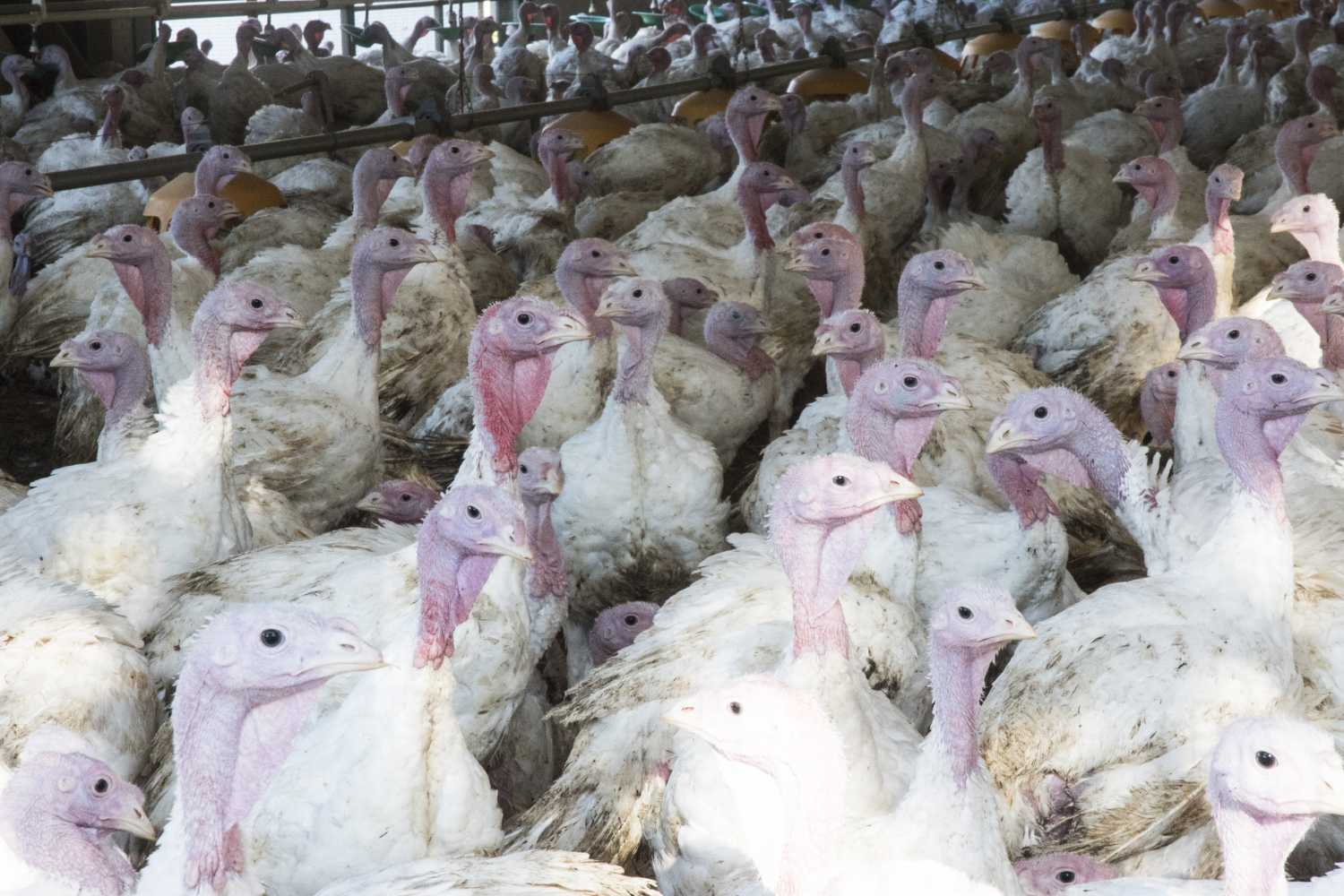
When we talk about intensive farming, our minds immediately go to chickens. The images of overcrowded warehouses, animals struggling to move, precarious hygienic conditions have entered the collective imagination thanks to decades of investigations and documentaries. But there is an animal that shares the same fate, often in an even more serious way, and which only rarely appears in public debate: the turkey.
With around 4 kg consumed per capita every year in Italy, turkey is the second most purchased poultry meat after chicken. Yet, unlike the latter, there is still no specific European regulation on its welfare on farms. A void that EFSA – the European Food Safety Authority – which has published a scientific opinion dedicated entirely to the living conditions of turkeys on farms, now wants to fill.
The aim was to examine the most up-to-date scientific evidence and provide concrete recommendations to improve the welfare of these animals. The result is an important document, which deserves attention.
Before getting into the details, it is worth clarifying who we are talking about. The report takes into consideration three categories of animals: chicks, i.e. newborn turkeys up to 7 days of age; turkeys for fattening, reared between 15 and 22 weeks and intended for meat production, with a weight that can vary from 7 to 25 kg; and breeding turkeys, selected to generate subsequent generations.
Throughout the European Union, the vast majority of these animals are kept indoors in large groups. There are also systems with access to covered verandas or open pasture, but they represent a minority compared to intensive conventional farming.
Space: the first right to be guaranteed
Among EFSA’s recommendations, the one on available space is perhaps the most immediate to understand. To allow a turkey to express its own behaviors – moving, lying down, eating, drinking, exploring – very specific minimum surfaces are needed: at least 0.49 square meters for a 7 kg animal, and at least 0.82 square meters for a 25 kg one.
These are not luxuries, they are the minimum conditions for the animal to live in dignity. When these spaces are not guaranteed, the consequences directly affect the physical health and psychological well-being of turkeys.
It must be considered that turkeys bred today grow at impressive rates: females reach 9-10 kg in just over three months, males exceed 20 kg in five months. Huge animals, genetically selected to gain weight as quickly as possible, who find themselves dealing with a body that grows faster than it can support. More weight means less mobility, more effort to move, more pressure on the legs and more space needed to even just stand without bumping into your neighbor.
Litter, air and light
The scientific opinion also dedicates ample space to those environmental elements which, at first glance, might seem secondary but which have a profound impact on the quality of life of animals.
Bedding, which is the material on the floor of the house, must be kept dry, clean and crumbly. Damp or poorly managed litter is one of the main causes of leg problems, which represent one of the most common signs of discomfort in farm turkeys. Equally crucial is air quality: EFSA recommends ensuring adequate ventilation that keeps ammonia levels below 10 ppm and carbon dioxide levels below 2,000 ppm.
Light also has its weight, in fact at least 10 lux of light intensity and the presence of UV-A light are needed, which for these animals is not a negligible detail but an essential element for their visual and behavioral well-being.
Environmental enrichment
Another interesting passage of the document concerns environmental enrichment. EFSA recommends providing animals with foraging materials to explore and elevated platforms to perch on. Two apparently simple elements, but which respond to profound behavioral needs of this species, the turkey is a curious animal, which in nature spends a good part of its time exploring the environment and looking for food.
Denying these possibilities means forcing him into an impoverished dimension, with consequences on his physical and psychological balance.
Genetic selection and mutilations
The EFSA opinion also addresses two sensitive issues. The first concerns genetic selection: experts underline that the current orientation towards rapid growth favors mobility problems and leg injuries, one of the main problems of fattening turkeys. EFSA suggests that in future genetics should also take into account animal welfare, not just weight and growth speed.
The second theme is that of mutilations. The EFSA is explicit: practices such as beak trimming, removal of the snood (the fleshy appendage above the beak of males) and toe clipping must be avoided. These are painful interventions which, when carried out, serve to manage the problems linked to forced coexistence in confined spaces but not to solve them. The solution, according to scientists, lies upstream, in spaces, in management, in the environment.
A change of course is necessary (and possible)
On organic farms these practices are not allowed. There are also farming systems with access to open spaces or covered verandas, which offer much better conditions than the closed sheds in which most European turkeys live. So change is possible as well as absolutely necessary.
But until there is a specific European regulation that implements scientific recommendations on space, air quality and prohibited practices, millions of animals will continue to grow too fast, in too little space, without any rules really protecting them.
