
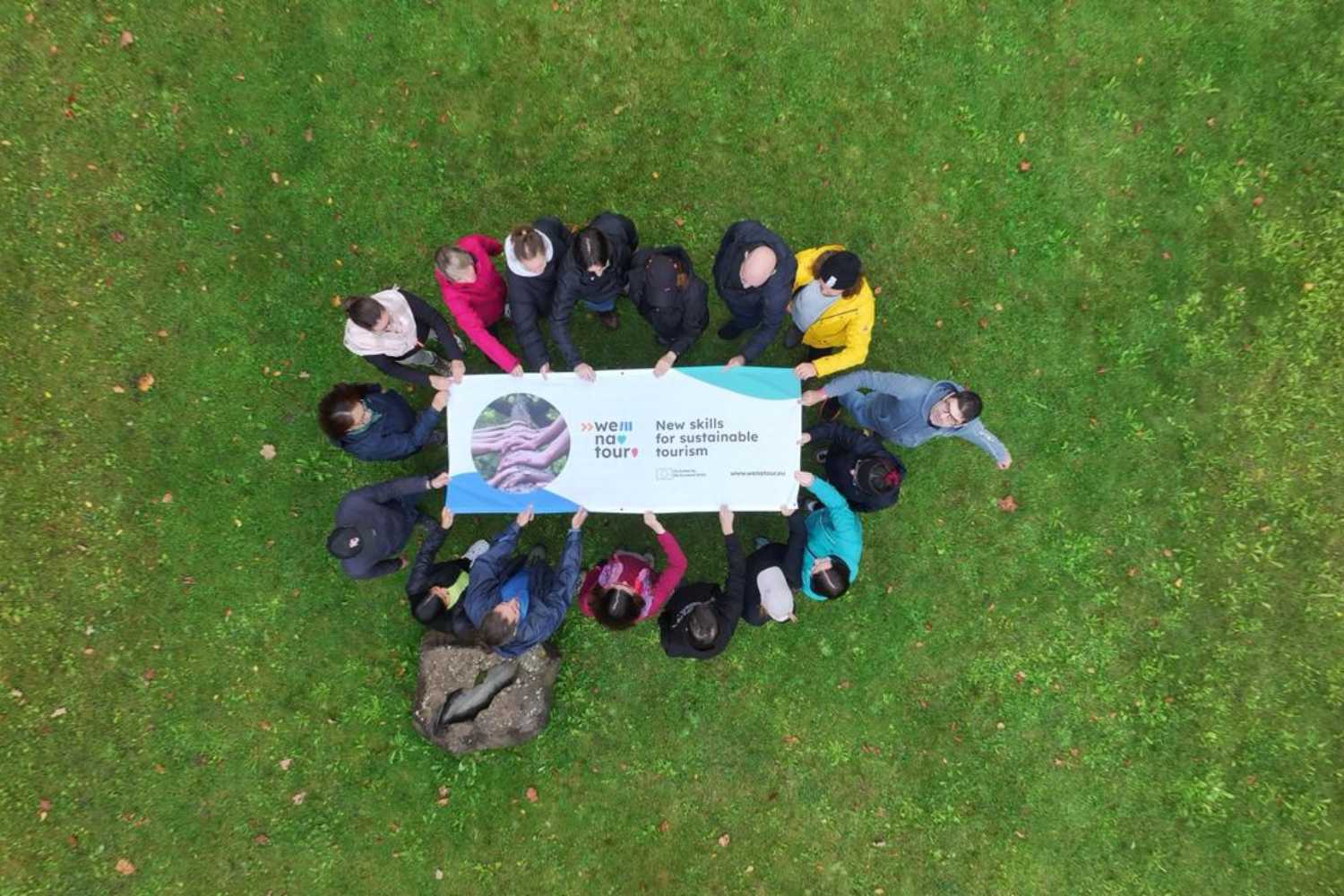
European tourism is faced with a delicate transition: continue to grow according to high-impact models or rethink its tools to respond to environmental, social and economic urgencies. WeNaTour, a European project financed by the Erasmus+ programme, fits into this scenario and, after the results of the first edition, relaunches with a new training offer dedicated to students, professionals and businesses. The objective is to build skills to accompany the transformation of destinations towards more resilient, inclusive and territorial-sensitive models.
The numbers of the first cycle confirm the interest: over 400 participants involved, coming from nine countries, from Colombia to Norway, with an intensive course that led sixteen selected students to experiment in the field with sustainable tourism practices between Italy and Austria. An international laboratory that has demonstrated how the demand for new professionals is no longer a niche phenomenon, but a widespread need.
A professional figure still to be built
At the center of the project is the development of the Sustainability Manager for tourist destinations, a profile that integrates local governance, strategic planning and assessment of environmental and social impacts. A figure that is currently missing in most contexts, where tourism management often remains fragmented between sectoral skills. WeNaTour aims, however, at a systemic approach, capable of connecting public policies, economic operators and resident communities.
According to the promoters, the ecological transition of tourism requires interdisciplinary skills and coordination capabilities, rather than isolated solutions. Hence the choice to build training courses that combine theory, operational tools and direct comparison with European case studies.
Two complementary paths for 2026
The 2026 offer is divided into two free and complementary courses. The first is the second edition of the 150-hour e-learning course “Welfare, Nature and Innovation in Tourism”, a MOOC hosted on the Moodle platform of the University of Padua, with academic recognition equal to 6 training credits.
The course is aimed at university students, tourism professionals, sector operators and people in career transition interested in specializing in sustainability. No mandatory specialist qualifications are required: you just need to be over 18 and have a motivation consistent with the themes of responsible tourism.
The lessons take place entirely online, in asynchronous mode, allowing each participant to manage time and study loads independently. The course, lasting a total of 150 hours, is active from 1 February 2026 and registration remains open until 15 April. At the end, a valid certificate is issued for the recognition of 6 equivalent CFU/ECTS.
Alongside this more structured path, the microcredential course “Nature-based Tourism for Wellness and Health” debuts, dedicated to nature, health and wellness tourism. Ninety-two hours in total, divided into four independent modules, delivered online by Austrian universities and professional training centers.
The course is designed for tourism professionals, corporate welfare operators, new green entrepreneurs and for those who want targeted updating through continuous training. Each module can be followed individually and allows you to obtain a recognized professional microcredential. The launch is scheduled for spring 2026 and it is already possible to pre-register to receive detailed information on the calendar and access methods.
Nature, health and corporate welfare
Among the pillars of the project, the link between tourism and well-being. The increase in pathologies linked to stress and sedentary lifestyle opens up new spaces for a tourist offer that enhances contact with ecosystems and promotes healthier lifestyles. Nature tourism thus becomes a prevention tool, capable of generating individual and collective benefits.
Another direction concerns corporate welfare. WeNaTour proposes that companies integrate sustainable tourism experiences into employee wellness plans, linking social responsibility policies to certified destinations. A model that intends to strengthen the coherence between ESG strategies and local development, transforming travel into a social as well as economic investment.
From training to impact on the territories
The added value of WeNaTour lies in its operational dimension. International mobility experiences, thematic webinars and case studies on governance, cultural sustainability and regenerative tourism build a direct bridge between training and practice. The objective is not to train abstract figures, but professionals capable of influencing the real decisions of destinations.
In a sector that has a decisive impact on environmental and social balances, investing in the quality of skills means acting on the foundations of the system. The new cycle of courses marks a strategic transition: from experimentation to a structured training model, capable of networking at a European level.
WeNaTour bets on an idea of tourism that does not measure its success above all in its ability to generate shared value. A perspective that looks to the future of destinations as spaces of balance between economy, environment and community, where training becomes the first infrastructure for change.
You might also be interested in:
