
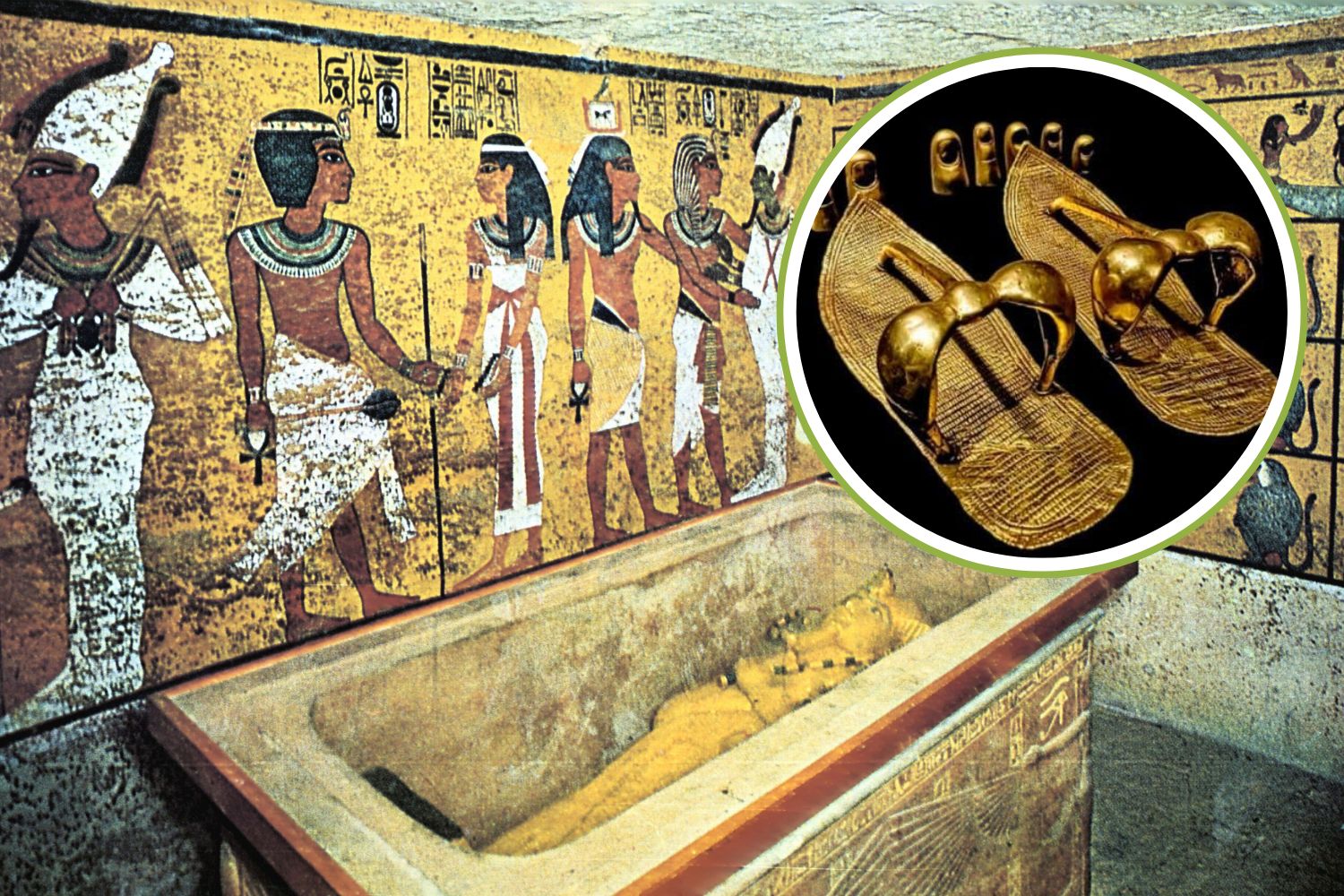
There are details that go unnoticed. Then there are others which, if you look at them carefully, completely change perspective. In 1922, when Tutankhamun’s tomb was opened, the world’s attention fell on the gold, the chariots and the funerary mask. But among those silent objects there were also them: over 80 pairs of sandals. Not a random accumulation, but a studied set.
The materials tell a story of nature and luxury together: woven palm leaves, hand-sewn papyrus, patiently worked plant fibres. And then dyed leather, set precious stones, gold embossed with a precision that still leaves you speechless today. Some models were simple, sewn. Others required actual teams of craftsmen. And here comes the interesting detail: precisely the apparently most essential sandals were considered distinctive signs of very high status.
The archaeologist André J. Veldmeijer he explained that these shoes were reserved for the royal family and officials awarded directly by the sovereign. We still don’t know why such “simple” models were so prestigious. But perhaps, as still happens today, true power does not need excesses.
Even the golden sandals placed on the mummy were not overly elaborate in shape. They reproduced the models sewn in vegetable fiber, but transformed the stitching into decorative motifs embossed on gold. An almost poetic gesture: taking something everyday and making it eternal.
And there is another striking aspect. In ancient Egypt, wearing sandals was not a given. Most people walked barefoot. Having some footwear meant belong to an elite. Every step was a statement of power. The Egyptologist Salima Ikram observed that some of Tutankhamun’s shoes feature decorations of gold, birch bark, bone, and perhaps even glass. Not just functional objects, but pieces of a true royal wardrobe also destined for the afterlife.
And here a question arises: how many of these shoes were actually worn? And how many were born just to accompany him on the journey after death?
Power under your feet: when every step means crushing your enemies
Among the most striking pairs is one with bound prisoners depicted on the inner sole. Yes, right under your feet. It’s about the dei motif Nine Archestraditional symbol of the enemy peoples of Egypt. The image was placed so that Pharaoh “trampled” them with every step. Walking became a political gesture. Every movement, an assertion of dominance.
But the story doesn’t end here. Because behind that idea of absolute strength a fragility could hide. Modern CT scans on the mummy suggest that Tutankhamun could suffer from clubfoot and other skeletal problems. Genetic studies have highlighted additional health conditions, including malaria. Some sandals found in the tomb feature strap configurations never before seen in ancient Egypt.
According to Veldmeijer, these characteristics have no direct comparison with other footwear of the time. They could be functional adaptations. Or foreign influences. Or again, simply a real trend that we no longer know.
Yet, there is no definitive evidence, based on the wear of the soles, that demonstrates a different gait of the pharaoh. It therefore remains a hypothesis suspended between science and interpretation. The striking thing, however, is something else. Let’s imagine this boy, ascended to the throne at nine years old, loaded with symbols, rituals, expectations. Gold coated. And perhaps, physically fragile.
Today, thousands of objects from his tomb, including sandals, are on display at the Grand Egyptian Museum in Cairo. Objects that still speak. Just stop for a moment and listen to them.
