
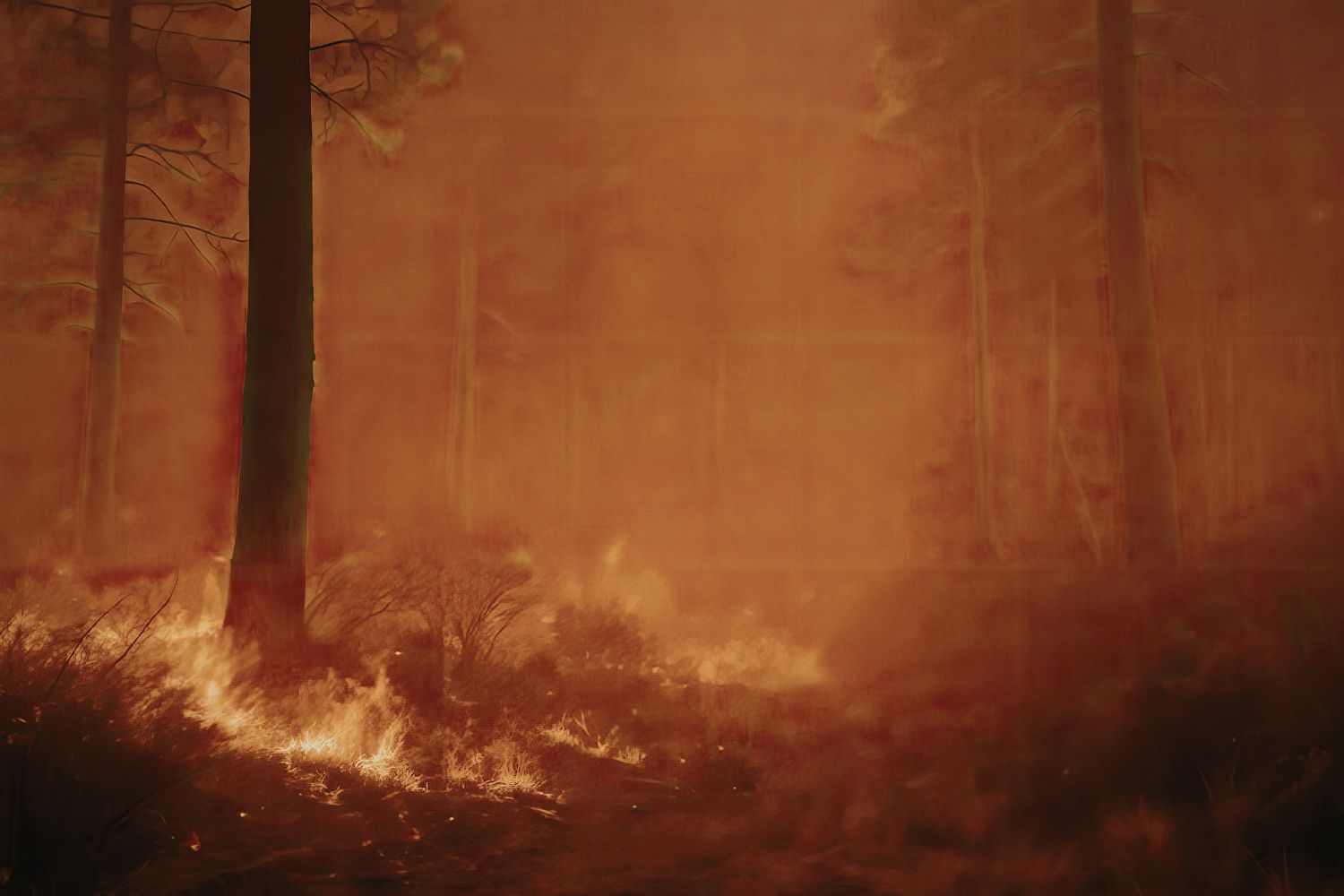
Wildfires in the Alaskan Arctic are surpassing any event recorded in the past 3,000 years. This is revealed by a new reconstruction that combines modern satellite data and traces of charcoal preserved in the peat layers of the soil, showing that the tundra is no longer protected from the cold and humidity that in the past made flames rare.
The change marks the beginning of a new era of more frequent and more intense fires, fueled by drying soils, thawing permafrost and the expansion of woody shrubs driven by climate warming.
To reconstruct the evolution of the fires, researchers analyzed peat cores taken along the Dalton Highway in northern Alaska. In these soils rich in partially decomposed plant material, tiny particles of charcoal remain which indicate the presence of ancient fires.
For about 2,000 years, fires in the tundra north of the Brooks range remained rare. Even in the slightly drier periods, between the years 1000 and 1200, traces of burning indicate long fire-free intervals. After a brief phase of increase, activity fell again for another seven centuries. The surge came only after 1950, in parallel with rising temperatures and profound environmental changes observed in the Arctic.
The study
A team of researchers from the University of Alaska Fairbanks reconstructed the history of fires on the Arctic tundra – an environment traditionally cold, wet and not prone to combustion – by analyzing peat layers at nine sites along the North Slope, north of the Brooks Range. These samples, which date back as far as 1000 BC, show that for much of these millennia fires were rare and sporadic events, even when soils dried out slightly between 1000 and 1200 AD and then again for another seven centuries.
A radical change came starting from the 20th century, and particularly markedly after the 1950s: fire activity increased, surpassing any other period in the thousand-year history of the region. This total change is mainly linked to two phenomena related to global warming. First, the thawing of permafrost – that ground frozen for at least two consecutive years – causes surface water to seep deeper, leaving layers of peat and soil increasingly dry and vulnerable to flames. Secondly, rising temperatures favor the spread of more flammable woody shrubs in areas that were once dominated by mosses and plants that grow in humid environments that are difficult to burn.
The result is a tundra that burns more frequently and with more intense flames, because the dry soils and woodier vegetation create an ideal fuel. The analysis of peat cores combined with satellite data confirms an acceleration and extension of fires that has been unparalleled over the course of three millennia, a sign that the Arctic climate is rapidly entering a new fire regime.
This evolution does not only affect the local territory: fires in the Alaskan tundra release large quantities of carbon stored in the soil frozen for centuries, contributing to the increase in greenhouse gases in the atmosphere and further fueling global warming. Furthermore, smoke can travel long distances, impacting air quality even far from the fire front.
The picture that emerges is alarming: what for millennia has been a relatively stable ecosystem and little subject to flames is becoming more vulnerable every year, with increasingly intense and regular fire seasons. Scientists warn that these dynamics could extend to other Arctic areas if global warming is not stopped or at least slowed.
In other words, Arctic Alaska isn’t just burning: It’s clearly showing us the face of a changing climate, with consequences that go far beyond the Arctic Circle.
