
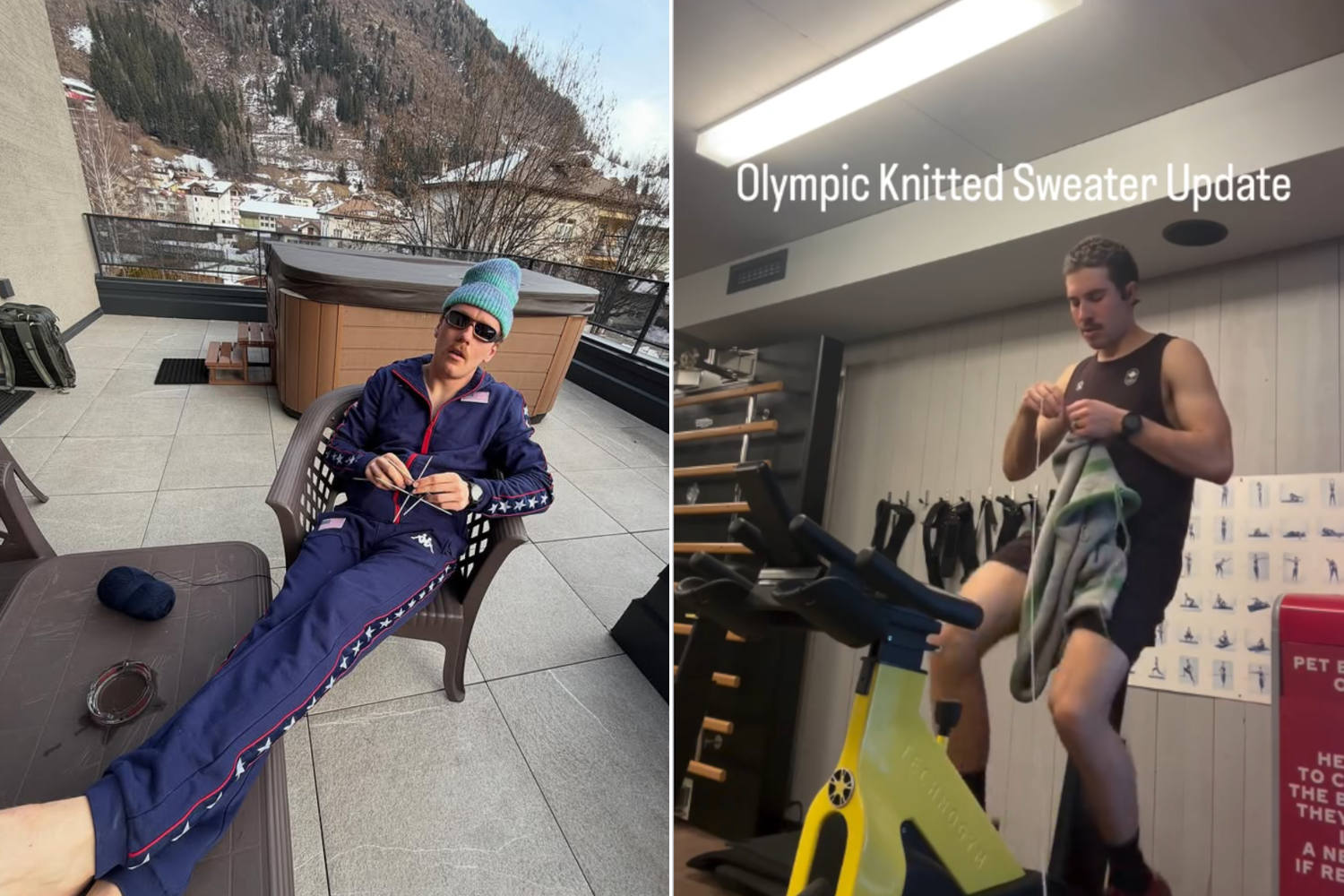
There is a discipline that does not award medals but is gaining attention, likes and curiosity during the Milan-Cortina 2026 Winter Olympics: knitting. Between one race and another, more and more athletes are immortalized while weaving wool and silence, transforming this hobby into a mental management strategy. They call it knitting therapy: an informal but increasingly widespread practice that uses repetitive movements and focused attention to reduce stress and keep performance anxiety at bay. In a context like the Olympic one, where every detail matters, concentrating on a knitting pattern becomes a way to slow down the chaos without losing concentration. It’s not escapism, it’s control.
View this post on Instagram
From viral phenomenon to Olympic ritual
The British diver Tom Daley popularized this trend, photographed in the stands with needles and balls already at Tokyo 2020 and then at Paris 2024. Those images went around the world, transforming a personal hobby into a symbol of normality and emotional resistance. Today, in Milan-Cortina, that gesture has almost become a shared language.
View this post on Instagram
The Ben Ogden case, silver and wool
Among the most emblematic faces is the American Ben Ogden, the absolute protagonist of cross-country skiing. In Val di Fiemme he won a historic silver medal in the sprint, breaking an American fast that had lasted for fifty years. The last one to do it was Bill Koch in 1976. And when the interviews got heated, Ogden didn’t talk about music or TV series: he talked about knitting. After the race, with the adrenaline still pumping, Ogden explained that to regain balance he will return to his projects: already finished sweaters, gloves inspired by Joan of Arc, the wool waiting for him.
View this post on Instagram
Adam Runnalls: a ritual against Olympic pressure
But he’s not the only one. Even Adam Runnalls, a Canadian biathlete, once his shooting sessions are over, replaces his rifle with knitting needles and balls of yarn in search of concentration and balance during such a stressful period as the games. Runnalls, 27, discovered the shirt as a mental preparation tool at the suggestion of his coach.
Since December, hats and sweaters have started to take shape between pre-Olympic training and rallies. Knitting has become much more than a hobby for him: it allows him to slow down the pace without turning off his attention to the sport. A detail that also struck the online public, causing his Instagram profile to grow from just over 1,500 to over 10,000 followers in just a few days.
View this post on Instagram
Success doesn’t just come from curiosity. Runnalls intercepts a common ground between two worlds that are only apparently distant: that of sports enthusiasts and that of knitters. His presence sparked a reflection on male representation in an often stereotyped context, demonstrating that even an Olympic athlete can find strength in slow and repetitive manual skills.
In biathlon, an extreme discipline that combines cross-country skiing and shooting, the ability to calm the pulse in a few seconds is decisive. Runnalls trains just that: the transition from movement to immobility. He also knits on the exercise bike, turning recovery into an exercise in continuous concentration. Not surprisingly, he explains that the shirt allows him to “sit down” while remaining mentally active. Raised in a family of ski instructors, Runnalls went through hockey, alpine skiing and cross-country before arriving at biathlon. A life marked by winter, today enriched by a wool thread running between the fingers.
View this post on Instagram
You might also be interested in:
