
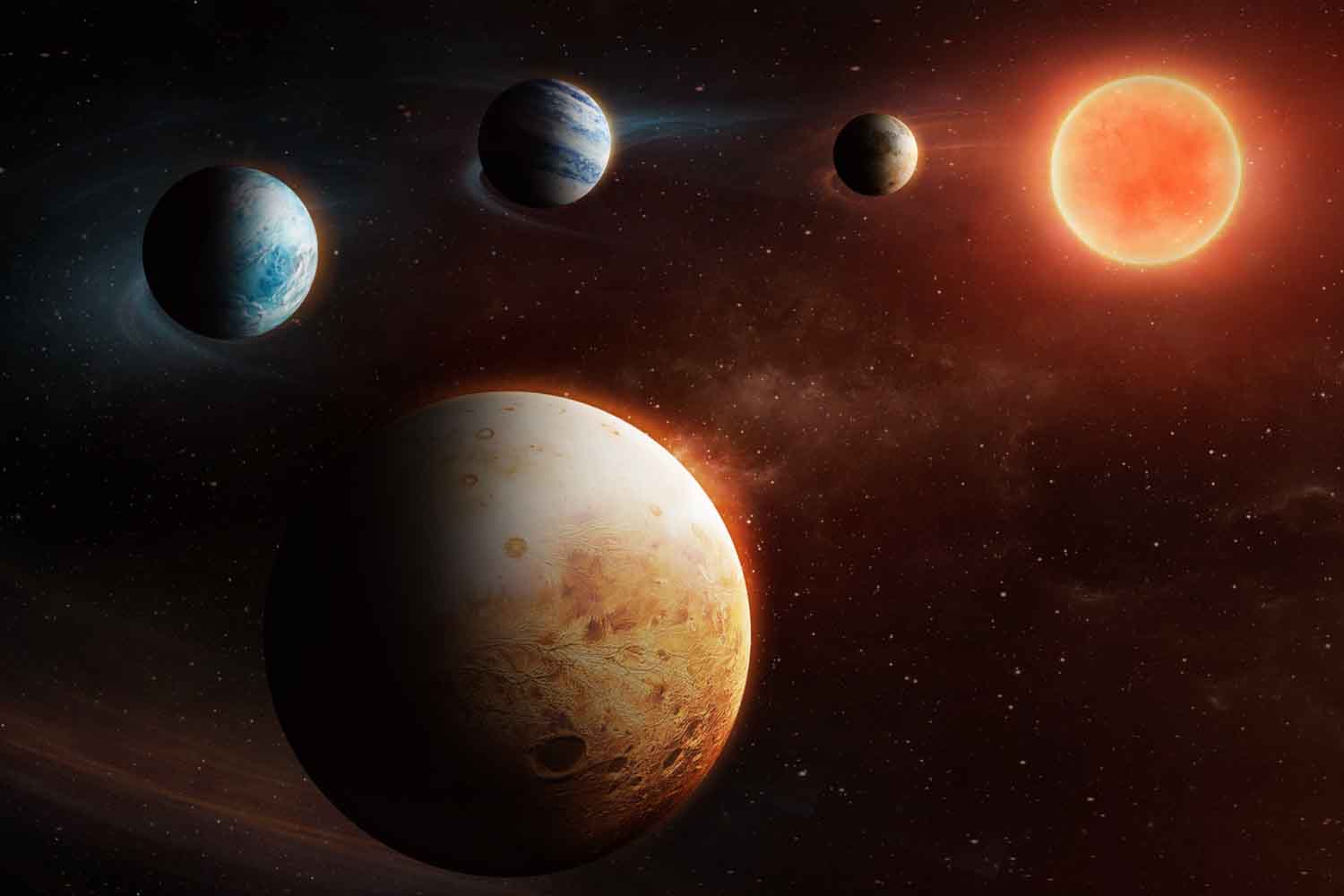
A rocky planet where it shouldn’t exist. This is the anomaly that makes it Lhs 1903 one of the most interesting planetary systems of recent years. Satellite data discovered it Cheops of theEuropean Space Agency (ESA), who have shined a light on a configuration capable of calling into question traditional theories on the formation of planets. In the LHS 1903 system there is a rocky planet in an external orbit, precisely where models predict the exclusive presence of gas giants. A detail that changes everything.
The study, led by Thomas G. Wilson (University of St. Andrews and University of Warwick) and carried out with the contribution ofNational Institute of Astrophysics (Inaf), of theItalian space agency (Asi) and the universities of Padua and Turin, was published in the magazine Science. And no, it’s not a detail for insiders: this discovery could change the way we look at the birth of worlds.
Lhs 1903 and that rocky planet too far away
Let’s start from the beginning. Lhs 1903 it is an M-class red dwarf, cooler and dimmer than the Sun, located about 116 light years from Earth. Astronomers had initially identified three planets: a rocky one, close to the star, and two more external gas giants. An almost “textbook” structure. Then came the Cheops data. And there something is no longer right.
The satellite identified a fourth planet, the most distant from the star, which appears to be small and rocky. Precisely where, according to traditional models, lower temperatures should favor the formation of massive, gas-rich planets.
Current theories explain that in the internal regions of a planetary system, stellar radiation tends to sweep away the gas, leaving room for small, rocky planets. In the external areas, however, the gas should accumulate and give rise to gas giants.
So how do you explain this rocky planet so far away? Scientists have ruled out hypotheses such as catastrophic impacts or planetary migrations that could have moved it from its original position. The most convincing explanation is another, and it is decidedly fascinating.
Inside-out planetary formation
The theory gaining ground today is called “inside-out” planetary formation, that is, from the inside out. According to this hypothesis, the planets do not form all together within a single protoplanetary disk, but are born in succession. First those closest to the star, then, in a subsequent phase, those further away.
In the case of LHS 1903, the rocky outer planet may have formed when the gas in the system was exhausted. A condition that, until today, was considered incompatible with the birth of new worlds. If confirmed, this dynamic would force us to review many certainties. Because the models with which we interpret the universe are largely based on the example of our solar system. But what if our system is not the rule, but the exception?
The Italian contribution to the Cheops mission was decisive. Gaetano Scandariato, INAF researcher and national scientific manager for the mission, underlined the key role of the synergy between Asi, INAF and universities, both in the design of optical instruments and in data analysis. Manuele Gangi, ASI manager of Cheops’ scientific activities, also highlighted how the experience gained will be fundamental for future missions Plato And Arielwhich will still see a strong Italian participation.
And as increasingly sensitive instruments continue to scan the sky, one thing is clear: systems like LHS 1903 are not simply cosmic curiosities. These are scientific alarm bells. They remind us that the universe is more diverse, more creative, and less predictable than we thought.
Perhaps, in the end, the real “anomalous” system is not LHS 1903. It could be ours.
