
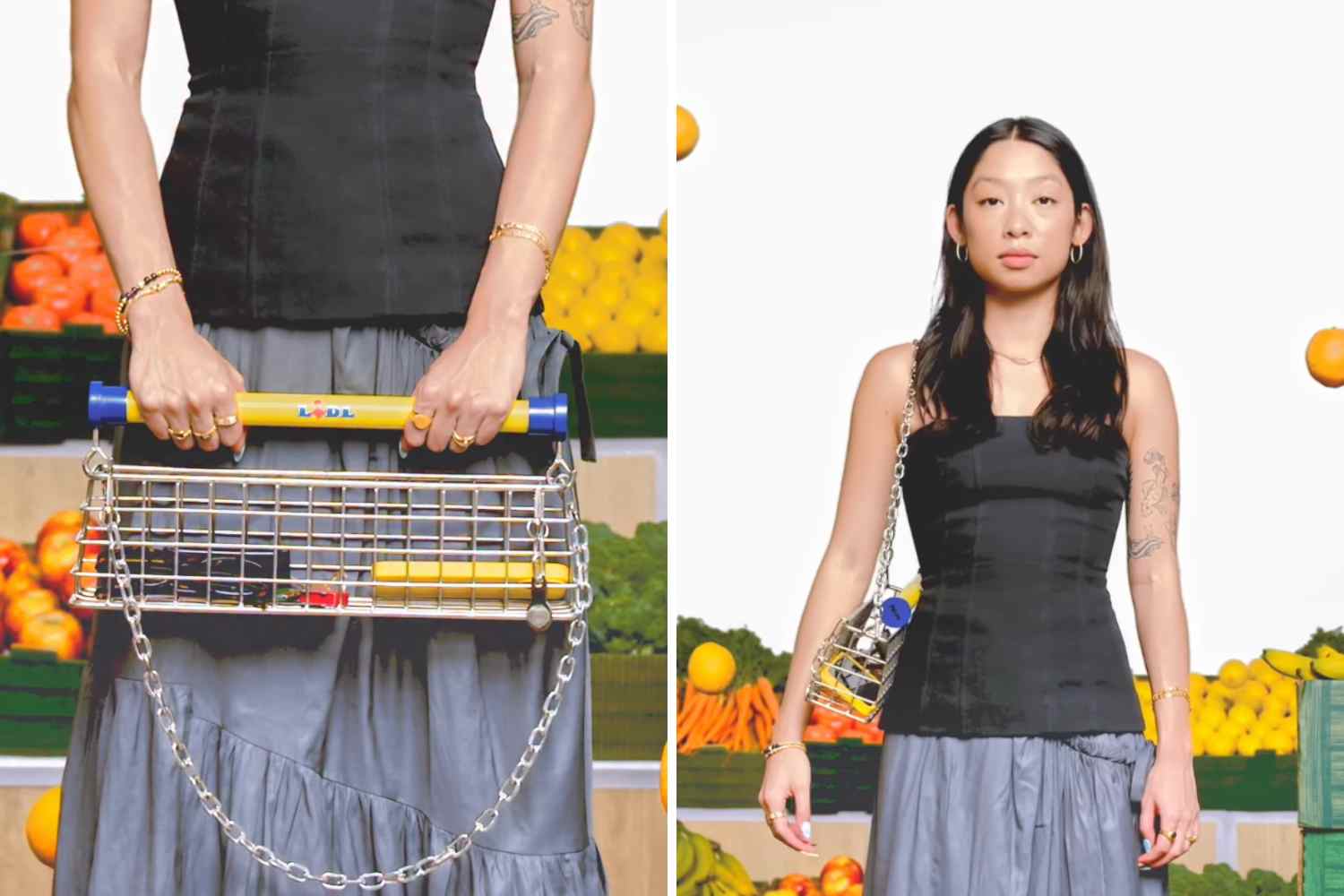
A banal object, transformed into an object of desire
There is something deliberately paradoxical in the idea of carrying a miniature replica of a shopping trolley on your shoulder, as if it were a high fashion accessory. Yet this is exactly what Lidl has decided to do by collaborating with Nik Bentel, a New York designer whose studio has built a precise reputation: taking objects of the most absolute ordinary and returning them to the public as cult pieces that can be sold out immediately. The result is called Trolley Bag, and it is a stainless steel clutch bag with a removable chain shoulder strap that faithfully reproduces, in a small way, the trolley that we all push through the aisles of the supermarket.
View this post on Instagram
Attention to detail as a message
What distinguishes the Trolley Bag from a simple branded gadget is the obsessive attention with which every detail has been taken care of. The bag replicates the shape of the trolley, features the Lidl logo and the characteristic blue-yellow color combination with a red accent, and is accompanied by a token – the same one we use to unlock real trolleys – which acts as a key ring. A dust bag is also included, strictly in the colors of the brand, for safekeeping. It is not a game of superficial irony: it is an object built with the same logic with which luxury fashion houses create their iconic accessories, however applied to a deliberately domestic and popular reference universe.
How to get the bag?
Lidl has chosen a distribution mechanism that further amplifies the perceived value of the bag: you don’t buy, you win. A pop-up store has opened in London where the only way to win it is to play a personalized slot machine, with symbols inspired by fresh fruit and vegetables from the supermarket. Only those who hit the jackpot take home the bag, free of charge. For those not in London, a public draw will open on 26 February on Nik Bentel’s official channels. No prices, no purchases: just luck. Whoever wears the Trolley Bag not only shows an accessory, but tells of having lived an exclusive experience, of having won it. The object thus becomes a story to carry with you.
Nik Bentel: the designer who transforms the absurd into the desirable
The name of Nik Bentel is not new to this type of operation. His studio has become known for its ability to do exactly that: take everyday objects — food, tools, street furniture — and transform them into bags and accessories that the fashion market buys immediately and completely. It is an approach that works on the friction between the code of luxury and that of ordinary life, generating a short circuit that entertains and works at the same time. The collaboration with Lidl is consistent with this identity: Europe’s most recognizable discounter meets the designer who best knows how to play with the border between high and low.
Lidl and fashion
The Trolley Bag is not an isolated episode in Lidl’s recent history. In recent years the German brand has built a coherent and recognizable path in the territory of pop culture and fashion, often surprising an audience that was not expecting it. There was the launch of sneakers in the brand’s colours, which immediately entered the category of so-called ugly shoes – those shoes that fashion has re-evaluated and transformed into trendy objects.
Then the flip-flops, same logic, same market response. Last summer the jacket arrived Lidl By Lidlwith a play on words on the title of an Oasis hit that reinterpreted Liam Gallagher’s parka. Every time, the formula repeats itself: an unexpected object, an accessible price, a marketing operation that creates scarcity or in any case urgency, and the market responds with queues, sold-outs and resales.
Why does it work?
There is a precise logic behind this strategy, and it doesn’t have much to do with fashion in the strict sense. Lidl has understood – and proves it every time – that desirability is not necessarily linked to price or the traditional positioning of the brand. Rather, it depends on the ability to generate a narrative, to create a moment, to make owning that object mean something beyond the object itself. A miniature shopping trolley signed by a cult designer, distributed only by draw or stroke of luck, in a London pop-up with fruit and vegetable themed slot machines: it is a story, not a product in the strict sense.
What’s really behind Lidl shoes (and why did you queue “unnecessarily”)
