
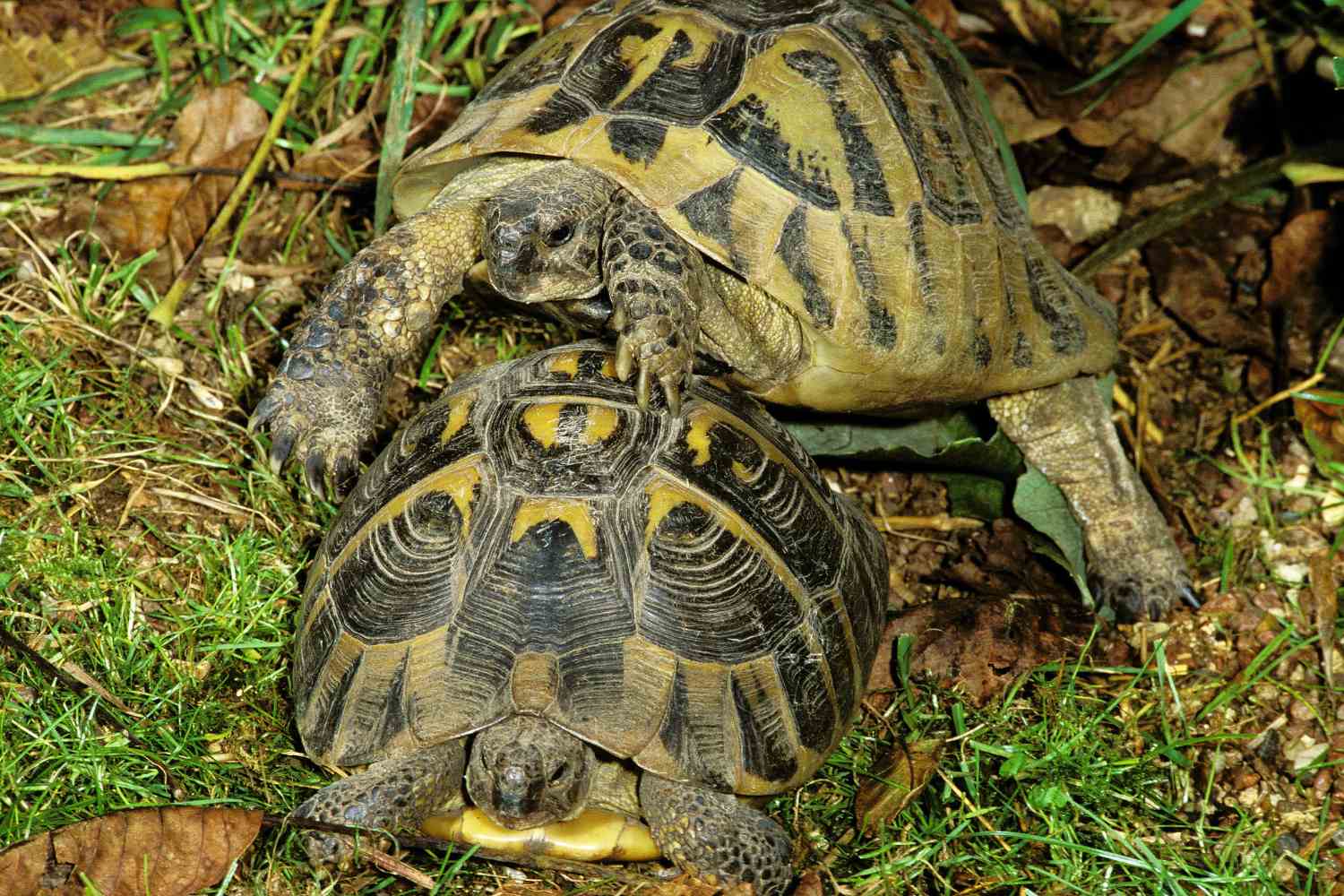
On the uninhabited island of Golem Grad, in Lake Prespa in North Macedonia, lives a population of around one thousand Hermann’s tortoises. A small natural paradise which, observed closely, revealed itself to be the scene of a disturbing phenomenon: a dramatic imbalance in the sex ratio, with a proportion of approximately 19 males for every female.
The study, published on Ecology Letters and signed by the Macedonian biologist Dragan Arsovski together with colleagues Xavier Bonnet, Ana Golubović and Ljiljana Tomović, speaks openly about “demographic suicide” and a possible “sex-discriminatory extinction vortexIf the trend is not reversed, females could disappear by 2083.
Repeated attacks and flight into the void
Field observations, which began in 2008, have documented behaviors that go far beyond simple courtship. Multiple males chase a single female, surround her, bump into her, bite her until causing lesions to the genital organs, mount her and hit her with the tip of their tail as she tries to escape. In some cases, the female is literally submerged by a tangle of carapaces.
The constant pressure generates a level of chronic stress that pushes many young specimens towards the island’s cliffs. In an attempt to escape the attacks, they throw themselves into the void. Males also fall, but the percentage of deaths among females is significantly higher. According to researchers, these are not just accidents: in several cases the behavior appears as an extreme choice to escape.
Compromised reproduction and risk of extinction
The consequences are not limited to direct mortality. Radiographic analyzes have shown that stress affects reproductive capacity: only 15% of females on the island have eggs, a much lower percentage than that recorded in a nearby mainland population. Additionally, harassed females show lower survival rates.
The result is a vicious circle. The fewer females survive, the greater the pressure from males on the few remaining, and the more the system heads towards possible collapse. This is the mechanism that scholars define as the “vortex of extinction”: a process within the population which, without external interventions, risks self-sustaining until the disappearance of the female sex on the island.
The experiment that confirms the pressure of males
To test the impact of harassment on escape behavior, Arsovski conducted a controlled experiment. Some females, coming from both the island and the mainland, were placed in an enclosure with a single safe opening to the outside. In the absence of males, continental females almost never tried to escape, while many island females attempted to escape spontaneously.
When five males were introduced into the enclosure, the reaction was clear: almost all the females fell through the opening. With one significant difference. Mainland females were often pushed, while those raised on the island lunged independently. A behavior that suggests a desperate adaptation to an environment that has become hostile. This internal dynamic highlights how fragile the natural balance can be when the pressure on just one sex becomes unsustainable.
You might also be interested in:
