
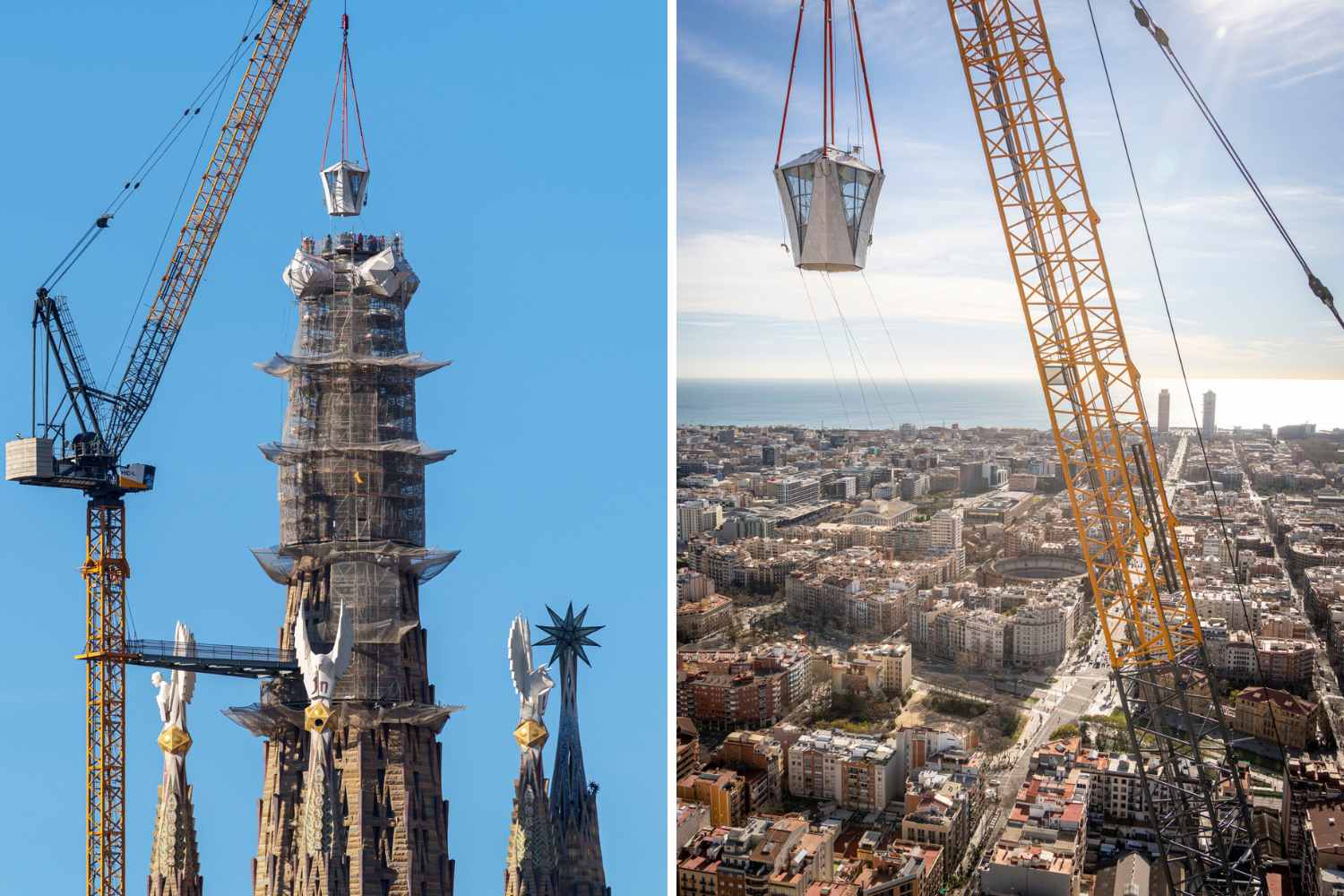
With the assembly of the upper arm of the cross that stands on the Tower of Jesus Christ, the Sagrada Família wrote a new page in the history of architecture. The Barcelona basilica reached an altitude of 172.5 metres, leaving behind the bell tower of Ulm Cathedral, which with its 161.5 meters had until today held the world record among religious buildings.
The altitude was not chosen by chance by Antoni Gaudí. The architect was convinced that no human creation should rise beyond the boundaries of nature, and therefore he designed the tower to remain just below Montjuïc hill, the highest natural point in the city, approximately 173 meters high. A difference of only fifty centimeters, almost a gesture of humility towards creation.
The cross: symbol and engineering together
The cross that crowns the structure measures 17 meters in height and 13.5 meters in width. Its surface is covered in white glazed ceramic and glass, designed to capture and return sunlight during the day, while at night an internal lighting system transforms it into a luminous point visible from afar, almost a lighthouse suspended in the sky of Barcelona. The horizontal arms, installed between the end of 2025 and the first days of 2026, each weigh approximately 12.8 tons and follow a double torsion geometry: the section passes from the square shape towards the outside to the octagonal one at the connection point with the central core.
Inside the tower
The work was placed inside the upper arm Agnus Dei by the Italian artist Andrea Mastrovito. The tower is open to visitors: a glass elevator allows you to climb up to 140 meters, flanked by a spiral staircase that accompanies those who want to get further closer to the base of the large cross.
A centuries-old construction site between obstacles and rebirths
Nothing of what we see today was taken for granted. During the Spanish Civil War, anarchists set fire to the architect’s workshop, reducing original plans and plaster models to ashes. Faithfully reconstructing Gaudí’s vision required decades of research and patient work, almost a work within a work. Yet the cranes never stopped for long, and the finish line remained, generation after generation, on the horizon.
The past century has also put the construction site to the test. In 2020 the pandemic interrupted the work, hitting the most sensitive point: financing. The Sagrada Família receives no public funding and survives entirely on visitor entrance fees. With tourism wiped out, the bills stopped along with the cranes. The recovery came gradual but solid: in 2024 almost 4.9 million people passed through the doors of the basilica, with around one visitor in seven coming from the United States.
Gaudí’s centenary
The completion of the tower is not accidental even in time: 2026 marks the centenary of Antoni Gaudí’s death, and the Foundation wanted this milestone to coincide with that anniversary. With the tower completed, the construction of the six central towers also ends. The Façade of Glory remains to be completed, the last major architectural piece of the construction site, around which open urban planning debates and a construction calendar that will extend for several years still revolve.
Record-breaking Sagrada Familia! Gaudi’s masterpiece is officially the tallest church in the world
