
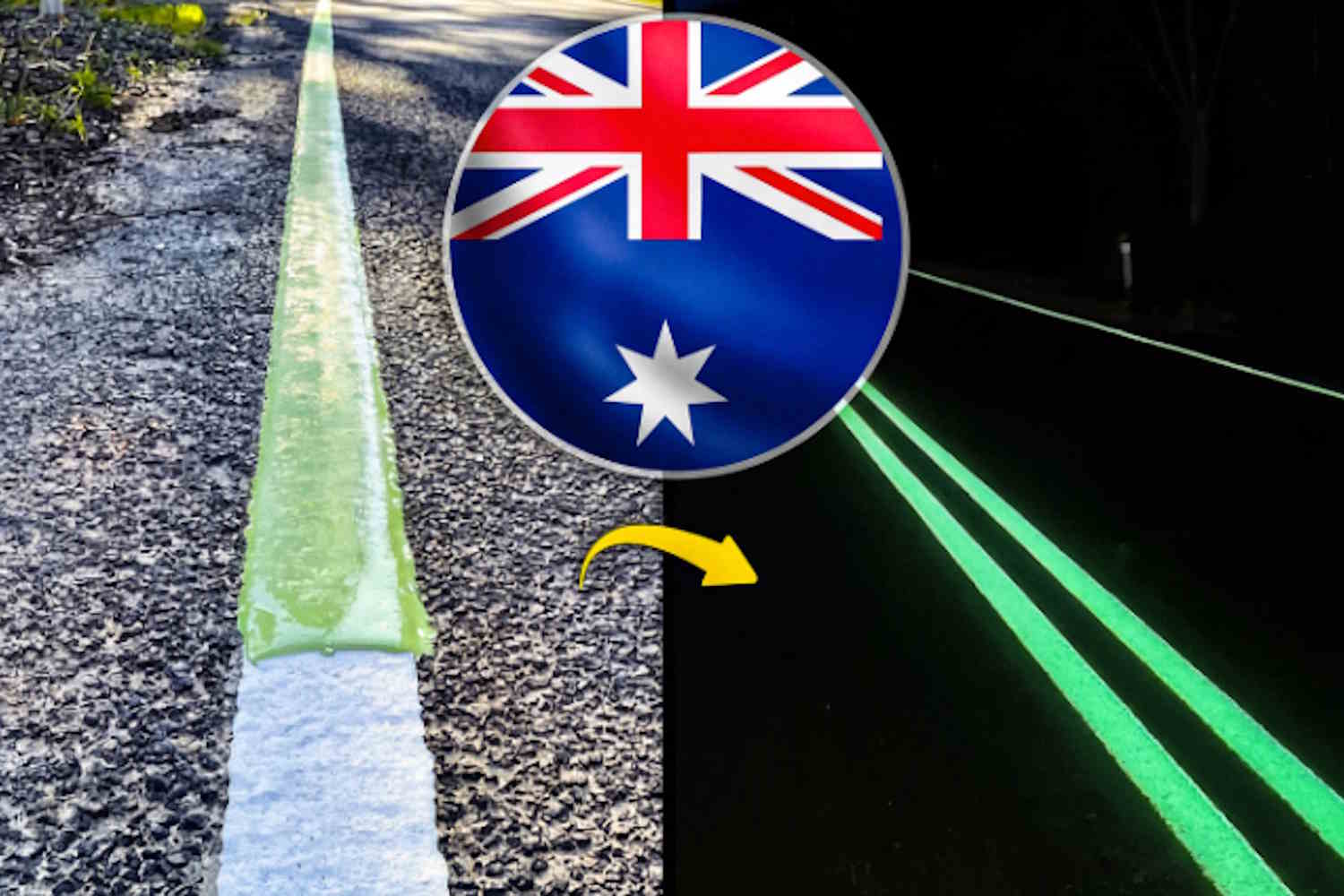
In Australia some streets literally start to light up after dark, without the need for streetlights or new electricity. It is the result of an experiment that is attracting international attention and which concerns photoluminescent road stripes, a technology designed to increase night safety in the most dangerous points of the road network.
The pilot project was launched in New South Wales, one of the Australian states with the highest rate of serious accidents at night. According to local authorities, about a third of fatal accidents occur at night, when visibility drops dramatically and even the most experienced drivers make errors in judgment.
Precisely for this reason it was decided to intervene not with new expensive infrastructures, but with a more intelligent and sustainable solution: making the streets visible even in the dark through the light accumulated during the day.
The stretch chosen for the test is located along the Bulli Pass, a mountain road south of Sydney, known for its steep slopes and a series of sharp bends that are particularly treacherous after dark. In a specific hairpin bend, in the space of just one year, 125 “near misses”, i.e. near-collisions, were recorded, mainly concentrated between 9pm and 4am.
A sufficient number to trigger the alarm and to identify that point as the ideal test bed for photoluminescent road stripes.
How glow in the dark strips work
The lines applied on the asphalt are made with a photoluminescent paint capable of absorbing sunlight during the day and slowly releasing it during the night. The result is road markings that remain visible even in the absence of artificial lighting, guiding the driver’s eye along the correct trajectory of the road.
It is not a dazzling light, but a constant and discreet glow, sufficient to make the roadway legible and improve the perception of the most complex curves.
The test, launched at the end of 2024 and scheduled to last six months, has already provided encouraging indications. Authorities in New South Wales have noted a significant reduction in night-time driving errors, with an estimated drop of more than 60% in near-misses on the affected stretch.
A fact that reinforces the idea that improving the readability of the road can have a direct impact on safety, especially when the installation of street lights is too expensive, difficult or environmentally invasive.
Because photoluminescent strips can make a difference
One of the strengths of this solution is efficiency. Photoluminescent road stripes do not require electricity, do not increase energy costs and do not involve structural changes to the roadway. In rural or mountain contexts, where traditional lighting is often impractical, they represent a concrete and immediate response.
For this reason, the Australian authorities are evaluating the extension of the project to other high-risk sections, especially in extra-urban areas where night driving remains one of the main danger factors.
The Australian experiment shows that, sometimes, major works are not needed to improve road safety, but rather targeted and intelligent interventions. The stripes that glow in the dark could become a model that can also be replicated in other countries, paving the way for a new way of thinking about night-time road signs.
You might also be interested in:
