
For years we have been told that intimate cleanser must be “neutral”. Then you discover that the famous 5.5 is not neutral at all and that your pH changes during the month, during pregnancy and with age. At that point you understand that it is not a question of marketing, but of physiology.
When it comes to intimate cleansers, there is only one central point: respecting the vaginal pH. 5.5 is a slightly acidic value, closer to skin pH than vaginal pH during childbearing age. But to do this we must first understand what it is and how it changes over time.
What is pH and why is it acidic by nature
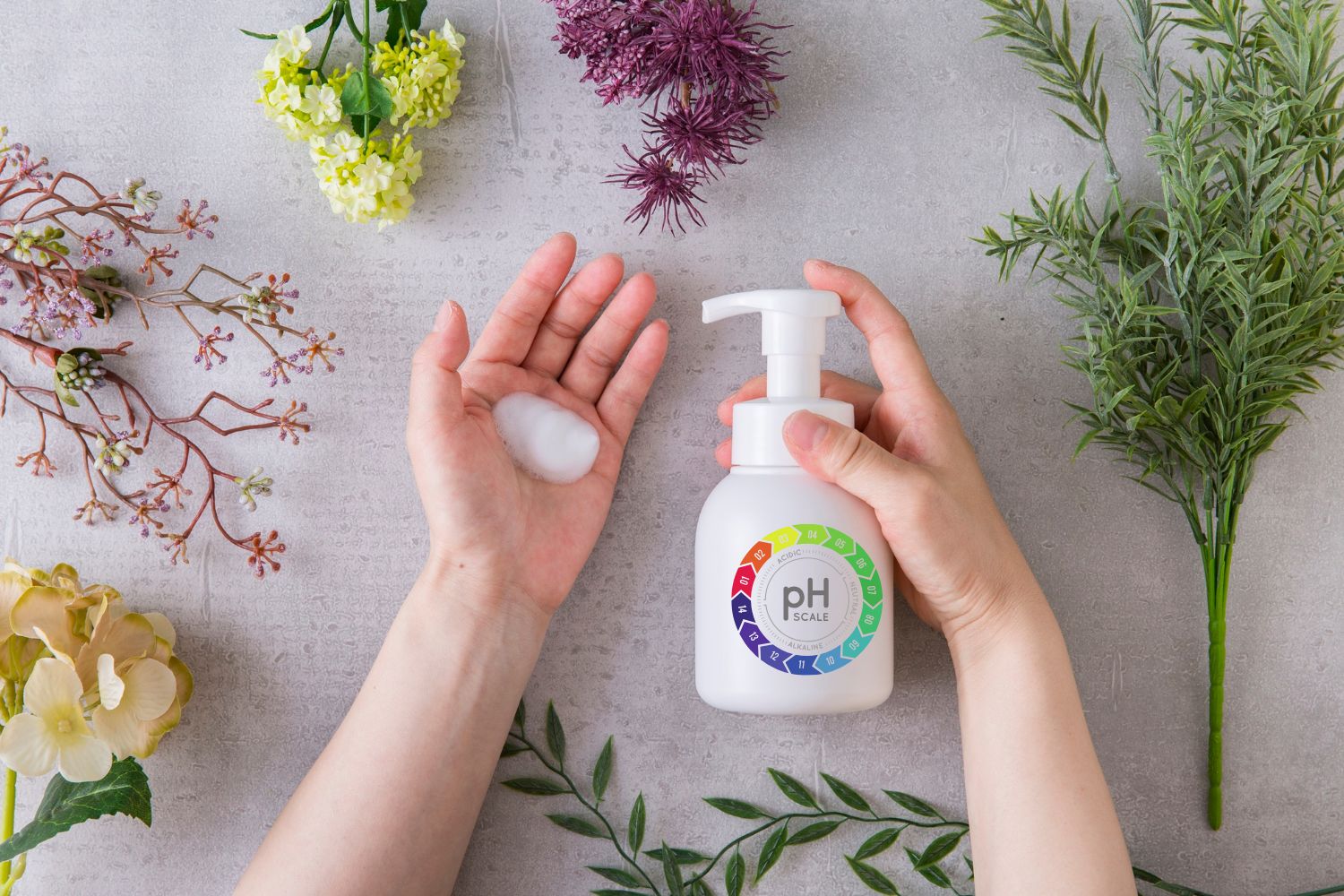
The pH measures the degree of acidity or alkalinity of an environment on a scale ranging from 0 to 14. The value 7 is neutral, below is acidic, above is alkaline. The intimate pH, in women of childbearing age, is physiologically acidic, generally between approximately 3.8 and 4.5. It’s not a detail: this acidity represents a natural defense mechanism.
This data is fundamental. The vaginal mucosa is not skin. It is an ecosystem regulated by lactobacilli that produce lactic acid, maintaining a protective environment. Numerous microbiological studies have highlighted how acidity is a key element in controlling bacterial growth. When the pH rises steadily above physiological values, the risk of microbiota imbalance increases.
5.5 may be a compromise solution in some conditions, but it does not represent a rule valid for all ages and all stages of life. However, pH is not an immobile constant. It changes with age, hormones and physiological events such as the menstrual cycle and pregnancy.
During the menstrual cycle the pH changes (and the numbers prove it)
The vaginal pH does not remain the same throughout the month. Several clinical studies have observed oscillations related to cycle phases. During menstruation the blood, which has a pH between 7.34 and 7.45, comes into contact with the vaginal mucosa and temporarily reduces its acidity. The pH may temporarily increase compared to the usual values of fertile age, due to contact with menstrual blood. It is a physiological variation, not an anomaly.
This explains why on those days some women feel greater sensitivity or a sense of “altered balance”. After the flow, with the resumption of estrogen towards the ovulatory phase, the pH progressively returns towards more acidic values, falling within the range of 3.8-4.5. The body regulates itself. But if at that moment we use detergents that are too alkaline or aggressive, we risk interfering with an already temporarily modified balance.
During pregnancy the pH remains acidic
Pregnancy does not “neutralize” the pH. On the contrary. The increase in estrogen stimulates glycogen production in vaginal cells, nourishing lactobacilli. The microbiota becomes even more dominated by these protective species and the pH remains acidic, generally within the typical range of fertile age (around 3.8–4.5), thanks to the predominance of lactobacilli favored by estrogen.
This acidity is a form of natural protection against ascending infections. Some studies have shown that a persistent increase in pH above 4.5 during pregnancy may be associated with a greater risk of infectious complications, although the interpretation must always be clinical.
At the same time, however, the hormonal environment of pregnancy can favor episodes of candidiasis. It’s a delicate balance: acidity protects, but the mucosa is more sensitive. In practice, during pregnancy there is no need to further “lower” the pH with aggressive detergents. We need to respect it.
During menopause the pH can rise
With the reduction of estrogen in menopause the entire vaginal ecosystem changes. Available glycogen decreases, lactobacilli decrease and the production of lactic acid is reduced. The pH tends to rise above 4.5 and can approach values closer to neutrality, often around 5–6, especially in the absence of hormone replacement therapy. This increase is related to greater dryness, fragility of the mucosa and susceptibility to infections.
Here the logic changes with respect to childbearing age. Forcing “thirty-year-old” acidity into a body that has changed its hormonal structure is not always sensible. We need adaptation, not rigidity.
So which pH should you choose for your intimate cleanser?
If during childbearing age the physiological pH is between 3.8 and 4.5, the detergent should be compatible with this range. Not necessarily identical to the tenth, but consistent with the natural environment.
During the cycle, when the pH temporarily rises due to the effect of menstrual blood, it is essential to avoid alkaline products that can amplify the alteration. During pregnancy, where the pH remains acidic around 3.8–4.0, it is important to choose ultra-gentle formulations. In menopause, with values that can approach 5–7, a less acidic cleanser may be more appropriate.
The truth is that there is no universal number that is valid for everyone, forever. For this reason it is better to stop buying “by heart” and start reading labels with awareness. Because the body changes. And the intimate cleanser should change with him.
You might also be interested in:
