
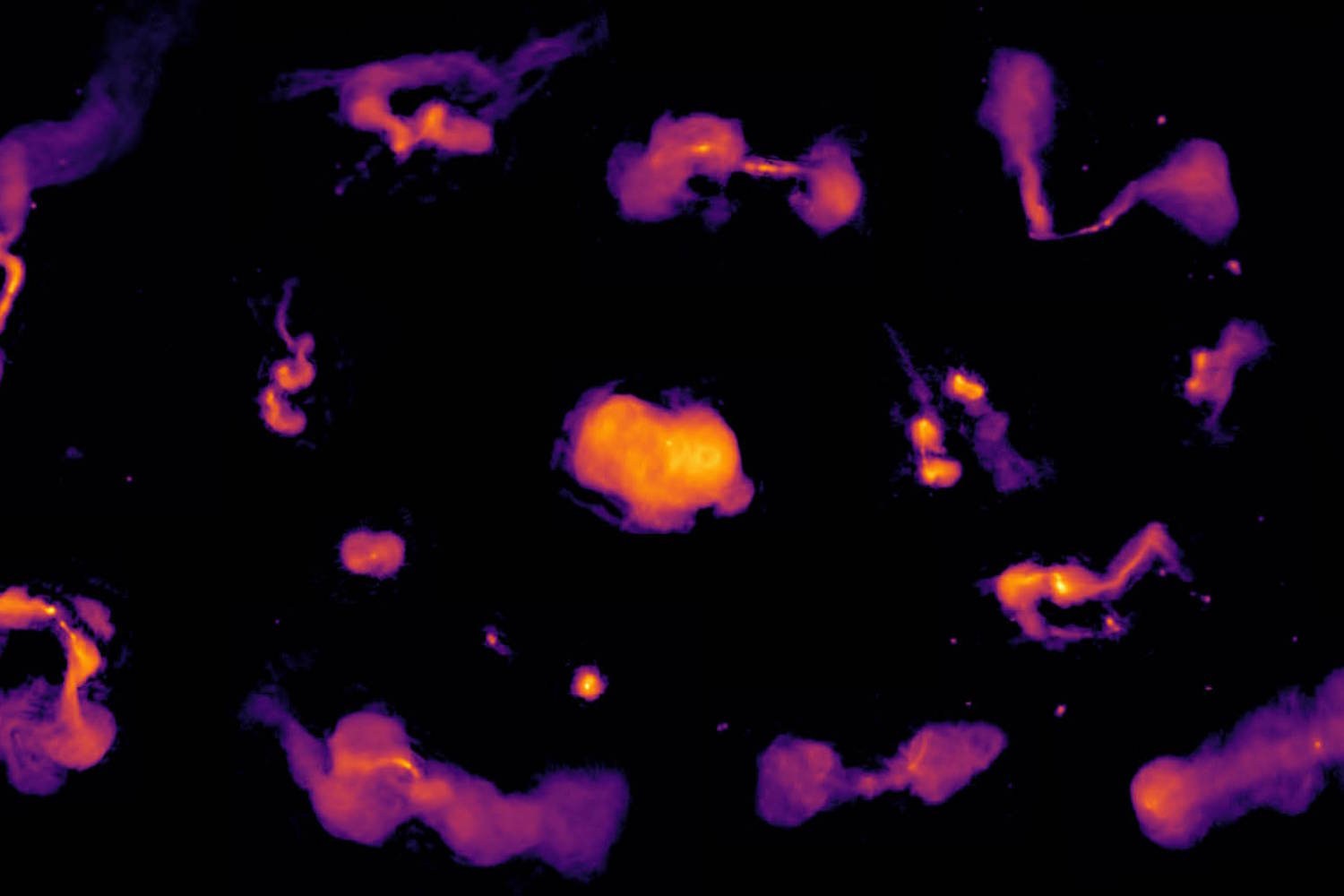
How wonderful! The European radio telescope Low Frequency Array (LOFAR) captured the third data set, 13.7 million cosmic sourcesthus allowing you to “draw” the most detailed radio map of the sky ever made (in 2022 the second dataset contained “only” 4.4 million sources). The data was collected as part of the work of a large international collaboration, which also includes ours National Institute of Astrophysics (INAF).
A map of the cosmos never made before
The map features an amazing variety of systems powered by black holeswhose radio emission can extend for millions of light years. The new investigation LOFAR Two-meter Sky Survey (LoTSS-DR3) scores one milestone in radio astronomy and in international scientific collaboration.
As astronomers explain, observing the sky at low radio frequencies, the survey reveals one radically different vision of the Universe from that observed to optical wavelengths (which cover the visible and infrared aspects).
In fact, much of the detected emission comes from relativistic particles moving through magnetic fields, which allows scientists to track energetic phenomena like powerful jets coming from supermassive black holes And galaxies undergoing extreme star formation over the course of cosmic time.
Thanks to its extraordinary level of detail, the investigation also brought to light rare and elusive objectsincluding merging galaxy clusters, faint supernova remnants and flaring or interacting stars, and is already enabling hundreds of new astronomical studies, offering new perspectives on the formation and evolution of cosmic structures, for example on how particles are accelerated to extreme energies and on cosmic magnetic fields, and making public the most sensitive large-area radio maps of the Universe ever produced.
Because LOFAR succeeded in this undertaking
This data publication brings together over a decade of observations, large-scale data processing and scientific analysis by an international research team – explains Timothy Shimwell, lead author of the work – This result highlights the model of the LOFAR European Research Infrastructure Consortium (LOFAR ERIC), which brings together expertise from the Netherlands, Germany, France, United Kingdom, Poland, Italy, Sweden, Ireland, Latvia and Bulgaria
LOFAR is in fact a “widespread” system, comprising 38 stations in the Netherlands and 14 international ones across Europe, with the most distant ones separated by almost 2,000 kilometres, thus forming one of the largest, highest resolution and most sensitive radio telescopes in the world.
We can study a diverse population of supermassive black holes and their radio jets at different stages of their evolution – echoes co-author Martin Hardcastle – showing how their properties depend not only on the black hole itself, but also on the galaxy and the environment in which it finds itself
The data is carefully analyzed in search of rare astrophysical phenomena and the team has already discovered several, including transient and variable radio sources, previously unknown supernova remnants, some of the largest and oldest known radio galaxies, and radio emissions compatible with interactions between exoplanets and their host stars.
Data analysis
Processing required it development of new techniques that accurately correct severe distortions caused by Earth’s ionosphere, the electrically charged layer of the upper atmosphere, through robust automation and optimization.
The software challenge was enormous – explains Cyril Tasse, who led the development of the algorithm – It took years to design, refine and optimize the algorithms, but they now allow us to regularly produce extremely sharp and detailed images of the low-frequency radio sky and to hunt for time-varying signals from stars and exoplanets
The last but not the leastextracting data from the telescope’s archives and distributing the computational workload across multiple high-performance computing systems posed an additional challenge.
The volume of data we handled, 18.6 petabytes in total, was immense and required continuous processing and monitoring for many years, using over 20 million hours of compute
reveals Alexander Drabentwho handled this part of the research
What will happen now (and what we can expect in the future)
LOFAR currently under construction update to LOFAR2.0: The collaboration plans to build on LoTSS-DR3 and take advantage of the doubling of detection speed offered by the updated tool.
Recent advances in data processing are also making visualizing survey data increasingly feasible much higher resolutionpaving the way for even more detailed studies.
LoTSS-DR3 is not an end point, but an important milestone – notes Wendy Williams, co-author of the study – New facilities like LOFAR2.0 will allow us to map the radio universe with even greater sensitivity and resolution, extending the legacy of this investigation well into the future
The work was published on Astronomy & Astrophysics.
Sources: Astronomie / INAF / NOVAastronomieNL/Youtube / Astronomy & Astrophysics
