
When we think of LEGO we imagine colorful houses, trucks, castles, maybe a spaceship built with painstaking patience. And then there are the “kids”, those who continue to accumulate boxes as if they were little treasures to display in the living room. This time, however, the bricks do not become collector’s items. They become pure physics.
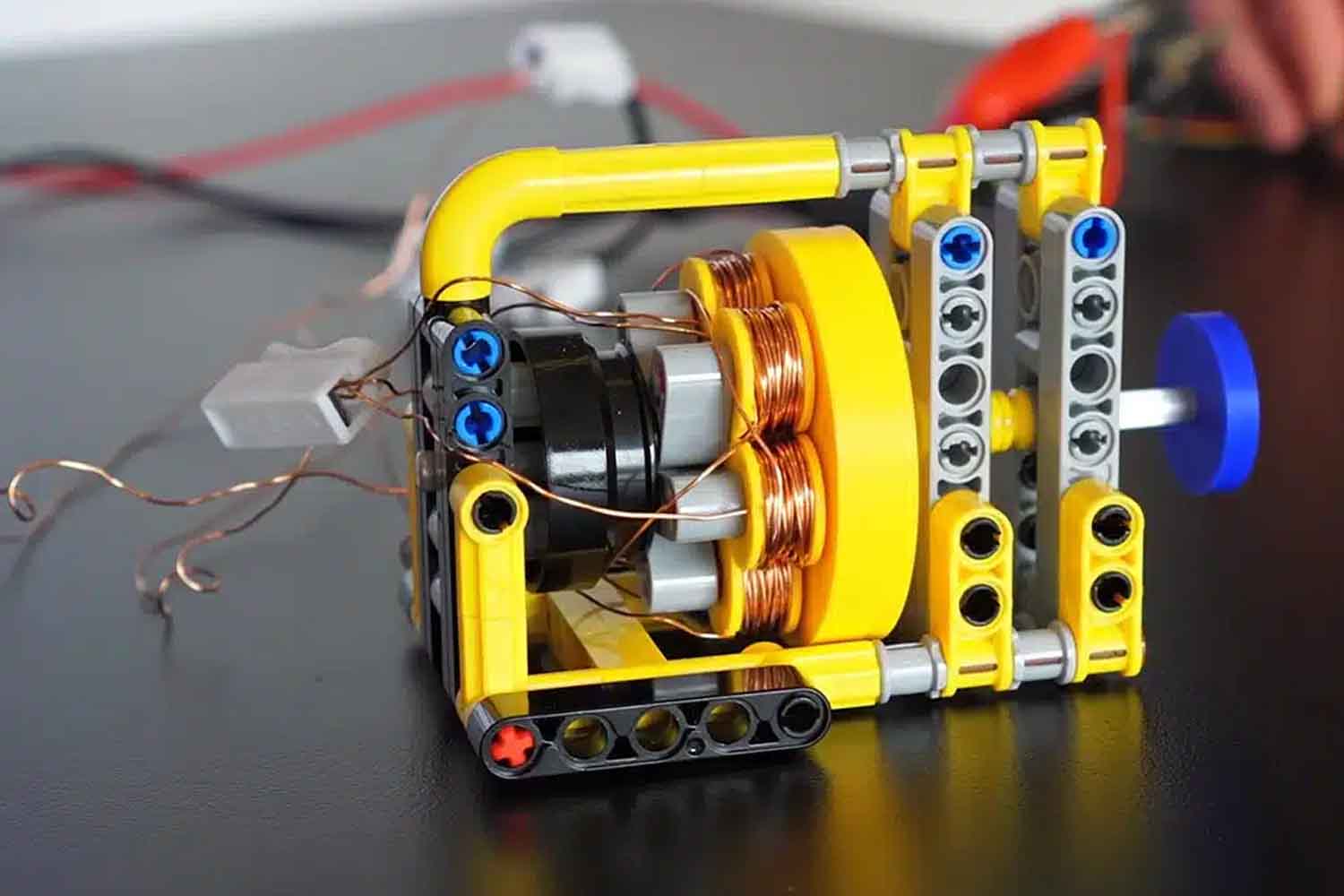
On the YouTube channel Jamie’s Brick Jams a creator managed to create a LEGO electric motor fully functional, capable of reaching up to 4,000 revolutions per minute. And no, he didn’t use microcontrollers, robotic kits or smart control units. Just magnets, copper wire, a transistor and a simple 9 volt battery. A lesson in electromagnetism that unfolds before our eyes.
An electric motor made of LEGO
The most fascinating thing about this project is not just the speed. It’s there transparency. There is nothing hidden here. The rotor is made of neodymium magnets attached to a LEGO axis. Around it we find a main coil of approx 150 copper coils: when current passes through it, a magnetic field is generated.
That magnetic field attracts or repels magnets. And it is precisely this alternation that sets the rotor in motion. There is no software that decides when to intervene. No lines of code. No apps. A second coil, of approx 100 turnsacts as a sensor: it detects the passage of magnets and sends a signal to a TIP31C transistor, which activates the next pulse. Synchronization occurs naturally, using exclusively the laws of physics. It’s a return to essentials. You dismount, you observe, you understand. And it works.
How the behavior of the electric motor changes in LEGO
In the simplest configuration, with two magnets, the motor reaches approx 1,300 rpm. By inserting a 3:1 gear reduction, speed decreases but torque increases, allowing it to power a small LEGO car. However, when the rotor is configured with eight magnetsthe speed drops to approx 480 rpmbut the movement becomes more fluid and the torque more constant.
And then there is the more extreme version, the one that goes up to 4,000 revolutions per minute. A surprising achievement if we consider that the power comes exclusively from a 9 volt battery.
The components always remain the same: main coil, sensor coil, TIP31C transistor, battery. No smart modules. No sophisticated electronics. Alone applied electromagnetism.
When LEGOs become tools for understanding the world
In an age where technology is increasingly complex and often invisible, seeing an engine work before our eyes has something reassuring. This LEGO electric motor demonstrates that innovation doesn’t always come from millionaire budgets or hi-tech laboratories. Sometimes all you need is curiosity, patience and the desire to understand how things really work.
For teachers and students it is an educational gold mine. For those who love science, it’s a powerful reminder: Electrical energy turning into motion is not magic. It’s physics. And we can observe it. Perhaps this is also the most interesting message: bricks are not just used to build imaginary worlds. They can help us understand the real one.
