
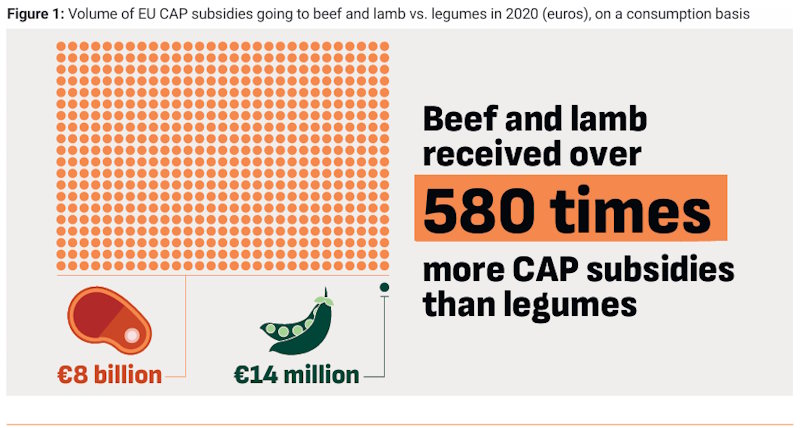
In 2020, the European Union allocated around 8 billion euros of Common Agricultural Policy (CAP) funds to the production of high-emission beef and sheep meat. Just 14 million went to legumes – such as lentils and beans, therefore 580 times more for meat and lamb than for low-impact vegetable proteins.
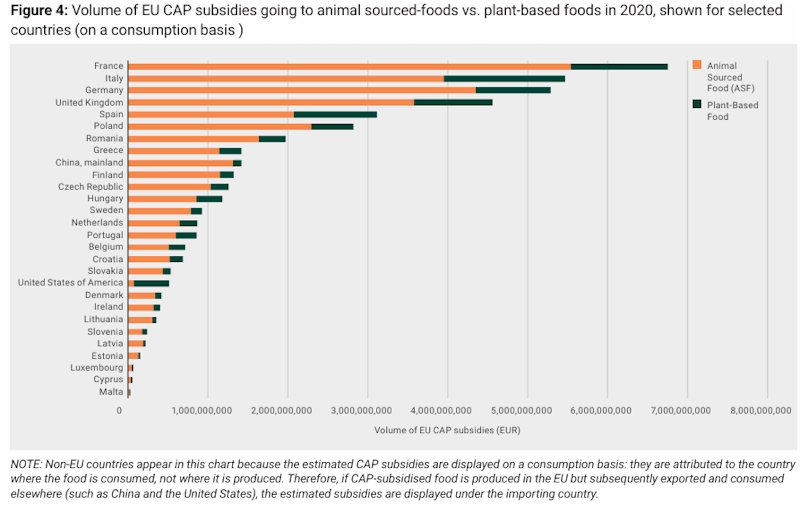
It is no better if you look at the dairy sector: 16 billion euros compared to just 29 million allocated to dried fruit and seeds, about 500 times more. Overall, in 2020 the EU directed three times more subsidies towards meat and dairy products than plant foods, with 77% of CAP funds (39 billion out of 51) going to high-emitting production.
These are the data that emerge from the new report “CAP at the Crossroads” of the Foodrise organisation, which photographs a highly unbalanced distribution of public funds: meat and milk have received over 10 times more subsidies than fruit and vegetables and 16 times more than cereals.
A climate (and health) paradox
The picture is even more critical if we consider the environmental impact. Foods of animal origin are responsible, according to estimates, for 81-86% of climate-changing emissions linked to European food production, despite providing approximately 32% of the calories and 64% of the proteins consumed in the EU.
Beef, in particular, can generate 21 to 62 times more emissions than legumes per gram of protein. Yet legumes, in addition to having a reduced climate footprint, improve soil fertility thanks to nitrogen fixation and bring health benefits.
It is therefore not surprising that in recent years there have been increasing calls to reform the CAP to support a transition towards healthy and sustainable diets, with a reduction in intensive farming. Among the voices calling for a change of direction are the European Court of Auditors, the World Bank and the EAT-Lancet Commission.
The CAP 2028–2034: opportunity or missed opportunity?
This year, European decision-makers are called upon to define the use of public funds for the period 2028–2034. The risk, Foodrise reports, is that meat and dairy products continue to receive the largest share of resources.
According to Martin Bowman, the organisation’s campaigns manager, it is “scandalous” that billions of taxpayers’ euros are supporting high-emitting production, distorting European diets and going against the EU’s climate and health targets.
Among the proposals put forward:
The benefits of a plant-based breakthrough
The adoption of the so-called Planetary Health Diet in high-income countries it could reduce agricultural emissions by up to 61%. Not only that: it would mean less dependence on imports, less use of fertilizers (up to -25%), fewer deaths linked to air pollution and a significant reduction in some forms of cancer.
Meanwhile, the European market for plant-based products is growing rapidly and could exceed 83 billion dollars by 2030, with hundreds of thousands of potential jobs in the alternative protein sector.
The 2024 strategic dialogue on the future of EU agriculture has already recognized the trend towards a more plant-based diet, calling it “crucial” to support it.
The CAP is at a crossroads. Continue to finance an agricultural model that weighs on climate, biodiversity and health, or invest in a food system capable of feeding Europe without compromising the future. The choice, this time, is political. And it affects all of us.
HERE is the complete report.
