
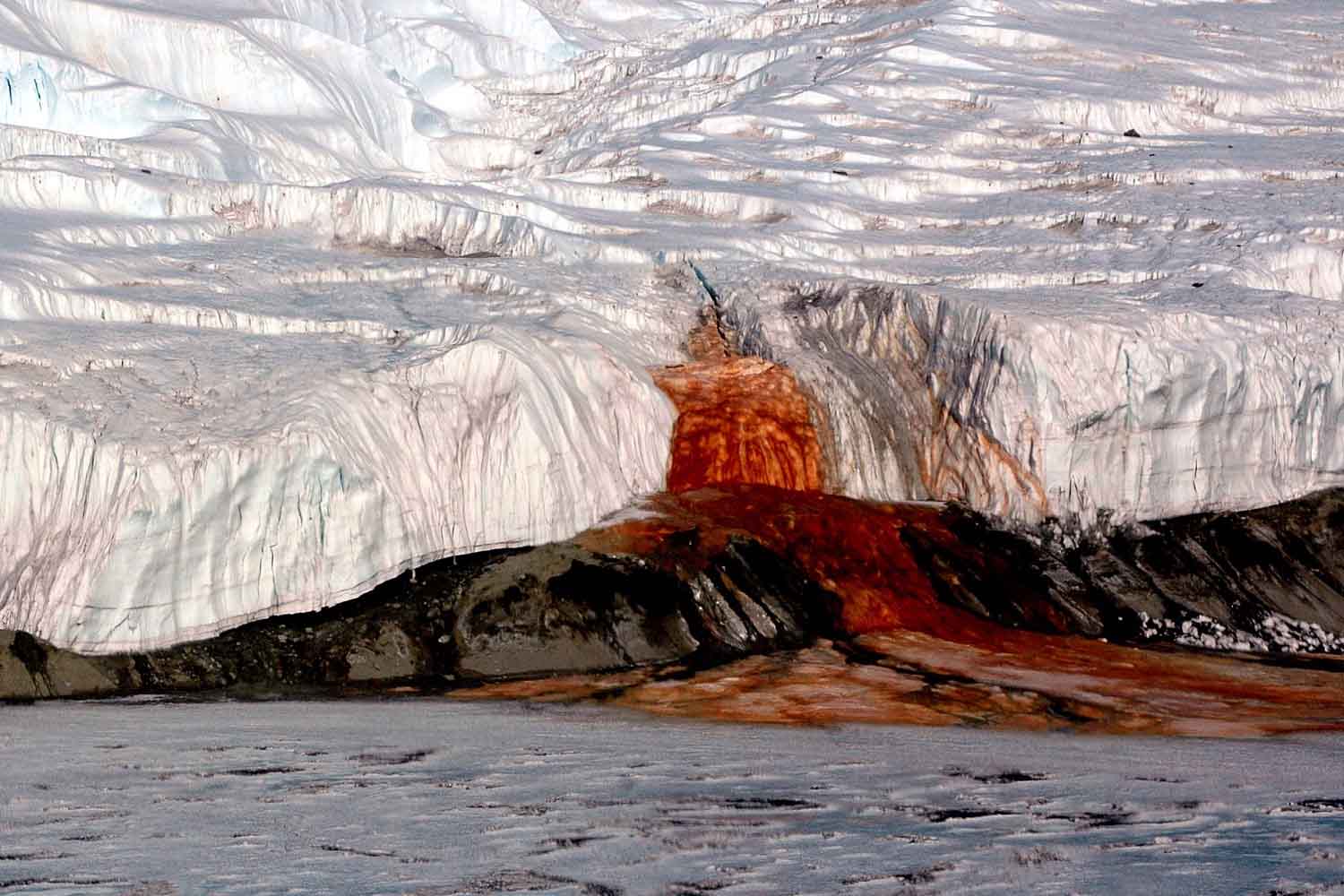
There are places on Earth that seem to belong more to science fiction than to geography. Antarctica is one of them. A continent that we associate with absolute silence, with blinding white, with the frost that immobilizes everything. Yet, right there, in the remote dry valleys of McMurdo, something happens that breaks the very idea of glacial purity: a dark red, dense, almost disturbing liquid periodically drips from the front of the Taylor glacier.
They call them blood waterfalls. The name sticks with us because the visual effect is powerful, almost visceral. The contrast between the white ice and that crimson flow leaves a mark even from a distance, even in photography.
Their scientific history begins in 1911, when the Australian geologist Thomas Griffith Taylor observed them for the first time during an expedition. For decades there has been discussion about their origin, between fascinating hypotheses and partial explanations. Today, thanks to a study published in Antarctic Science, even the last piece of the puzzle finally seems to be in place.
The red that is born under the ice
For a long time it was thought that the color was due to microalgae. A linear, almost reassuring explanation. The most recent research has opened up a completely different, more complex and infinitely more interesting scenario.
The deep red comes from tiny iron particles trapped in nanospheres along with silicon, calcium, aluminum and sodium. This material remains isolated underground for millions of years, incorporated into an ancient brine. When the fluid reaches the surface and comes into contact with the air, the iron oxidizes and takes on that rusty hue that stains the glacier.
At the origin of this process there are primordial bacteria trapped under the ice in an extreme and closed ecosystem. A microbial community capable of surviving without light and with very little oxygen, leaving behind a chemical trace that today we see exploding on the surface like a red signature on white.
Even the presence of liquid water in an environment that reaches temperatures around twenty degrees below zero has long represented an enigma. In reality it is a hypersaline brine formed about two million years ago, when the waters of the Southern Ocean retreated from the valleys. The very high concentration of salts lowers the freezing point and allows the fluid to remain liquid in conditions that would freeze any other mass of water.
The pressure that pushes the brine to the surface
One question remained: What force physically pushes this brine outward? The answer comes from a series of observations conducted starting in 2018 during one of the eruptions. The researchers combined GPS data, thermal sensors and high-resolution images, precisely reconstructing the mechanism hidden under the Taylor Glacier.
The glacier slowly slides downstream, exerting increasing pressure on the subglacial channels that hold the brine. The overlying ice mass compresses the underground deposits to the point of generating enormous stress. When the pressure reaches a critical level, the ice fractures and the pressurized fluid finds an escape route into the cracks, being expelled in short, spectacular explosions.
This release works as a natural hydraulic brake that temporarily slows the glacier’s movement. The system regulates itself through these episodes of leakage, in a very delicate balance that has been built over millions of years.
Today we can say that the mystery of the cascades of blood finally appears to have clarified its main dynamics. A chapter remains open regarding the future of this unique ecosystem. Global warming is changing the balance of the polar regions and such a sensitive system could react in ways that are still difficult to predict.
Blood Falls remains one of the most stunning images of Antarctica. They tell a story of ice, ancient bacteria, pressure and deep time. A story that reminds us how nature can be complex, powerful and capable of surprising even after more than a century of studies.
You might also be interested in:
