
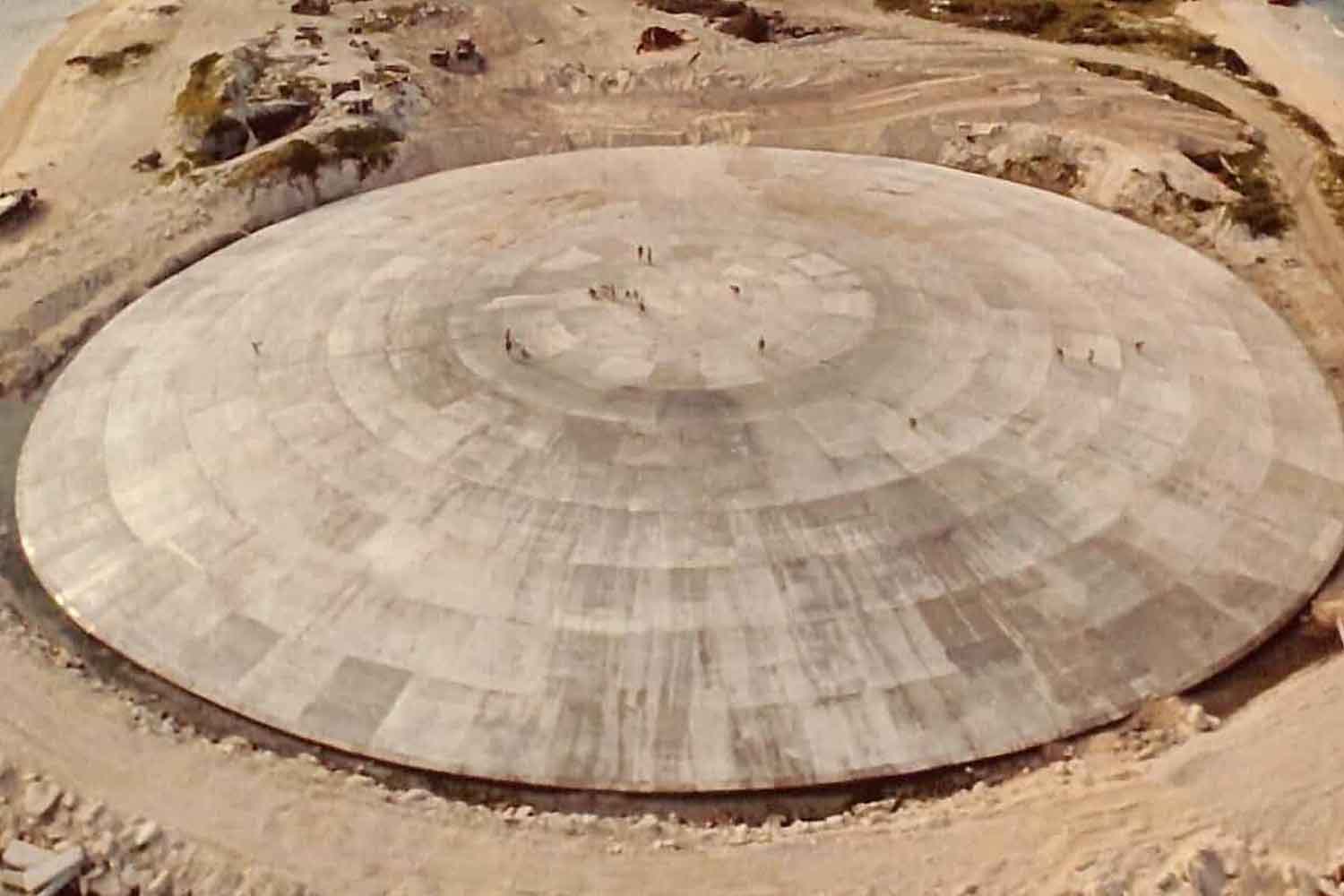
In the heart of the Pacific there is a place that tells better than any speech how political decisions can survive their authors. It is a story that weaves together Cold War legacies, hasty choices, radioactive contamination and the climate crisis. A legacy that today crumbles under the effect of rising seas.
That structure is known as Runit Dome, in the Marshall Islands. The inhabitants call it “The Tomb”. A name that does not arise from folklore, but from the awareness of what it preserves.
A hastily built plutonium tomb
The dome is located on Enewetak Atoll, inside a crater produced in 1958 by the “Cactus” nuclear test. Seen from above it appears like a perfectly circular concrete disk, about 115 meters wide, placed on the white sand like a gigantic lid. Under that 45 centimeter thick cover, more than 111,000 cubic meters of soil and radioactive debris were buried.
This is the residue of US nuclear tests conducted in the Pacific between 1946 and 1958. Among the substances present is plutonium-239, an extremely toxic isotope, with a half-life of 24,100 years. An infinitesimal amount can be lethal.
The dome was born as a quick solution to an immense problem. It was built between 1977 and 1980 during the Enewetak cleanup operation, when the United States was preparing to grant independence to the Marshall Islands. The project had a declared objective: to secure the area before the handover.
In reality, it was an economical and accelerated choice. The crater chosen to contain the contaminated material is located on a base of porous and permeable coral, already fractured by previous atomic explosions. The structure does not have any waterproof coating at the base. The concrete was poured onto land that communicates directly with the ocean.
Already at the time, the Environmental Protection Agency raised objections. Contractors also warned that sea water could infiltrate. The idea of sealing the bottom with a layer of concrete was discarded for reasons of cost and time.
Today that decision weighs like a boulder.
67 atomic explosions and a population sacrificed
The history of the Runit Dome has its roots in the post-World War II period. After World War II, the United States gained control of the Marshall Islands as a United Nations trust territory. The official mission included the protection of the inhabitants.
Between 1946 and 1958, 67 atmospheric nuclear tests were carried out. The total energy released was equivalent to approximately 1.6 Hiroshima bombs per day for twelve consecutive years.
Bikini Atoll and Enewetak Atoll were evacuated to be turned into test ranges. In 1954 the “Castle Bravo” test, a 15 megaton hydrogen bomb, was found to be a thousand times more powerful than Hiroshima. The radioactive fallout also affected inhabited atolls such as Rongelap and Utrik. Declassified documents show that authorities were aware of the direction of the winds.
The children played in a rain of radioactive ash that they mistook for snow. Secret medical studies, such as Project 4.1, conducted on the exposed population followed.
For years the reclamation remained in the background. In the 1970s, with independence imminent, the United States organized the cleanup operation. About 6,000 veterans participated in the work, often without adequate protection. Many handled contaminated debris with their bare hands, breathing in radioactive dust. Official reassurances spoke of minimal risks, comparable to a dental x-ray.
Many veterans have subsequently developed cancers, degenerative bone diseases and other serious conditions.
A structure that is crumbling today
The Runit Dome shows visible cracks. The concrete is deteriorating. Seawater seeps through the unlined base and the underlying water table rises and falls with the tides, carrying contaminants into the Enewetak Lagoon.
The US Department of Energy admits the leaks, but says the additional impact is negligible. According to this line, the lagoon would already be contaminated by decades of nuclear tests. A further release of radioactive material would produce a “negligible” dose increase.
A July 2024 report from the Pacific Northwest National Laboratory simulated a complete collapse of the dome in 2090. The conclusion indicates an annual increase of less than 0.2 millirem for residents, with no significant increase in health risk.
The question remains open on a political level. In 1986, the United States and the Republic of the Marshall Islands signed the Compact of Free Association. Washington considers that agreement a definitive closure of the claims. Since the dome is on sovereign Marshallese territory, the responsibility would fall to the local government.
Marshall Islands authorities dispute this interpretation. They argue that crucial information about the faulty design and the true extent of the contamination was omitted during the negotiations. A fact that emerged in the following years struck public opinion: the dome contained only 1% of the plutonium dispersed on the atoll. The remaining 99% is found in the sediments of the lagoon.
The climate crisis accelerates the risk
Rising sea levels pose a real threat to the Marshall Islands, which are made up of very low-lying atolls. Runit Dome was built at sea level, without considering future climate scenarios. Storm surges already exceed the edges of the structure during storms today.
A particularly intense typhoon, fueled by warmer ocean waters, could permanently compromise the dome. In an extreme scenario, radioactive material would be dispersed into the Pacific Ocean. For local communities, nuclear contamination is an everyday reality. Cancer rates are higher than average. Traditional food resources are compromised, resulting in dependence on imported foods and an increase in diabetes and obesity.
Structural solutions exist: a large waterproof containment system could be built on top of the current dome, or the radioactive material could be removed and transferred to a secure repository. Both options are expensive and, at the moment, are not the subject of concrete interventions.
The Runit Dome remains thus, exposed to the sun and the tides, a symbol of an unresolved nuclear legacy and of a still disputed international responsibility. Climate change is only accelerating a score that has remained open for over half a century.
You might also be interested in:
