
Reheating a ready meal in the microwave or traditional oven may seem like a harmless gesture that is now part of the daily routine of millions of people. But behind that practicality lies an invisible risk.
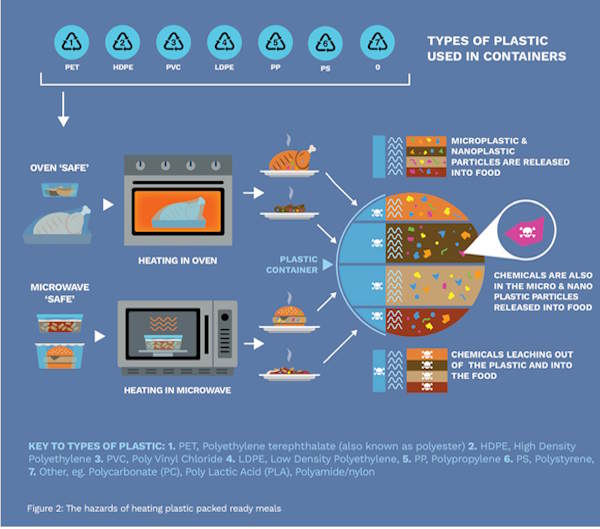
According to a new report from Greenpeace International, not surprisingly titled Are We Cooked? (“Are we cooked?”), plastic containers used for ready-to-eat and take-out foods can release hundreds of thousands of microplastic and nanoplastic particles directly into food, along with potentially dangerous chemicals.
People think it’s safe to buy and reheat a meal packaged in plastic: in reality we are being exposed to a mix of microplastics and dangerous chemicals that should never come into contact with the food we eat – says Graham Forbes, head of Greenpeace USA’s global plastics campaign. Governments have let the petrochemical and plastics industries turn our kitchens into testing laboratories – our report shows that “microwave safe” is nothing more than an illusion.
The report
The report, based on the analysis of 24 recent, peer-reviewed scientific studies, challenges a widely held belief: that containers referred to as “suitable for the microwave“are really safe. In one of the studies examined, heating for just five minutes led to the release of between 326,000 and over 500,000 plastic particles, with levels up to seven times higher than heating in an oven. Heat accelerates the degradation of plastic materials, favoring the release of microfragments and chemical additives into food.
Among the substances present in plastics in contact with food there are compounds already associated with serious health effects, such as:
Many of these are linked to hormonal disorders, infertility, metabolic diseases and increased risk of cancers. According to the research cited, over 1,300 chemicals from plastic have already been detected in the human body, a sign of widespread and continuous exposure. Containers that are more worn or scratched represent an even greater risk, because they release higher quantities of particles.
The problem concerns a rapidly expanding sector. Packaged ready meals are now worth almost $190 billion globally, while plastic production continues to grow rapidly, with packaging accounting for more than a third of the total. Yet, Greenpeace points out, regulations have not kept pace: there are no clear limits on the release of microplastics from food packaging, and statements such as “microwave safe” risk offering false reassurance to consumers.
This is why the organization is making an urgent appeal to governments involved in negotiations for the United Nations Global Plastics Treaty, calling for stricter rules and a reduction in plastic production at source. The fear is that a pattern already seen with other dangerous substances, such as asbestos and lead, is being repeated, where scientific signals have been ignored for too long.
The message is clear: plastic is not only an environmental problem, but also a health issue. And what happens every day in our kitchens demonstrates how urgent it is to rethink materials, packaging and habits, to truly protect what ends up on our plates.
