
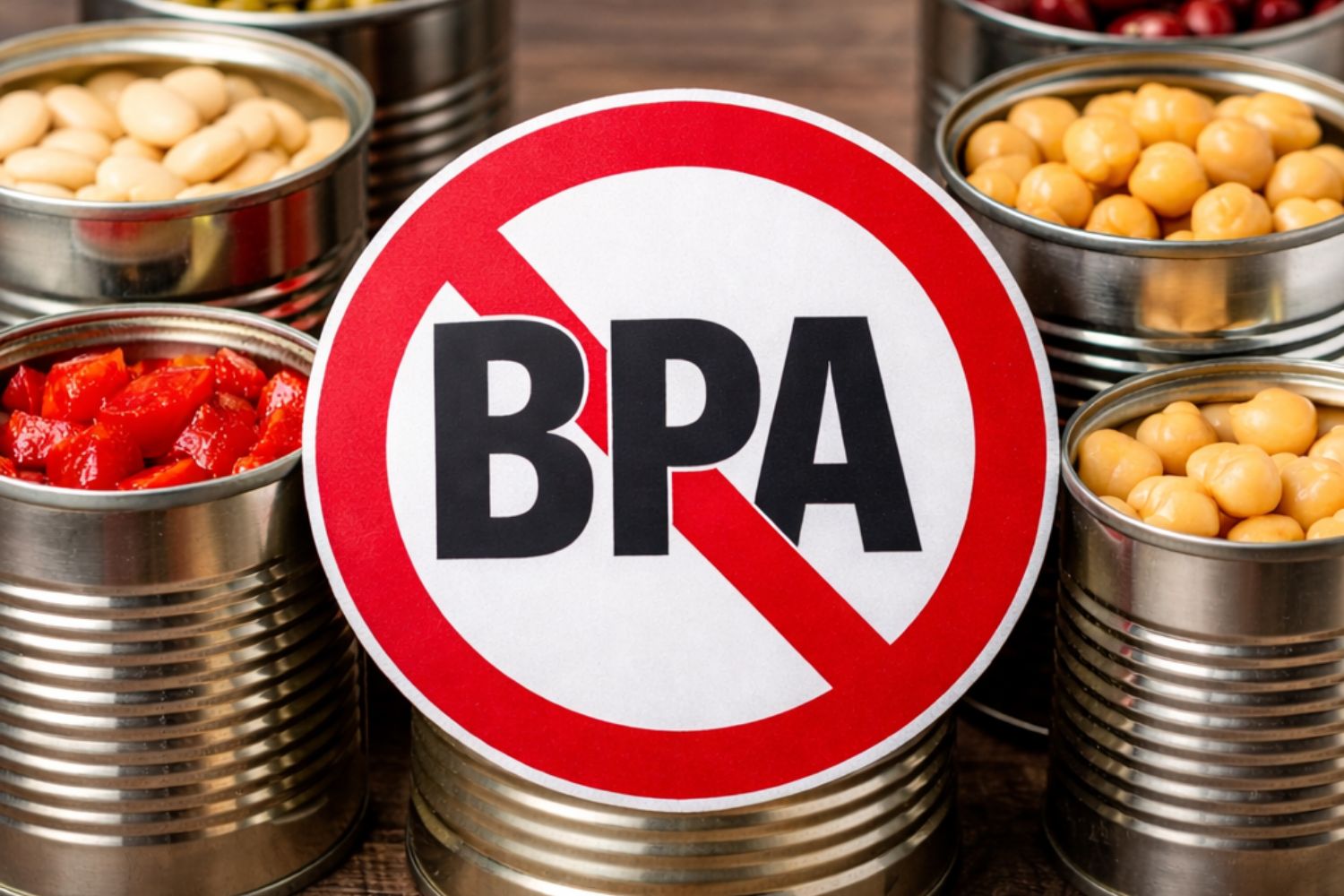
Have you gone shopping recently and wondered why the cans of chickpeas, beans, lentils or your favorite energy drinks are still there, sitting peacefully on the shelves? The European Union has officially banned Bisphenol A – commonly known as BPA – in all materials in contact with food, yet it is still possible to find it in abundance in Italian and European supermarkets. This is not a violation of the rules, it is simply the way regulatory transition works.
Let’s try to understand better.
What is Bisphenol A and why Europe has decided to ban it
Bisphenol A is a chemical substance used for decades in the production of plastics and resins. It is found in the internal linings of metal cans (the ones we use to preserve legumes, tomatoes, fish), but also in reusable plastic bottles, energy drinks and many other food containers. The problem is that this molecule does not remain passively in its container, it can in fact migrate into food and, from there, enter our body.
The effects on the human organism have been studied for years, and the picture that emerges is worrying. BPA is an endocrine disruptor, i.e. a substance capable of altering the functioning of the hormonal system. Prolonged exposure has been associated with fertility problems, immune system dysfunction, an increased risk of diabetes and cardiovascular disease, and even adverse effects on children’s brain development.
Considering all this, the European Food Safety Authority (EFSA) has drastically revised the tolerable daily dose downwards, believing that even very low quantities can have effects on the immune system.
The decision came in December 2024: with EU Regulation 2024/3190, BPA was banned from packaging, containers, kitchen utensils and water dispensers. The ban officially came into force on January 20, 2025, and although it is not a groundbreaking measure – France had already banned Bisphenol A in all food containers in 2013 – it is still an important step.
So why are products with BPA still on the shelves?
This is where the logic of industrial transition comes into play. Banning a substance does not mean that all products containing it will disappear overnight. The European regulation provides for different adjustment periods depending on the type of product.
For most single-use materials, such as soft drink and energy drink cans, the deadline for placing them on the market without BPA is 20 July 2026. After this date, manufacturers will no longer be able to supply supermarkets with batches containing BPA.
For more complex products, such as cans for canning tomatoes, fruit, vegetables, tuna and other acidic or fatty foods, the deadline for compliance is longer, until 20 January 2028, since replacing the internal lining requires longer tests to ensure its tightness.
The products already present in the warehouses can be sold until they run out, so realistically we will still be able to find “old generation” cans in 2026 for drinks and until 2029 for preserves.
This is a time window that the European Union deemed necessary to avoid creating traumatic disruptions in the production and distribution chain. An understandable choice from an industrial point of view, but which leaves consumers in a rather long gray area.
Infectious disease specialist Matteo Bassetti also recalled the risks of products packaged in cans with BPA in a post on Facebook.
What can we do while we wait
While waiting for all cans with BPA to be removed from the market, finding your way around isn’t easy. Some manufacturers have already anticipated the times, adopting alternative coatings and communicating this on the label with words such as “BPA free”. They are worth looking for. At the same time, it is useful to know that the greatest risks derive from prolonged and cumulative exposure: reducing the usual consumption of canned foods, preferring fresh or glass products when possible and storing leftover foods outside the original can are small measures that can make the difference.
However, there is another aspect that deserves attention: many manufacturers, to replace BPA before the regulation came into force, have already introduced other substances from the same chemical family, such as Bisphenol S. The problem is that recent studies suggest that these alternatives could have similar, if not even more serious, toxic effects. The European Chemicals Agency (ECHA) is considering broader restrictions on the entire bisphenol family, and new measures could come for these compounds too.
The ban on Bisphenol A is therefore an important milestone, but it is not the end of the story. It is the beginning — hopefully — of broader and more courageous regulation of all endocrine disruptors present in food packaging.
