
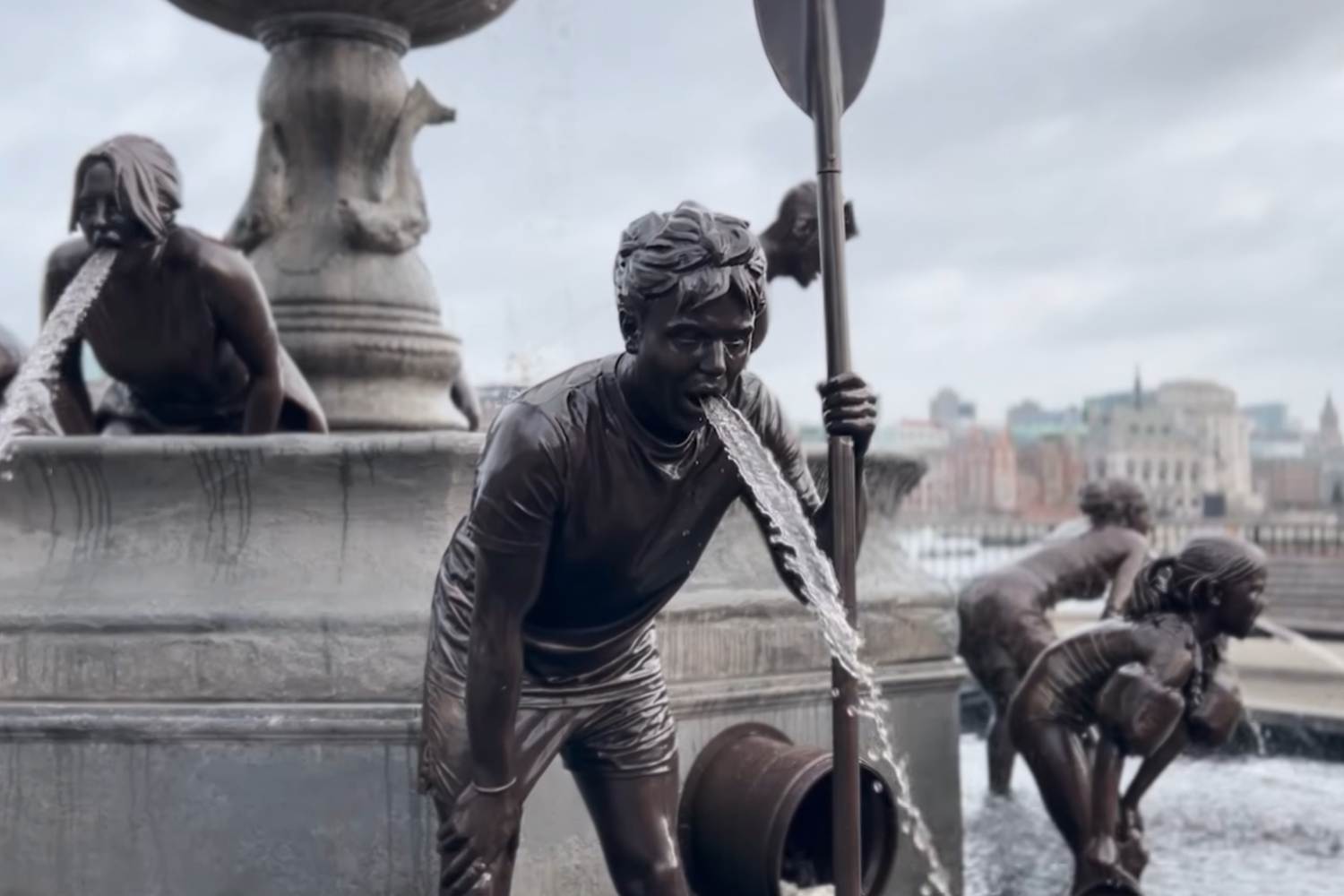
In the heart of London’s South Bank, at Observation Point, a fountain has appeared that celebrates neither heroes nor classical myths. Its statues, men, women and children, seem to vomit brownish, opaque water. The visual impact is immediate, almost disturbing. And this is exactly the goal.
The installation is called The Fountain of Filth and was created for the launch of DirtyBusinessthe new Channel 4 series inspired by true events. Not a simple promotional operation, but an urban intervention that transforms a traditional architectural symbol into an indictment of the UK’s wastewater crisis.
View this post on Instagram
From fiction to public denunciation
The structure, ten meters wide and installed from 23 to 25 February, reinterprets the aesthetics of monumental fountains in a contemporary key. Instead of clear jets, a dark flow visually recalls the untreated discharges that have fueled controversy and protests in recent years.
The faces of the statues are not generic. Some were made using 3D scans of real activists, including surfer and former national champion Sophie Hellyer and journalist Ella Foote. Their experiences, linked to exposures in contaminated waters, inspired the sculpted figures. Illness, discomfort and indignation become visible matter in public space.
The power at the top, the citizens below
At the top of the fountain stands a man in an elegant suit, with pockets and briefcase full of money. It is the most explicit metaphor of the work: while at the base the bodies suffer the health consequences, at the top sits the economic power accused of having favored profits over infrastructural investments.
The contrast is clear and designed to generate conversation. Art here is not decoration, but a political manifesto. The stated aim of 4Creative, Channel 4’s in-house team, is to turn a familiar object into a national talking point.
Beyond the fountain: a widespread campaign
A plaque with QR code invites passers-by to discover “the uncomfortable truth” behind the scandal, referring to testimonies and content connected to the series, broadcast from 23 February for three consecutive evenings. The project is part of a broader strategy: advertising trucks in front of the water company headquarters with direct messages and appearances on the beaches affected by the discharges.
In this way, television promotion becomes public pressure. The fountain is not limited to its shocking image. It makes an often invisible problem tangible, bringing it to the center of the city and of the debate. In London, for a few days, the water did not gush upwards. It made everyone look down.
You might also be interested in:
