
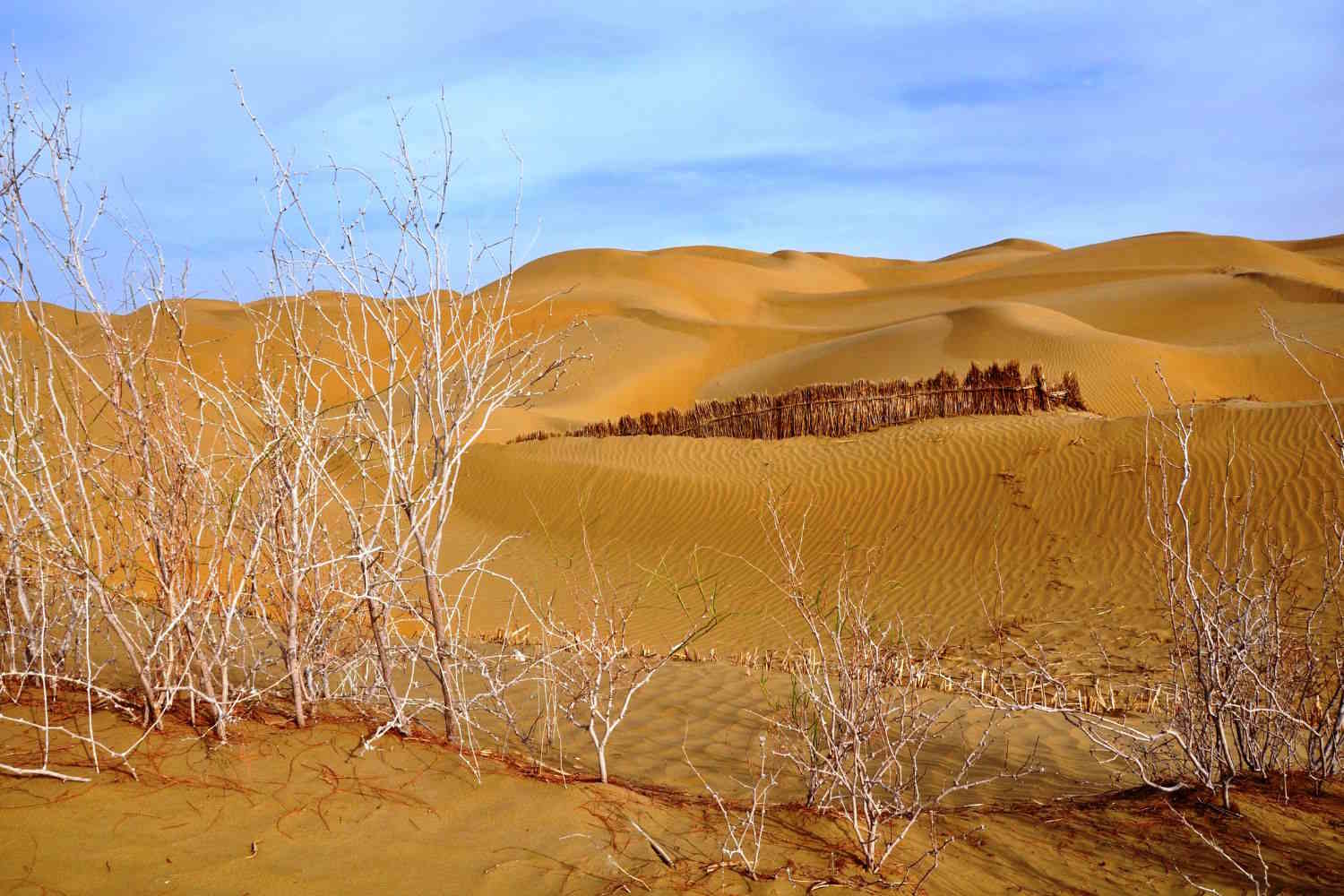
The desert advances in silence. It doesn’t make noise like a hurricane, it doesn’t overwhelm in a few hours like a flood, yet it modifies entire territories with implacable consistency, transforming fields, pastures and villages into arid expanses where life struggles to find space. Today, desertification threatens approximately 40% of the emerged lands, a fact that tells us better than any slogan how urgent it is to rethink our relationship with the soil.
In this scenario, news arrives from China that seems to come out of a visionary ecology manual: some scientists are transforming sand dunes into fertile soil using ancient microbes. And this is not an improvised experiment, but a 59-year study that has demonstrated how it is possible to accelerate soil formation in a surprising way.
The lesson of ancient microbes
When we think about fighting the desert we imagine trees planted next to each other, large reforestation projects and complex irrigation systems. China itself, on the edge of the Taklamakan desert, has invested for years in interventions of this type, achieving important results. However, nature had already written a much older and more essential strategy.
Even before plants appeared, cyanobacteria colonized extreme environments. These photosynthetic microorganisms, capable of surviving high temperatures and intense solar radiation, represent the true pioneers of arid ecosystems. When they intercept even a minimal amount of humidity, they produce polysaccharides, viscous sugary substances that act like a natural glue, binding the grains of sand together.
This is how the biological crusts of the soil are born, a sort of living carpet that compacts the sand, reduces erosion caused by the wind and creates a stable base on which, over time, native herbs and shrubs can take root. The principle is simple and powerful: stabilizing the soil means giving the ecosystem the opportunity to rebuild itself.
The study, published in the scientific journal Soil Biology and Biochemistryanalyzed samples from a field experiment that began nearly six decades ago, the longest ever conducted on this topic. The researchers compared natural biological crusts, which form spontaneously over many years, with Induced Biological Soil Crusts (IBSC), crusts induced through the controlled seeding of bacteria in the sand.
The difference is astonishing. Under natural conditions, the formation of a stable crust takes about fifteen years. With the induced technique, the same result is obtained in one or two years, compressing a generation-long process into a single favorable season.
The benefits aren’t limited to speed. The induced crusts show a greater capacity to accumulate carbon and nitrogen, fundamental elements for soil fertility. The levels of these nutrients progressively increase with the age of the crust, a sign that the system consolidates and becomes increasingly efficient in supporting life.
Bacteria seeds and drones: the desert regenerates from within
The most recent technological leap came from the Shapotou Desert Research and Experiment Station, where researchers developed actual “solid seeds” of cyanobacteria. In the past, liquid cultures were sprayed on the sand, a solution that required heavy machinery and electricity, which are difficult to find in the heart of the dunes.
Today the microbes are dried and mixed with organic matter, creating a dry, transportable product that is easy to distribute even manually or via drones. When it rains, these seeds are activated and the bacteria begin to produce their natural “glue”, quickly stabilizing the sandy surface.
The induced biological crusts integrate with the surrounding environment and become part of the local microbial community, contributing in a stable and sustainable way to the regeneration of the territory. However, they remain delicate structures: the passage of a vehicle or a herd can destroy years’ work in a few moments, making careful management of the treated areas essential.
A sustainable strategy against global desertification
One of the most interesting aspects of this approach concerns water consumption. Traditional reforestation campaigns often require significant water resources, a critical element in regions already affected by drought. IBSCs, on the other hand, have a much smaller water footprint, because they act directly on soil stabilization and exploit natural precipitation to activate.
The study also shows that these artificial crusts do not remain closed systems dominated by bacteria. The rapid accumulation of nutrients creates an environment favorable to the arrival of other plant and microbial species, starting a process of ecological succession that can gradually bring life back where previously there was only sand.
Over the next five years, China plans to rehabilitate around 100,000 mu, equivalent to around 6,600 hectares of desert land, using these microbial seeds. The extension may seem limited compared to the vastness of global deserts, but the cultural change it introduces is enormous: the fight against desertification can start from the microscopic, collaborating with the oldest processes on Earth.
You might also be interested in:
