
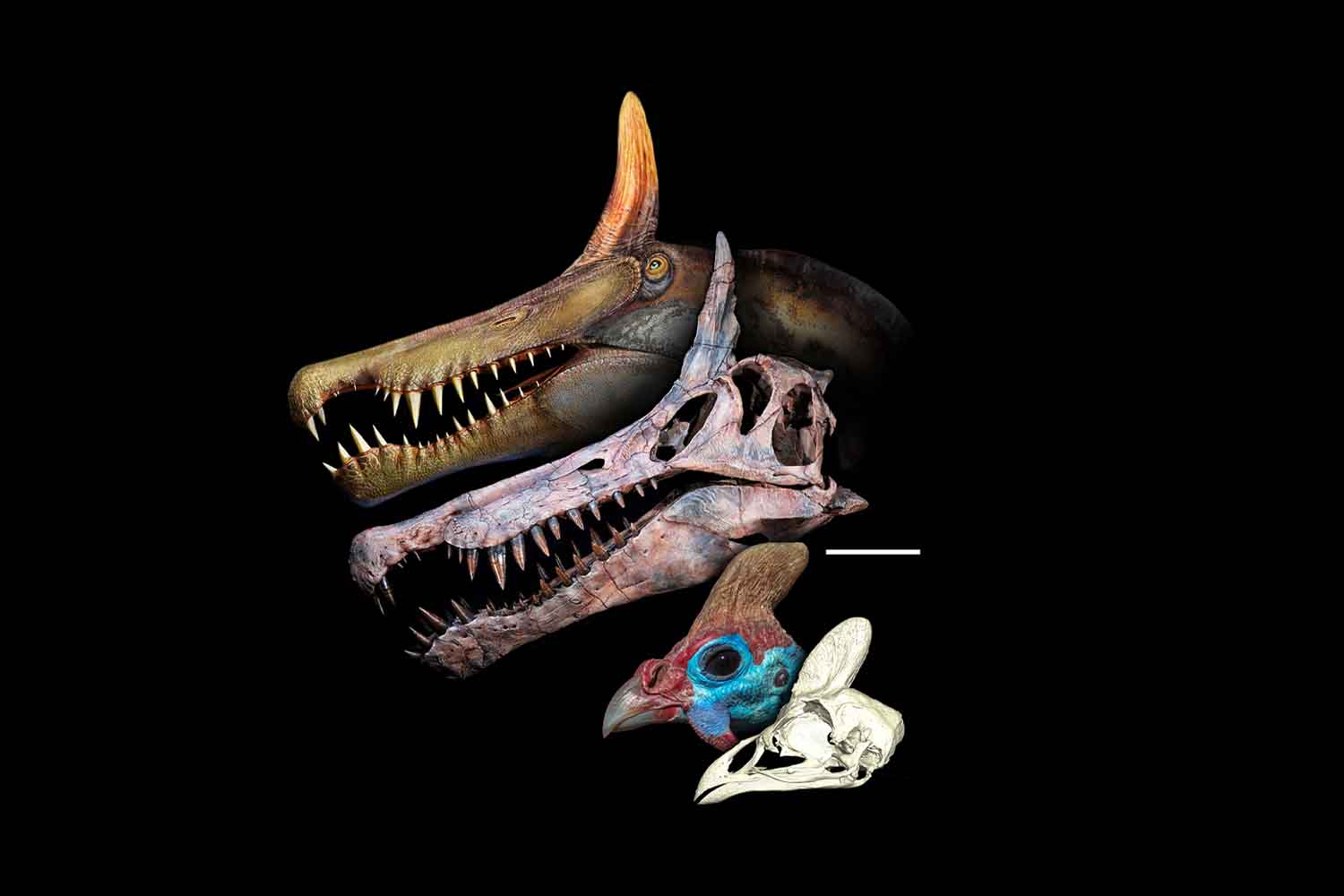
When we think of the great predators in the history of the Earth, the mind immediately goes to Tyrannosaurus rex, pop icon, protagonist of films and documentaries, very symbol of primordial strength. Yet paleontology, every now and then, still manages to surprise us and call into question certainties that seemed carved in rock. That’s what’s happening with the discovery of Spinosaurus mirabilisa new species identified in the central Sahara and described in a study published in Science.
Yes, because this new spinosaurus would have been over two meters longer than the largest known specimen of Tyrannosaurus rexthus gaining the title of largest predator ever to have lived on Earth. A statement that changes perspective and forces us to look with new eyes at a past that we thought we knew quite well.
A Cretaceous giant emerges from the Sahara
The fossil remains were found in the central Sahara Desert, Niger, in continental deposits dating back to ca 95 million years agoat the height of the Late Cretaceous. Today the Sahara is synonymous with sand and extreme aridity, but at the time it was crossed by river systems, wetlands and environments rich in life. It is in this scenario that the new protagonist of our story moved: Spinosaurus mirabilis.
The animal belongs to the group of spinosaurids, carnivorous dinosaurs between 2.35 and 5–7 meters tall, characterized by a elongated skullconical teeth and adaptations that suggest a strong specialization in the capture of aquatic prey. The most famous name of this group remains Spinosaurus aegyptiacus, famous for its spectacular dorsal sail, but the new species has even more particular features.
The skull of Spinosaurus mirabilis indeed shows a marked scimitar-shaped crestprobably covered in keratin when the animal was alive. A structure which, according to the authors of the study, would not have had a nutritional function, but rather a role linked to visual communication or recognition between individuals. A detail that tells of complex behaviors, perhaps social rituals or competition dynamics that we can only imagine.
A predator between rivers and land
The morphological analysis of the skull highlighted another fascinating element: the teeth of the upper and lower jaw fit together precisely, a characteristic compatible with a predominantly fish diet. This reinforces the idea that spinosaurids, and in particular the genus Spinosaurus, were predators specialized in fishingcapable of catching large fish in waterways.
However, these were not animals confined to the sea coasts. The geographical context of the discovery is a key aspect of the discovery: the remains come from internal deposits of the Sahara, far from the ancient coastlines even considering the different configuration of the continents in the Cretaceous. This suggests that Spinosaurus mirabilis frequented river systems and humid continental environmentsmoving with agility between water and land.
The hypothesis fits into a broader evolutionary framework, which sees spinosaurids going through a gradual process of adaptation: from initially more terrestrial forms, already equipped with useful tools for fishing, up to species increasingly specialized for semi-aquatic environments. In this scenario, Spinosaurus mirabilis represents a fundamental link in the evolutionary transitiona step that helps to clarify the diversification of the group.
Because this discovery changes our idea of dinosaurs
Every new species discovered adds a piece to the grand narrative of life on Earth, but in this case the piece is huge, literally. Knowing that there was a predator larger than T. rex, capable of living in internal river environments and with such peculiar morphological characteristics, broadens our understanding of ecological complexity of the Cretaceous.
The Sahara, which today we imagine as a hostile and immobile place, continues to return traces of a dynamic and surprising past, made up of rivers, swamps and gigantic carnivores that dominated African ecosystems. And it is fascinating to think that under those expanses of sand there are still hidden stories ready to rewrite what we know about evolution.
