
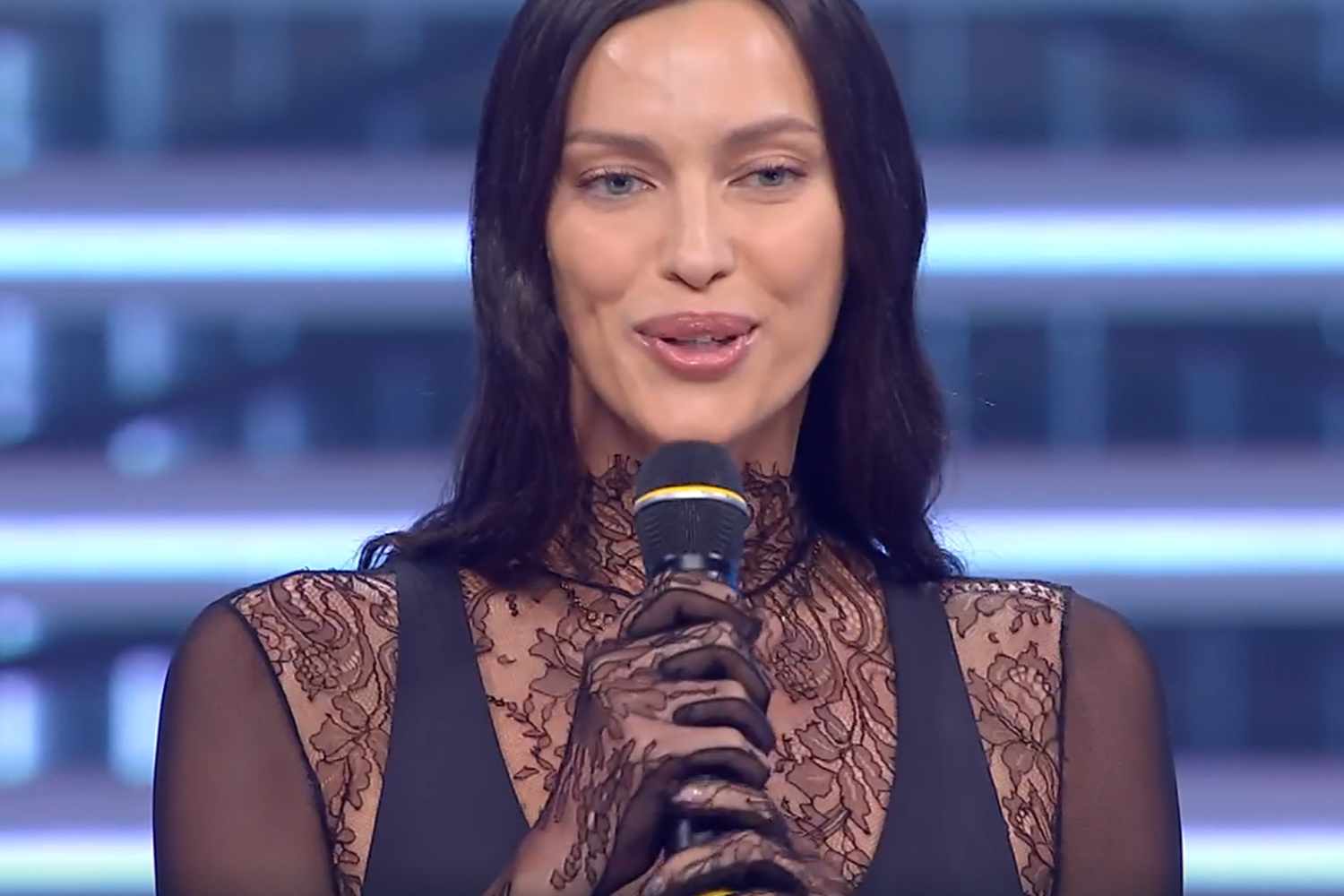
Let’s start by stating a key concept: no one wants to question the charm, professionalism and media power of Irina Shayk. Irina is a figure that amplifies any stage. What we ask ourselves today, with a cool head after yesterday’s Sanremo evening is: was it really suitable for THAT stage?
Upon his arrival it was immediately clear what his role would be. Going down the steps of the Ariston it shone with black, lace and transparencies amidst applause and flashes. The impact was immediate, social media in fibrillation, securities guaranteed. But if aesthetics dominated, content took a back seat.
The first moment with Carlo Conti became a curtain of fake sympathy which frankly tired us: “Carlo, I’m here for youThe joke triggers laughter from Laura Pausini, but what remains is a message reduced to symbolic courtship, a gesture designed more for the public than for the substance.
View this post on Instagram
Co-host or ornamental presence?
This is where the debate arises: the impression is that the choice was for scenic effect, not incisiveness. That beauty has occupied all the available space, leaving the content in the shade. A co-host should have a narrative function, a recognizable voice, a thematic contribution.
In Shayk’s case, many perceived a use closer to the ornamental dimension than the authorial one. Bold clothes, light jokes, non-existent Italian complete with supporting translation: elements that fueled the sensation of a return to dated television dynamics.
It is true that this Festival, also deliberately due to the passing of Pippo Baudo, harks back to Festivals of other times, when women on stage were often a decorative presence rather than a protagonist. But let’s talk about years gone by, when Italy opened up to foreign “valleys”. An image that in 2026 clashes with a public narrative that claims equality, competence, conscious representation of women. Not of an object woman.
The crux of commodification
The point is not to reduce Shayk to a negative symbol. On the contrary. The risk is precisely that of falling into the same trap that is criticized: turning a professional into a target. The theme is broader and concerns the commodification of the female image in entertainment. If the choice of a co-host falls mainly on beauty, the implicit message weighs heavily.
Sanremo is a showcase that builds narratives. When you choose an international figure, you can decide to enhance not only their face but also their voice, ideas and point of view. In this case, the widespread impression is that the surface was preferred. She certainly did what was asked of her: impeccable stage presence, smile, elegance. She is a fashion icon and has proven herself to be so. But Sanremo asks and demands something else and cannot be (just) a fashion catwalk. Sanremo knows how to be powerful when it combines music and entertainment, but this time it has chosen to stop one step earlier.
We still have a lot to learn about the role of women (and disability)
Unfortunately, TV, of which the Festival is the emblem, pays an invisible price: that of words that reduce people to stereotypes. And it’s not just an issue that concerns Irina Shayk. We saw it with the “special” children of the Anfass choir invited for the “disability bonus”, where every sentence seemed circumstantial, superficial, masking a vision anchored to the past.
We saw it with Francesca Lollobrigida, introduced as a “golden mother”, not as a multiple Olympic champion. The skater, winner of two gold medals at the Milan-Cortina Olympics, saw her identity reduced to a maternal role, neglecting her sporting merit. No one would dare call a male athlete “golden dad”; yet, in this case, motherhood becomes the main lens for reading a woman’s successes.
And again with the Rag Dolls issue that exploded in the press conference. Here the Milanese rockers found themselves having to face the statements of a journalist who minimized the patriarchy: “My wife is in charge in my house”. Their response, dry and precise, was “We don’t want to rule at home, we want power everywhere“. A blow to superficial narratives that relegate women to the background role, behind someone else’s success. Or rather, a man’s.
And if it is true that the Festival is a microcosm of Italian society, this type of stereotypes can no longer be accepted. We still have so much, too much, to learn.
No real reference to peace
Finally, a personal reflection. Last night was announced as an evening dedicated to peace and we saw it with the interpretation of Heal the World by Laura Pausini with the children of Antoniano. Perhaps rhetorical, but it was there, as was the singer’s appeal to stop all war.
Irina’s origins are now known: she is Russian. Although he made it clear in the press conference that he did not want to become a political symbol, we did not hear any kind of reference to the war in Ukraine. If we wanted to give a deeper signal on a symbolic evening, there remains a sense of missed opportunity. A slogan was not needed, a flag was not needed, one word was enough: peace. Because peace is not political, it is what we should all hope for.
View this post on Instagram
You might also be interested in:
