
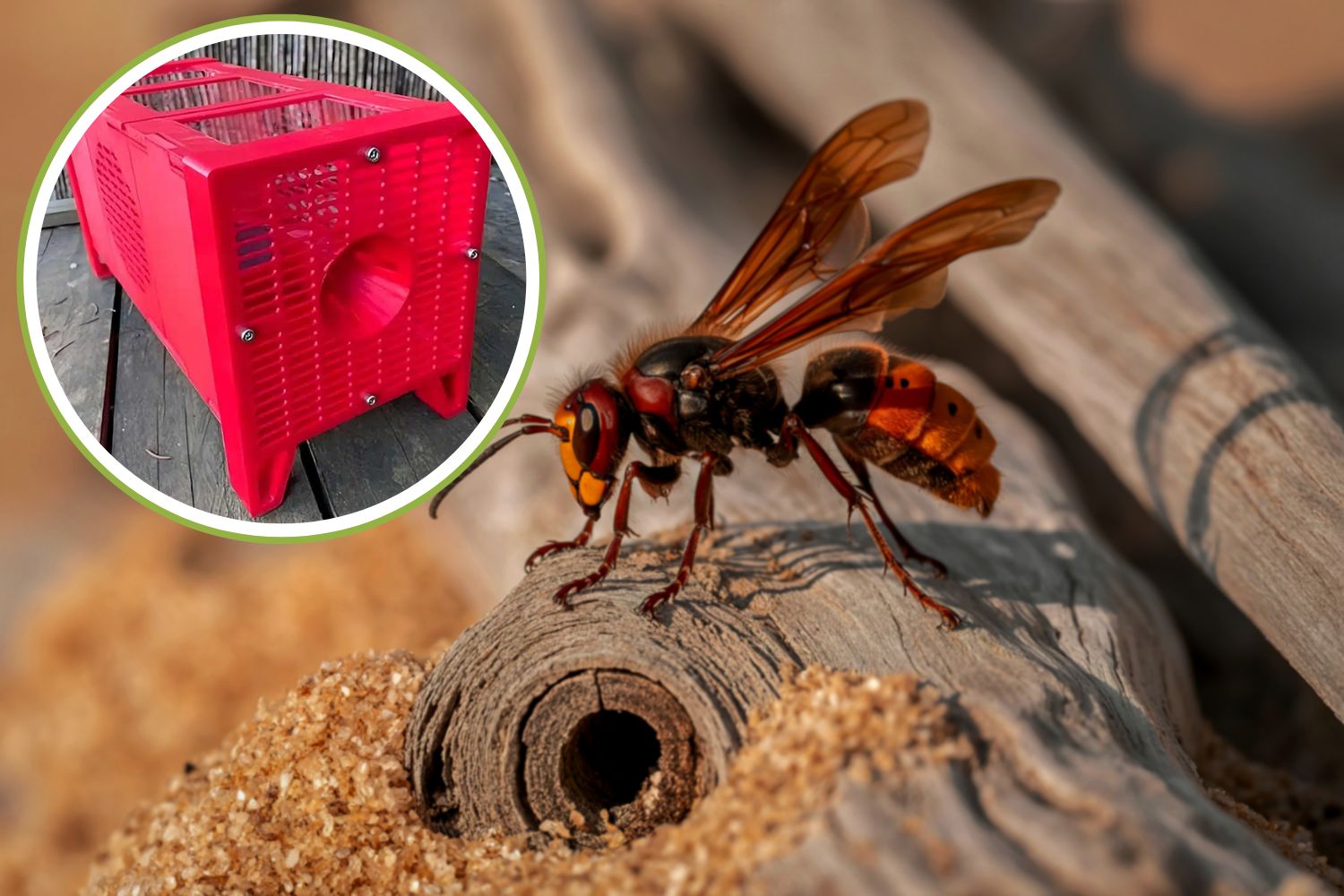
There is a time of year when the fate of bees is decided in the silence of our gardens. It is early spring, when the queens of the Asian bumblebee, known scientifically as Vespa velutinacome out of hibernation and begin looking for a place to found a new colony. It is in those days that the most important game is played, the one that can avoid the birth of thousands of specimens ready to besiege the hives during the summer.
In France this step is not left to chance. More and more Municipalities have chosen to intervene directly, distributing free traps against Vespa velutina to citizens and transforming the fight against the Asian hornet into a shared responsibility. A model that is also causing discussion beyond the border and which inevitably leads us to ask ourselves what is happening in Italy.
Free traps against Vespa velutina: the French model
In recent years, several French municipalities, especially in the most affected areas such as New Aquitaine and Brittany, have launched public spring trapping campaigns for the Asian hornet. The mechanism is simple but strategic: intercept the queens between February and May, before they build the first nest.
Citizens can collect traps for free at the town hall, often by presenting proof of residence. In some cases, a card is also provided to note the number of catches, so as to feed a territorial monitoring system that allows us to understand the trend of the infestation year after year.
In Brittany, selective devices are being tested, designed to minimize the accidental capture of bees and other pollinating insects, while in Belgium some administrations even cover the costs of destroying the identified nests, supporting distribution with public information meetings.
What is striking is the collective dimension of the initiative. The fight against Vespa velutina becomes a civic, visible, organized action, accompanied by training and scientific data. It is not just a problem for beekeepers, but an environmental issue that affects everyone.
Because catching queens in the spring changes everything
The Asian hornet is not just a simple annoying insect. It is a specialized predator that positions itself in front of the hives and intercepts the bees in flight, weakening entire colonies to the point of compromising their survival. A single colony of Vespa velutina can produce thousands of individuals in a season.
That’s why spring trapping is considered crucial: each queen captured means one fewer nest, and one fewer nest means thousands fewer hornets over the summer. It is a preventive logic, which aims to intervene before the problem explodes.
In France this awareness has pushed local administrations to invest in coordinated campaigns, involving citizens, schools, beekeepers and environmental associations in a shared action to protect biodiversity.
Asian hornets: how to capture a vespa velutina queen and why it should be done by March 20th
And in Italy? The situation of Vespa velutina
Vespa velutina has also been present in Italy since 2012, with consolidated outbreaks especially in Liguria, Piedmont, Lombardy, Veneto, Emilia-Romagna and Tuscany. The problem is known and monitored, but the approach is different than the French one.
In our country, management is mainly based on regional monitoring networks, citizen reports and coordinated interventions with beekeepers and competent authorities for the removal of nests. Spring trapping is recommended, but we rarely see free and widespread distribution of traps by municipalities.
It is often beekeepers’ associations that promote information campaigns or provide information on do-it-yourself selective devices, while local administrations intervene above all in the phase of identifying and destroying nests.
The difference lies not in the severity of the problem, but in the structure of public intervention. In France the Municipality becomes a direct protagonist of prevention; in Italy the model is more fragmented and delegated to technical and professional networks.
A challenge that concerns everyone
The spread of the Asian hornet is an issue that affects the health of ecosystems, the balance of biodiversity and the survival of bees, which are fundamental for pollination and agricultural production. The comparison between the French and Italian models opens up a broader reflection on the role of local communities in environmental protection.
Spring remains the decisive moment. It is there that it is decided whether a territory chooses to intervene preventively or whether it will simply manage the consequences in the following months. And perhaps, by observing what is happening across the border, we can begin to imagine an even more coordinated response in our country too.
You might also be interested in:
