
There are places where water does not flow in rivers, does not rest in lakes and does not flow from underground springs. Yet, tens of thousands of people live there, hundreds of thousands of tourists arrive every year and life flows with surprising normality. In the middle of the Atlantic, Bermuda has transformed a geographic boundary into a global lesson in water resilience.
We are talking about an archipelago that is home to around 65,000 residents and welcomes over half a million visitors a year. A territory battered by some of the most violent hurricanes on the planet, devoid of natural reserves of fresh water and built on a porous rocky base that swallows rain in a few moments. By all logic, he should have succumbed to thirst centuries ago. Instead it thrives.
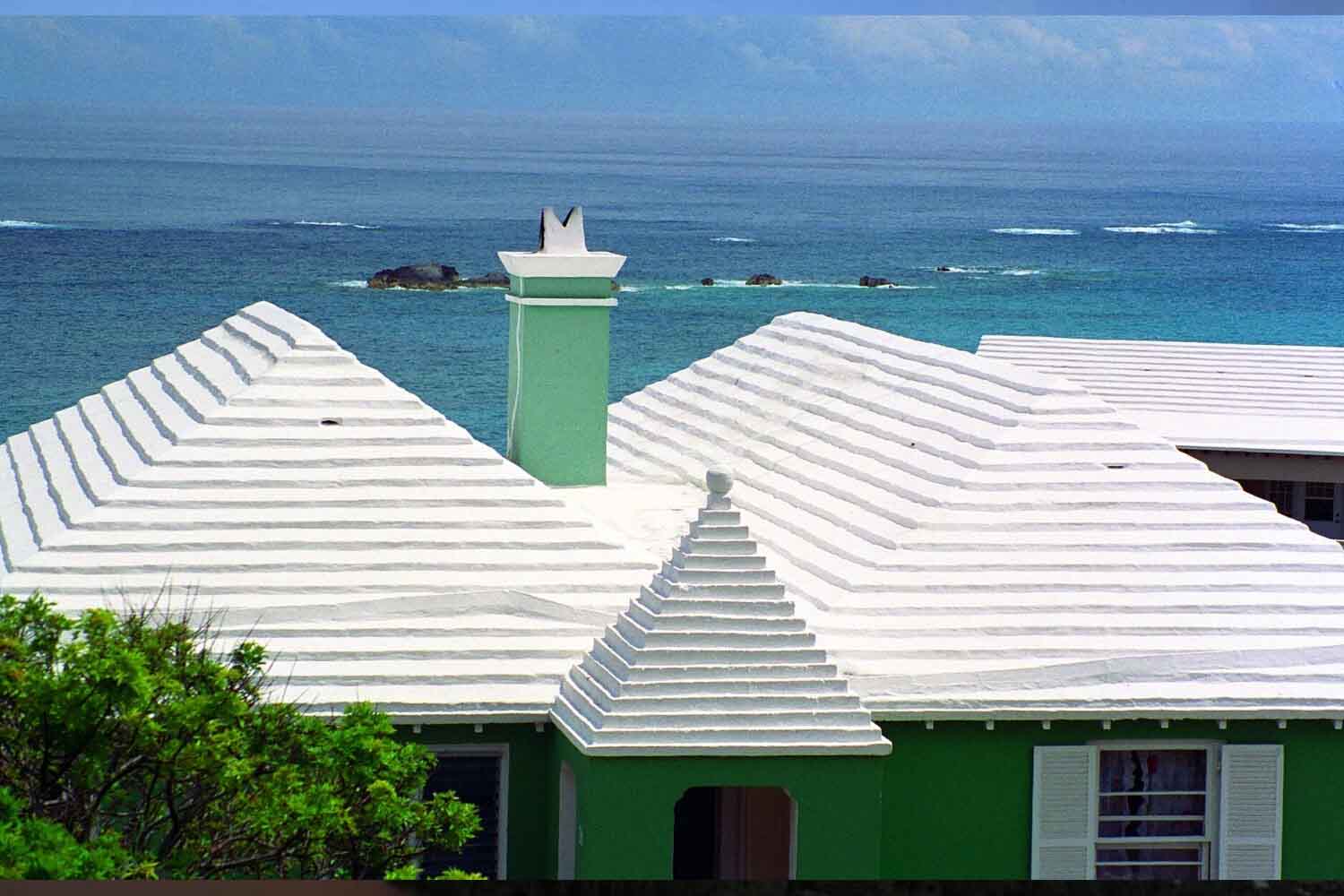
The answer is there for all to see: every building is a rainwater collection system. And those white stepped roofs, so distinctive they appear to be covered in icing, are the heart of a strategy that many drought-stricken cities should study carefully today.
An architecture born from necessity
The archipelago is a limestone cap sitting on an ancient volcano. The rock is so porous that when it rains, water immediately seeps down. Freshwater lenses form underground and float on top of the salt water, but contamination is inevitable. The result is simple: that water is not drinkable.
When the Virginia Company’s ship Sea Venture crashed on the coral reefs of Bermuda in 1609, the survivors immediately realized two things: cedar wood was perfect for building boats and the island completely lacked water to drink. Three years later, in 1612, stable colonization began.
Early settlers attempted to replicate English homes with wood and thatch roofs. The Atlantic winds destroyed them mercilessly. It was then that they decided to observe the ground under their feet and began to use local limestone, experimenting with solutions until they defined a structure that still characterizes the landscape today. The Bermudan roof is not an aesthetic detail, but a survival device.
The limestone slabs are placed on a cedar frame and overlapped, creating a sequence of steps. This geometry slows the water during tropical storms, when the rain falls slanting and lashing. The steps work like small brakes that prevent water from overcoming the gutters.
The same structure breaks air currents during hurricanes. Smooth surfaces generate lift, like airplane wings. The stepped roofs interrupt the flow and anchor the building to the ground, transforming it into a sort of protective shell.
When rain hits the limestone, it runs down the steps and is channeled into channels built into the walls, called “glides.” From there it reaches large underground cisterns, dug under the houses. The law imposes very strict criteria: for every square foot of roof you need eight gallons of storage capacity and at least 80% of the surface must be dedicated to collection.
In rural areas there is no public water network ready to intervene. Each family is responsible for its own reserve. Rain is a currency. An intense downpour is called a “tank-filler”.
Those who grow up in Bermuda learn the value of a glass of water before they even read. The tap closes while brushing your teeth because the reserve is concrete, visible, limited. During storms, in older homes, you can hear the water running through the pipes like a reassuring melody.
The white that protects and purifies
The white color of the roofs has a function that goes beyond aesthetics. In the past, a mixture of lime, water and sometimes whale or turtle oil was used to waterproof surfaces. Lime, derived from heated calcium carbonate, has high alkalinity. When rain runs off your roof, tiny particles dissolve into the water, increasing the pH and creating an environment hostile to bacteria. It is a natural system with antimicrobial properties.
Today many homes adopt modern paints, but the principle remains: white reflects the intense subtropical ultraviolet radiation, contributing both to the purification of water and the cooling of internal environments. It is an example of passive thermal regulation that reduces energy needs.
A model for a thirsty planet
In Bermuda, water is not perceived as an automatic right flowing invisibly from a distant pipe. It’s a daily responsibility. This awareness changes behaviors, habits and priorities.
In the rest of the industrialized world, centralized infrastructure has created a distance between the source and the consumer. Water networks are being put under increasing pressure by extreme events, prolonged droughts and increasingly intense storms linked to climate change. From California to Cape Town, entire metropolises face recurring water crises.
The Bermuda system suggests an alternative: a distributed network of domestic micro-reservoirs alongside large infrastructures. A low-tech, scalable and resilient solution.
However, the island had to adapt. With the explosion of tourism in the twentieth century, hotels and accommodation facilities showed the limits of rain collection alone. Multi-storey buildings with hundreds of rooms multiply consumption without increasing the roof surface area. The calculation becomes unsustainable.
They then drilled into the delicate freshwater layers and built desalination plants that filter the ocean through reverse osmosis membranes. Today about a quarter of the water requirement comes from these systems and, when domestic cisterns are empty, tank trucks distribute desalinated water.
Many inhabitants experience this integration as a symbolic surrender. The white roof represents independence, self-sufficiency, pride. Perhaps the answer is not always a larger aqueduct or a more powerful power plant. Sometimes it is a white limestone roof, built four centuries ago, that continues to teach the world how to transform vulnerability into strength.
You might also be interested in:
