
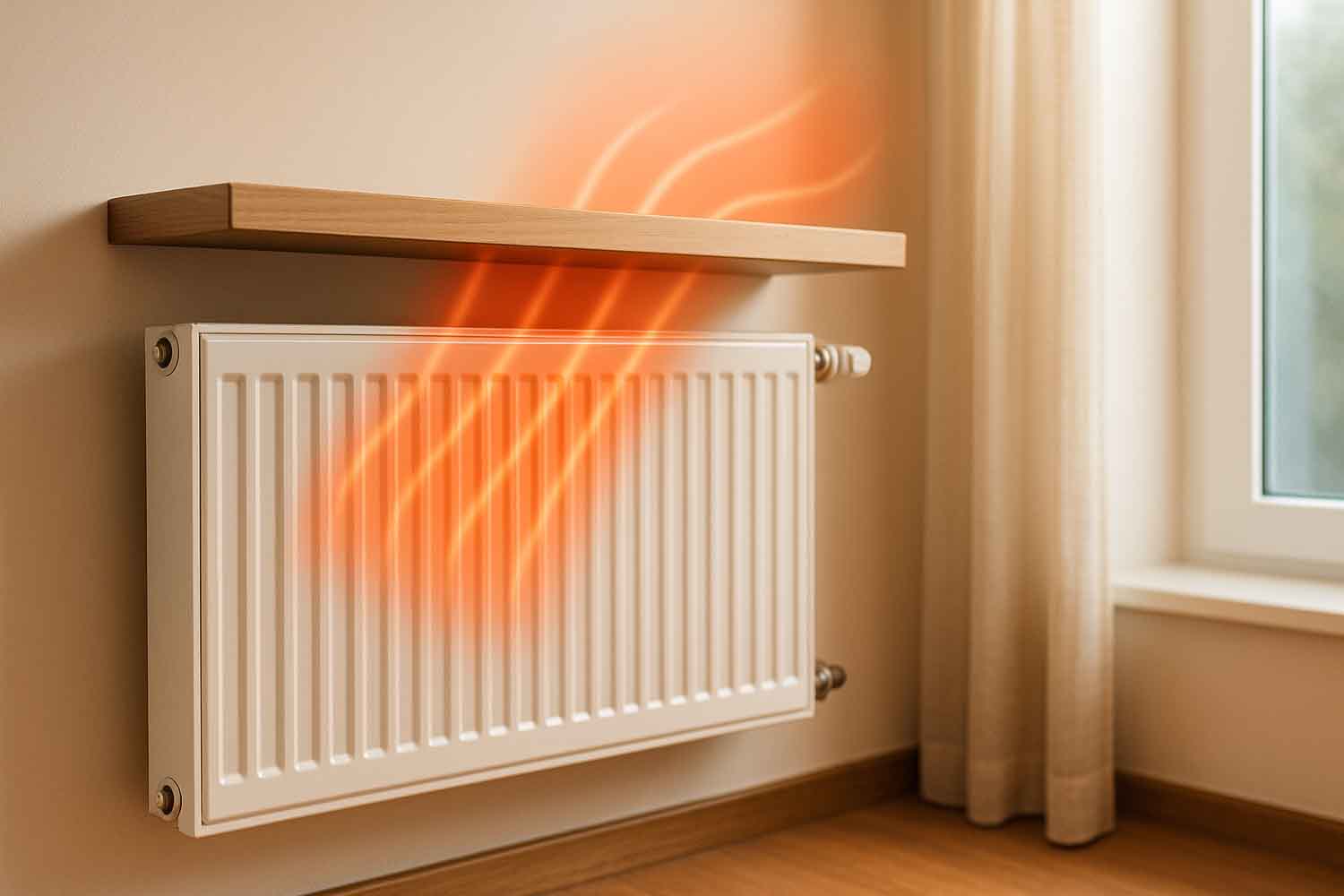
It happens to everyone: you see a slightly sad radiator, you look at it, you look at the empty wall above it and the idea of the shelf escapes you “this way I decorate, I place something on it and I cover that white thing a bit”. It’s an understandable, almost spontaneous thought. The problem is that, at home, seemingly clever ideas sometimes work against comfort and, worse, against the bill.
Physics makes no concessions: the hot air rises, moves, turns in the room and warms it. However, if you place a shelf that is too low above the radiator, that air won’t go anywhere. She gets trapped down there like an uncomfortable guest, and the room stays colder. Result? The system stays on longer, consumes more and you continue to wonder why, despite everything, your feet still feel cold.
It seems silly, yet several experts point to it as one of the most common errors in homes. Ten or fifteen centimeters of distance is enough for the radiator to work peacefully. But very often the shelf is glued on there, like an unwanted lid. And when you have three, four, five radiators placed like this, it’s a sum that hurts your bill.
What scientific research reveals
It’s not just a question of shelves: any obstacle placed on or in front of a radiator changes its behavior. A study published in the journal also confirmed this Energy and Buildings by a group from Liverpool John Moores University, who analyzed what happens when a radiator gets “stuck” under different covers.
The researchers compared a free radiator with one closed inside a wooden structure – the classic decorative covering that we have all seen at least once – and with one covered with a magnetic plate, which is much thinner and more adherent. To measure the differences they used thermocouples, infrared measurements, air and surface analysis.
The result is very clear: the wooden covering suffocates the movement of air and reduces the performance of the radiator. Magnetic covers, on the other hand, although not perfect, manage to maintain a better efficiency between 13% and 20%. They don’t work miracles, but at least they don’t “choke” the heat flow like rigid and thick structures.
Translated into real life: every time you put something on top of the radiator – a shelf, a panel, a piece of furniture – you are creating a domestic version of the wooden covering studied by the researchers. And the closer it is, the more the heat gets stuck. Physics, once again, does not bend to the compromises of furniture.
How to tidy up your home without compromising the heating
You don’t need to disassemble everything. Sometimes you just need to move the shelf a few centimeters higher. Or give up on placing it right above the radiator, letting the air do its job. If you really want to improve performance, you can use reflective panels behind the radiator or choose furnishings that don’t stick to it.
The truth is simple: a free radiator works better, heats faster and costs less. It’s like removing a half-applied handbrake without realizing it. You feel like you’re going, but the car is straining, wearing out and not performing as well as it could. This is why that seemingly innocent shelf, placed there “for order”, can be the reason why you overpay and keep saying: “Well, it always seems a bit cold…”.
Sometimes the difference is made precisely by what you cannot see.
You might also be interested in:
