
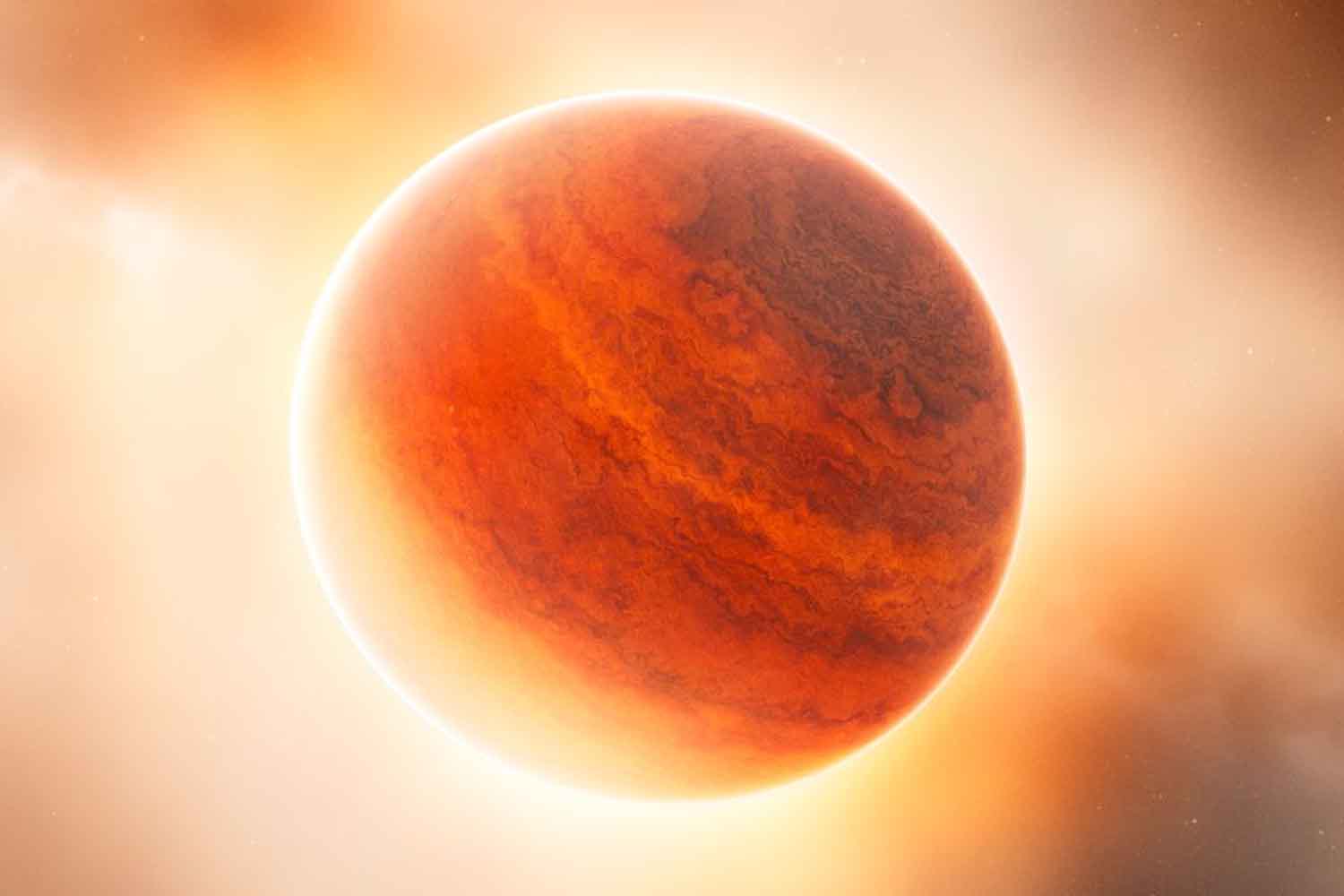
“Great Jupiter!”. Who he loved Back to the future he perfectly remembers the visionary’s exclamation Emmett Brown faced with something unthinkable. It’s the phrase you say when reality surpasses imagination, when what’s in front of you doesn’t fit the mold. And this is exactly the reaction that astronomers are having today when observing some gigantic planets over 130 light years from Earth.
In the star system H.R. 8799in the constellation of Pegasus, orbit four gaseous giants that weigh between five and ten times Jupiter. Huge planets, very far from their star, so distant as to undermine the classical theories on planetary formation. Because according to what we have always thought, such objects simply shouldn’t exist at those distances. And yet they exist.
Super-Jupiter at extreme distances: the problem of classical theories
The planets of HR 8799 orbit between 15 and 70 astronomical units from their star. In more intuitive terms it means being two to ten billion kilometers away, up to seventy times further away than the Earth from the Sun. A location that makes everything more complicated.
The most accredited model to explain the birth of gas giants is called core accretionor growth of the nucleus. It works like this: in a disk of gas and dust surrounding a young star, tiny rocky and icy grains slowly aggregate to form an increasingly larger nucleus; when this becomes sufficiently massive, it attracts enormous quantities of gas and a planet like Jupiter is born.
The critical point is time. At such great distances from the star, the material is less dense and collisions between particles occur more slowly. According to models, the protoplanetary disk would have to dissolve before a planet could grow to such a massive size. For this reason some astronomers had hypothesized another mechanism, similar to that of brown dwarfs: a direct gravitational collapsefaster and more “stellar” than planetary.
And here the new observation comes into play.
The James Webb and the sulfur track that changes everything
Thanks to James Webb Space Telescopescientists analyzed the atmospheres of the three innermost planets of the HR 8799 system using the NIRSpec instrument, focusing on wavelengths between 3 and 5 microns. Separating their signal from that of the star was a job of extreme precision, considering that the planets are thousands of times fainter than their luminous “mother”. The clue sought was one: sulphur.
In the protoplanetary disk, sulfur tends to get trapped in solid grains. If it is found in the atmosphere of a planet, it means that during its formation that object incorporated large quantities of solid material. It is a chemical signature that tells its story, and it has arrived.
A clear presence of was detected in the planets HR 8799 c and d hydrogen sulfidewhile atmospheric models indicate a similar enrichment also for the third planet analyzed. Not only that: all three show a high concentration of heavy elements such as carbon, oxygen and sulfur compared to their star. Simply put, these super-Jupiters appear to have formed precisely through core accretion, like Jupiter in our Solar System.
An efficiency that leaves you perplexed
The real puzzle concerns the efficiency of the process. To accumulate so many heavy elements at such extreme distances, these planets would have had to absorb enormous quantities of solid material in a relatively short time. A result that is difficult to match with traditional simulations.
It is as if nature had accelerated a mechanism that we considered slow and limited. And when nature accelerates, science stops, observes and recalculates. The study, published on Nature Astronomyopens up a fascinating scenario: the formation of giant planets could be much more dynamic and adaptable than we thought. And HR 8799 thus becomes a cosmic laboratory capable of putting our certainties to the test.
Because this discovery concerns us more than it seems
Understanding how gas giants are born also means better understanding the conditions that allow the formation of rocky planets like Earth. Massive planets influence the architecture of star systems, shape orbits, distribute material, protect or destabilize.
Every time the James Webb gives us new data, the map of the cosmos is redrawn before our eyes. Theories are adjusted, certainties become thinner, questions increase. It is the liveliest moment of science, the one in which a definitive answer is not celebrated but we agree to call everything into question.
And in front of planets so enormous, so distant, so unlikely according to traditional models, amazement becomes inevitable: the sensation is that of being faced with something that forces you to change perspective, once again.
